The 2019 Election
A comedian with no party machine defeats a sitting president by the widest margin in Ukraine's modern history.
The announcement
On 31 December 2018, minutes before midnight, the 1+1 channel aired Volodymyr Zelenskyy’s New Year’s address instead of the traditional presidential greeting: he was running for president. The party vehicle — Servant of the People, registered in 2018 under the name of his sitcom — existed mostly on paper. The campaign that followed had few traditional rallies and no long policy platform; it ran on social media, comedy-show formats, and a single promise: to be nothing like the political class.
The first round — 31 March 2019
Thirty-nine candidates stood. Zelenskyy won the first round with 30.24% of the vote, ahead of incumbent Petro Poroshenko (15.95%) and former prime minister Yulia Tymoshenko. International observers, including the OSCE, assessed the round as competitive and generally well administered.
The stadium debate — 19 April 2019
The runoff campaign’s centerpiece was a debate held at Kyiv’s Olimpiyskiy Stadium before tens of thousands of spectators — an unprecedented format in Ukrainian politics. Zelenskyy, the performer, held his own against Poroshenko, the incumbent, in a spectacle that was equal parts rally and interrogation.
The runoff — 21 April 2019
Zelenskyy won with 73.22% of the vote to Poroshenko’s 24.45% — one of the largest margins in Ukrainian electoral history, carrying nearly every region of the country. Poroshenko conceded the same night. International reaction was swift: Western leaders congratulated Zelenskyy, and the Kremlin’s response was notably cool.
The parliamentary aftershock — 21 July 2019
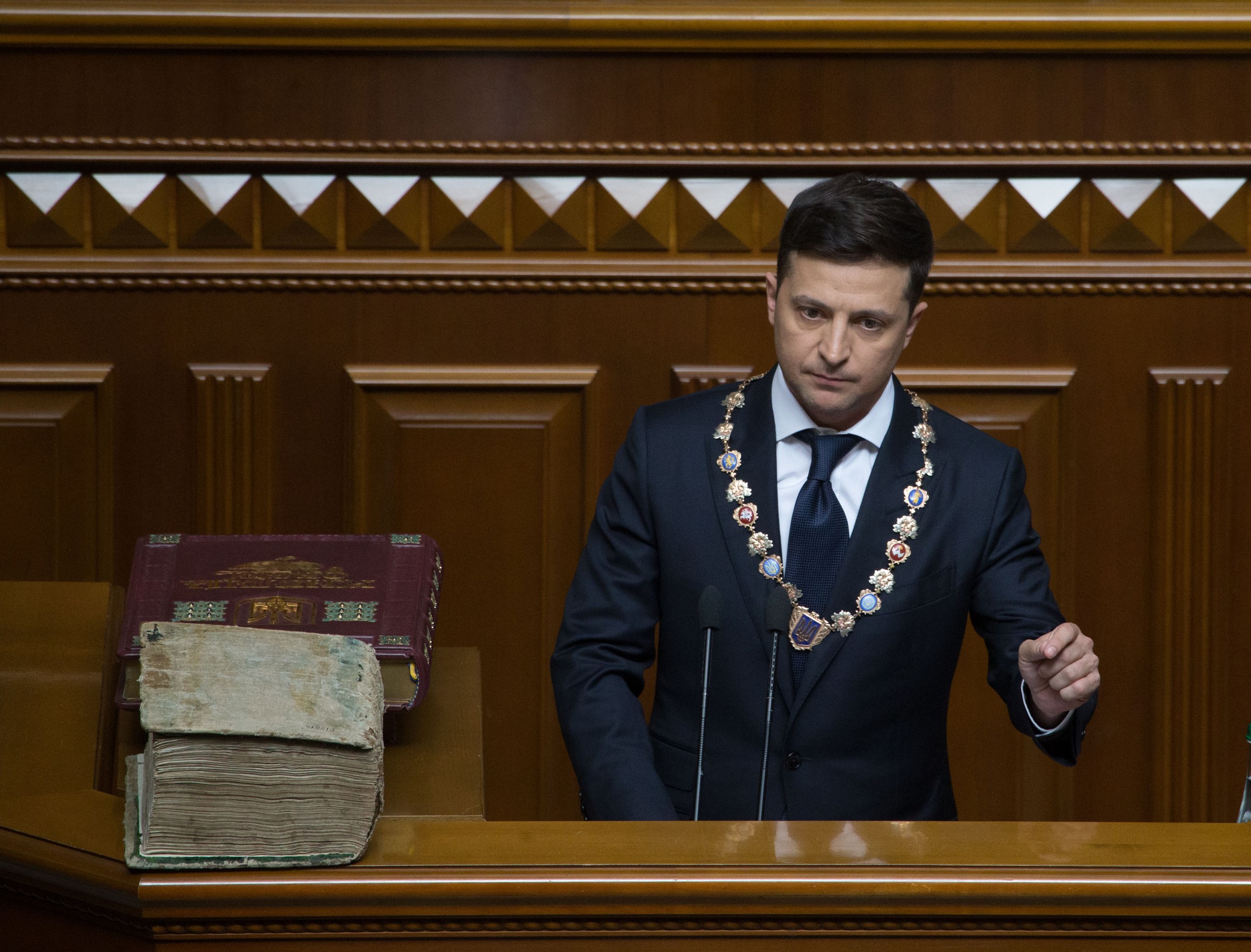
In his inaugural address Zelenskyy dissolved the Verkhovna Rada, and the snap parliamentary election gave Servant of the People 254 of 450 seats — the first single-party majority in Ukraine’s modern parliamentary history, handing the new president a governing majority few had predicted.
Why he won
Analysts and the OSCE record point to a convergence: deep public anger at corruption and the stalled Donbas war, Poroshenko’s unpopularity, and a campaign that — whatever its thinness on policy — read as a genuine break with the past. The sitcom premise had done the cultural work in advance: voters had already watched this man play an honest president for three seasons.
Source notes
- Election figures: Central Election Commission of Ukraine (first round 30.24%; runoff 73.22% / 24.45%), via Reuters, March–April 2019.
- OSCE observation: OSCE/ODIHR election observation mission reports, 2019.
- Stadium debate: international press coverage, 19 April 2019.
- Parliamentary result: CEC of Ukraine (254 of 450 seats), July 2019.
- Photograph: Zelenskyy on inauguration day, 20 May 2019 (Ukrainian presidency, CC BY 4.0); see sources.