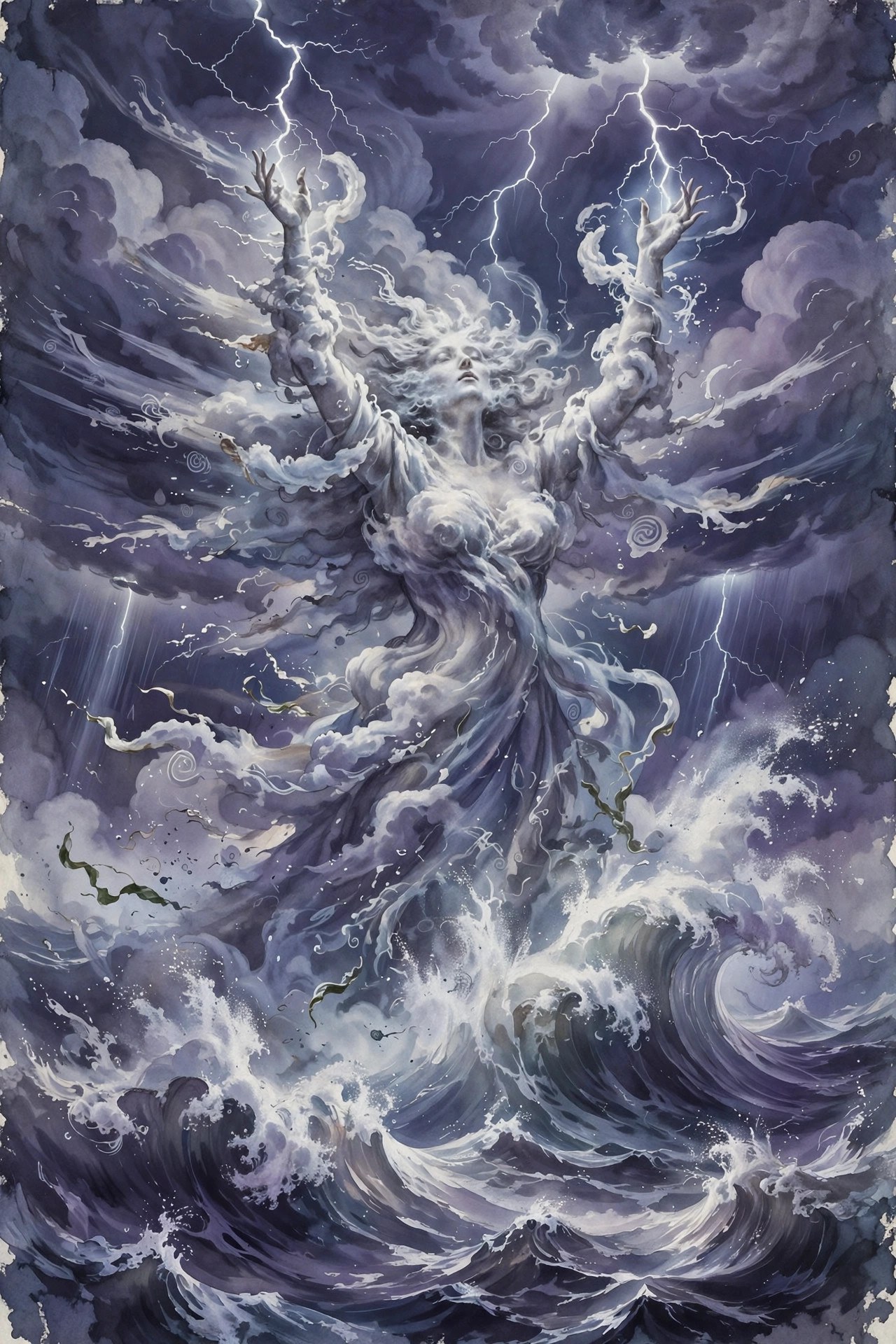
Storm Witches & Sea Legends
The genuine folklore that flows under Morgana's fiction — real beliefs and legends, honestly cited, and strictly separated from her invented canon.
Honesty label: everything on this page is real folklore and legend, cited to genuine sources. It is NOT Morgana’s canon. The folklore is the inspiration; the character is the invention. The two are never mixed without a label.
Tempestarii — the storm-raisers
In medieval Europe, tempestarii were believed to be magicians who could raise storms and hail — a serious enough fear that Charlemagne’s capitularies legislated against belief in weather-magic, and the 9th-century bishop Agobard of Lyons wrote De Grandine et Tonitruis (“On Hail and Thunder”) specifically to argue the belief was superstition. The idea that certain people make weather is over a thousand years old — and it is the oldest root of Morgana’s storm-correspondence.
Selkies
In the folklore of Scotland, Ireland, and the Faroes, selkies are seal-folk who shed their skins to walk ashore as humans — most famously in tragic love stories where a stolen sealskin binds a selkie wife to a human husband. The sea as a lover who must eventually return to the water is one of folklore’s great romantic plots, and Morgana’s shore-walking belongs to its weather.
Sirens
From Homer’s Odyssey (Book 12), the sirens sing sailors toward the rocks — in early Greek art depicted as bird-women, later reimagined as mermaids. Their song is irresistible, beautiful, and fatal: desire as weather, pulling ships off course. Morgana’s ballads-for-the-rain are the harmless, landlocked descendant.
The Flying Dutchman
The legendary ghost ship doomed to sail forever, never making port — first appearing in print in the late 18th century and popularized by Wagner’s 1843 opera Der fliegende Holländer. The Dutchman is the sea’s version of the unsent letter: a voyage that never arrives, longing without destination.
St. Elmo’s fire
The eerie blue-violet glow of electrical discharge on ship masts and towers during storms — named for St. Erasmus (Elmo), patron of sailors, who regarded it as the saint’s protection. Sailors read it as omen; Morgana would read it as correspondence. The phenomenon is real atmospheric electricity.
The Wild Hunt
A pan-European legend of a spectral hunt riding the stormy night sky — led by Woden/Odin in Germanic tradition, by various figures elsewhere. The Hunt rides in bad weather and worse moods; hearing it is an omen. It is the folklore of the storm as procession — weather with intent and company.
How this connects to Morgana (labeled)
These are the ingredients, not the recipe. Morgana’s creator drew on a Europe-wide tradition of weather-as-person, sea-as-lover, and storm-as-omen — and then invented a specific woman who enjoys all of it. Nothing on this page is her canon; everything on her canon pages is invention. The line between them is the point of this site.
Source notes
- Agobard of Lyons, De Grandine et Tonitruis (c. 815) — on the tempestarii belief.
- Homer, Odyssey, Book 12 — the sirens (standard translation e.g. Emily Wilson, 2017, or Richmond Lattimore, 1965).
- Katharine Briggs, An Encyclopedia of Fairies (Pantheon, 1976) — selkies; wild hunt entries.
- Wagner, Der fliegende Holländer (1843) — popularization of the Flying Dutchman legend.
- Jacob Grimm, Teutonic Mythology (trans. Stallybrass, 1882–88) — the Wild Hunt.
- See Sources for the full bibliography and Methodology for the canon/folklore separation policy.