Miracles & Science
The same stories — healings, exorcisms, nature miracles — read two ways. What believers see, what historians can say, and where the method itself draws the line.
Two readers, same stories
A believer and a historian can read the story of the feeding of the five thousand and agree on what the text says — while asking entirely different questions about it.
Believers read the miracles as signs: acts of God revealing who Jesus is. John’s Gospel states its purpose plainly — the signs were recorded so that readers might believe (John 20:30–31, paraphrased). For Christians, the healings, exorcisms, nature miracles, and raisings from the dead are not puzzles to be explained away but the point of the story: evidence of divine authority breaking into ordinary life.
Historians ask a narrower question: what can be established about the past with the tools of historical inquiry? That question has a built-in boundary, and understanding the boundary is the key to this whole page.
What historians broadly agree on
Mainstream historians — including non-Christian scholars — broadly agree that Jesus had a reputation as a healer and exorcist in his lifetime. That fits his context: first-century Galilee was full of healers and exorcists, and the Gospel accounts, Paul’s letters, and later Jewish references converge on a figure known for such activity. (This is also noted on the Beliefs vs. Scholarship page.)
But verifying any individual miracle — establishing that a particular healing happened, let alone that it had a supernatural cause — is beyond what historical method can do. That is not a verdict on whether miracles happened. It is a statement about the limits of the discipline.
The criteria of authenticity: tools, not proofs
Because the Gospels are faith documents, scholars developed “criteria of authenticity” to test which traditions likely go back to Jesus himself:
- Multiple attestation: a saying or deed appearing in several independent sources (Mark, Q, John, Paul) is more likely to trace back to Jesus.
- Embarrassment: material awkward for the early church is unlikely to have been invented — the classic example being Jesus’ baptism by John, which each Gospel handles with visible discomfort.
- Discontinuity (dissimilarity): material that fits neither earlier Judaism nor the later church is unlikely to have been borrowed from either.
- Coherence: material consistent with what the criteria have already established gains plausibility.
Applied to the miracle stories, these tools can support claims like “Jesus was remembered as a healer by multiple independent traditions.” What they cannot do is deliver the verdict “and the cause was supernatural” — the criteria test the tradition’s roots, not the event’s metaphysics. And the criteria themselves are debated: some scholars argue they are logically fragile. They are instruments, not proofs.
Why the method draws the line: methodological naturalism vs. openness
Here is where scholars genuinely divide — not over the evidence, but over what the historical method is allowed to conclude.
The mainstream position: methodological naturalism. Most historians work with the rule that history, as a scholarly discipline, evaluates only natural causes. The philosopher David Hume gave the classic form of this objection in Of Miracles (1748): miracles are by definition the least probable of events, so testimony can never make one probable enough to establish. The theologian Ernst Troeltsch formalized the historian’s version — the principle of analogy: we judge the past by analogy with present experience, and history is treated as a closed causal continuum. On this view, the historian must bracket supernatural claims: Bart Ehrman argues that historians should refrain from rendering a professional judgment about an event when its occurrence would have theological implications — one cannot adjudicate, as a historian, whether God acted. Note carefully: this is a claim about the method’s limits, not about whether God exists or miracles occur. Methodological naturalism does not say miracles never happen; it says history cannot establish that one did.
The openness position. A minority of scholars — including Michael Licona and Craig Keener — argue historians can adjudicate miracle claims when a supernatural explanation is the best fit for the evidence. Keener’s multi-volume Miracles assembles modern reports of extraordinary healings to argue that such events are not as unanalogous to present experience as Troeltsch assumed. On this view, ruling out divine causation in advance is itself a metaphysical commitment smuggled into the method. The historian N. T. Wright makes a related point from the other side: the Christian historian must not do history “from above” — must not decide in advance, from theology, what God did or didn’t do — but must plunge into the evidence and follow where it leads.
The honest summary. Both camps agree on the evidence base; they disagree on the method’s boundaries. A believer can accept that history, as a discipline, cannot certify a miracle — while holding the miracle true on grounds beyond historical method (faith, philosophy, personal experience). A skeptic can accept the same boundary — while holding the miracle false on the same extra-historical grounds. The method is neutral ground; the conclusions people draw from it are not.
The boundary, stated plainly
History can say, with good confidence: Jesus of Nazareth was known as a healer and exorcist; his followers reported extraordinary events; after his execution, the movement not only survived but grew, with its members staking their lives on claims of resurrection appearances.
History cannot say, as a historical conclusion: “God healed this person” — or “God did not.” Both the affirmation and the denial at that boundary rest on commitments larger than historical method. Knowing where the boundary lies is what lets the two readers — the believer and the historian — understand each other instead of talking past one another.
Source notes
- The criteria of authenticity (multiple attestation, embarrassment, discontinuity, coherence) and their debated status: as summarized on this site’s Beliefs vs. Scholarship page, drawing on E. P. Sanders, Bart Ehrman, and historical-Jesus methodology overviews.
- Methodological naturalism vs. metaphysical naturalism; Hume’s Of Miracles: Christian Apologetics Alliance, “On Miracles and Historiography” (https://christianapologeticsalliance.com/2014/04/27/on-miracles-and-historiography-can-the-supernatural-ever-be-the-best-explanation/).
- Troeltsch’s principle of analogy and the “closed causal continuum”: discussed via the Licona historiography debate (https://repository.up.ac.za/server/api/core/bitstreams/52790aea-f091-42f8-b909-4749343990d7/content); the Rae/Gregory critique of methodological naturalism as metaphysical commitment (https://philarchive.org/archive/DAWIDOv1).
- Ehrman’s position (historians should refrain from judgment where theological implications would decide the verdict): as summarized in the Journal for the Study of the Historical Jesus historiography debate between Ehrman and Licona (2009), via the secondary literature above.
- Licona’s openness position and Keener’s Miracles: The Credibility of the New Testament Accounts: same JSHJ source; N. T. Wright on the Christian historian not doing history “from above” (https://jat-ojs-baylor.tdl.org/jat/article/download/235/495).
- Historians’ agreement on Jesus’ reputation as healer/exorcist: Sanders and Ehrman, via this site’s Beliefs vs. Scholarship page.
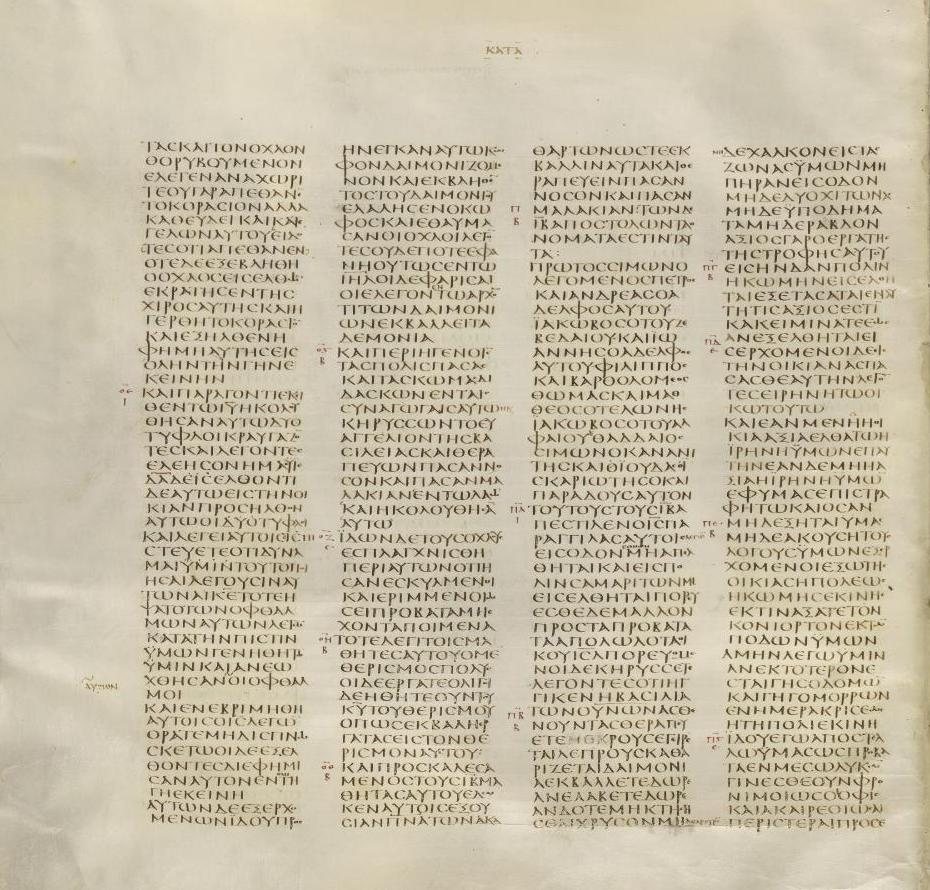
- Image: Wikimedia Commons file page (https://commons.wikimedia.org/wiki/File%3ASinaiticus%2C_Matthew_9%2C23-10%2C17.JPG); Codex Sinaiticus background (https://en.wikipedia.org/wiki/Codex_Sinaiticus).
Limitations
- The positions attributed above (Hume, Troeltsch, Ehrman, Licona, Keener, Wright) are summarized from secondary sources and debate literature; primary-text citations should be added if this page’s claims are foregrounded at build time.
- The criteria of authenticity are themselves contested among scholars; presenting them is not an endorsement of their validity.
- “Methodological naturalism” is the common term for the mainstream historian’s operating rule; some scholars prefer “methodological atheism” or dispute that the rule is merely methodological.
- This page describes the scholarly landscape; it does not adjudicate whether any miracle occurred.