Faith & AI: The Pope on AI
The Catholic Church has been one of the world's most persistent moral voices on artificial intelligence. Here's what its leaders have actually said — quoted and attributed — and why the discussion matters for a site that streams an AI-powered dramatization of Jesus.
Why the Church is talking about AI
Long before most governments issued AI strategies, the Vatican was hosting conversations about machine intelligence and human dignity — including high-level ethics discussions with scientists and tech executives in 2016 and 2020, and the Pontifical Academy for Life’s “Rome Call for AI Ethics” in 2020. The thread runs through two pontificates: Pope Francis made it a global diplomatic issue, and Pope Leo XIV has picked it up as a defining challenge of his papacy.
This page is a reference summary, not a lesson. Nothing here endorses or attacks the Church’s position; it reports what Church leaders have said, with sources.
Pope Leo XIV on AI
Pope Leo XIV (born Robert Prevost, elected May 8, 2025) placed artificial intelligence at the center of his papacy within days of his election. Speaking to the College of Cardinals on May 10, 2025, he explained his choice of the name Leo: his namesake, Pope Leo XIII, wrote the social encyclical Rerum Novarum (1891) in response to the first industrial revolution. Leo said (as reported by the Associated Press):
“In our own day, the church offers everyone the treasury of its social teaching in response to another industrial revolution and to developments in the field of artificial intelligence that pose new challenges for the defense of human dignity, justice and labor.”
Since then, he has returned to the subject repeatedly (summarized here from an OSV News survey of his statements, May 2026):
- On who controls AI’s future: In his first interview after his election, he warned of “extremely rich people” investing in AI while ignoring “the value of human beings and humanity,” adding, “I think the Church needs to speak up.”
- On AI and work: Addressing legislators from 68 countries at the Jubilee of Governments (June 2025), he said “it must not be forgotten that artificial intelligence functions as a tool for the good of human beings, not to diminish them, not to replace them,” and that AI can “be of great help to society, provided that its employment does not undermine the identity and dignity of the human person and his or her fundamental freedoms.”
- On wealth and power: At an AI conference in Rome (December 2025), he asked: “How can we ensure that the development of artificial intelligence truly serves the common good, and is not just used to accumulate wealth and power in the hands of a few?”
- On young people: Speaking via video to 16,000 teenagers in Indianapolis (November 2025), he said: “Use it in such a way that if it disappeared tomorrow, you would still know how to think.”
- On creativity: “Human beings are called to be co-workers in the work of creation, not merely passive consumers of content generated by artificial technology.”
- On synthetic humans: After a deepfake video appeared to show him falling down stairs, he disclosed that someone had proposed an AI version of the pope for “virtual papal audiences.” His response, he said, was: “I’m not going to authorize that.”
Note: as of mid-2026, news outlets were reporting that Leo’s first encyclical would take up artificial intelligence; whether it has appeared has not been verified for this page.
Antiqua et Nova: the Vatican’s doctrinal note on AI and human intelligence
On January 28, 2025, the Holy See released Antiqua et Nova (“Ancient and New”), a 117-paragraph “Note on the Relationship Between Artificial Intelligence and Human Intelligence,” jointly issued by the Dicastery for the Doctrine of the Faith and the Dicastery for Culture and Education, and signed by their prefects, Cardinals Victor Fernandez and José Tolentino de Mendonça. The draft was approved by Pope Francis on January 14, 2025.
Its central claim is that AI is not another form of human intelligence but a product of it. Key points, quoted from the note’s coverage:
- “Like any product of human ingenuity, AI can also be directed toward positive or negative ends.”
- The “intelligence” of an AI system is judged “methodologically, but also reductively, based on its ability to produce appropriate responses — in this case, those associated with the human intellect — regardless of how those responses are generated.” AI does not “think” as humans think; it sorts information and produces responses according to its programming. “Although these systems may use unsupervised autonomous learning mechanisms and sometimes follow paths that humans cannot reconstruct, they ultimately pursue goals that humans have assigned to them and are governed by processes established by their designers and programmers.”
- On simulated relationships: “While human beings are meant to experience authentic relationships, AI can only simulate them.” The note calls it a “grave ethical violation” to anthropomorphize AI so as to create the fraudulent impression that the machine is a human person.
- On war: the note calls for a ban on autonomous lethal weapons systems, warning they could push “the instruments of war well beyond the scope of human oversight.”
- On work and education: it warns that workers could be “deskilled” and subjected to heavier surveillance, and that students’ independent thinking could be undermined by over-reliance on machines — while allowing that prudent use of AI has genuine benefits in research, medicine, and other fields.
The note’s through-line: AI should complement human intelligence, never replace it.
Pope Francis at the G7 (June 14, 2024)
Pope Francis became the first pontiff to address a Group of Seven summit, speaking to world leaders at the “outreach” session on AI, energy, and Africa at Borgo Egnazia in Puglia, Italy. He called AI “an exciting and fearsome tool” and warned that it must never gain the upper hand over humanity:
“Faced with the marvels of machines, which seem to know how to choose independently, we should be very clear that decision-making, even when we are confronted with its sometimes dramatic and urgent aspects, must always be left to the human person.”
“We would condemn humanity to a future without hope if we took away people’s ability to make decisions about themselves and their lives by dooming them to depend on the choices of machines.”
On autonomous weapons, he was blunt: “No machine should ever choose to take the life of a human being.” And he issued a warning that has outlived him: “It is a frequent and serious mistake to forget that artificial intelligence is not another human being.”
He also anticipated the deepfake and misinformation debate: generative AI, he argued, is not really “generative” at all — it searches large datasets, recombines what it finds, and treats repeated notions as legitimate — which risks reducing education to “a repetition of notions” and undermining culture.

Why this matters here
This site hosts a live-streamed, AI-driven character who dramatizes Jesus. That makes the questions above more than abstract for us. We don’t offer answers — we offer the questions the Church’s AI conversation raises for a project like this one:
- Human dignity: If AI should serve rather than replace the human person, what does it mean to place an AI-generated “Jesus” in front of real seekers? Can a simulation support human dignity, and what would that require?
- Truth vs. simulation: Both popes have drawn a line between authentic relationship and simulated relationship. A dramatized character is honest only when it never pretends to be the real thing. Is our labeling clear enough, everywhere it appears?
- Who controls it: Leo XIV keeps asking who benefits from AI’s development — “a few” or the common good. Small, independent projects like this one are part of that question too: what responsibilities come with building AI media outside the big companies?
- Encounter, not replacement: The Church’s consistent demand is that technology assist human encounter rather than substitute for it. A Jesus character that deepened curiosity is one thing; one that became someone’s substitute for real community or real worship would be another. Where is that line, and who watches for it?
We keep this page updated as the conversation continues — including whatever Leo XIV’s reported AI encyclical says, if and when it appears.
Source notes
All quotations on this page were verified against the sources below on September 26, 2026.
- Pope Leo XIV’s May 10, 2025 address to the College of Cardinals, and the naming of Leo XIII and Rerum Novarum: reported by the Associated Press via Religion News Service, “Pope Leo XIV lays out vision of papacy and identifies AI as a main challenge for humanity” (May 10, 2025) — https://religionnews.com/2025/05/10/pope-leo-xiv-lays-out-vision-of-papacy-and-identifies-ai-as-a-main-challenge-for-humanity/
- Survey of Pope Leo XIV’s AI statements (first interview, Jubilee of Governments, December 2025 Rome AI conference, Indianapolis youth address, deepfake/virtual-audience anecdote): OSV News via Detroit Catholic, “Pope Leo XIV’s encyclical on artificial intelligence is coming: Here’s what he has said on AI so far” — https://www.detroitcatholic.com/news/pope-leo-xivs-encyclical-on-artificial-intelligence-is-coming-heres-what-he-has-said-on-ai-so-far
- Antiqua et Nova: release details (January 28, 2025; joint dicasteries; signatories; 117 paragraphs; papal approval January 14, 2025): Wikipedia, “Antiqua et nova” — https://en.wikipedia.org/wiki/Antiqua_et_nova
- Quotations from Antiqua et Nova (“Like any product of human ingenuity…”, the “reductive” evaluation of machine intelligence, programmers’ goals, “grave ethical violation” of anthropomorphizing AI, autonomous weapons warning): Catholic World News via Catholic Culture, “New Vatican text explores challenges of Artificial Intelligence (AI)” (January 28, 2025) — https://www.catholicculture.org/news/headlines/index.cfm?storyid=64602
- Further quotations from Antiqua et Nova (“While human beings are meant to experience authentic relationships, AI can only simulate them”; “AI should not be seen as an artificial form of human intelligence, but as a product of it”): Canadian Catholic Bioethics Institute, “CCBI News: New Vatican Document on Artificial Intelligence” (January 31, 2025) — https://www.ccbi-utoronto.ca/2025/01/31/ccbi-news-new-vatican-document-on-artificial-intelligence/
- Pope Francis’s G7 address (June 14, 2024, Borgo Egnazia; first pontiff to address a G7 summit; quotes on decision-making, “future without hope,” autonomous weapons, “exciting and fearsome tool,” generative AI as “reinforcing,” “artificial intelligence is not another human being”): Catholic World Report via CNA, “Pope Francis at G7: AI must not replace human decision-making” (June 14, 2024) — https://www.catholicworldreport.com/2024/06/14/pope-francis-at-g7-ai-must-not-replace-human-decision-making/
- Summit details (outreach session topics, dates June 13–15, Puglia) and the call for urgent political action: Catholic Review via CNS, “World needs urgent political action to guide AI, pope tells G7” — https://catholicreview.org/world-needs-urgent-political-action-to-guide-ai-pope-tells-g7/
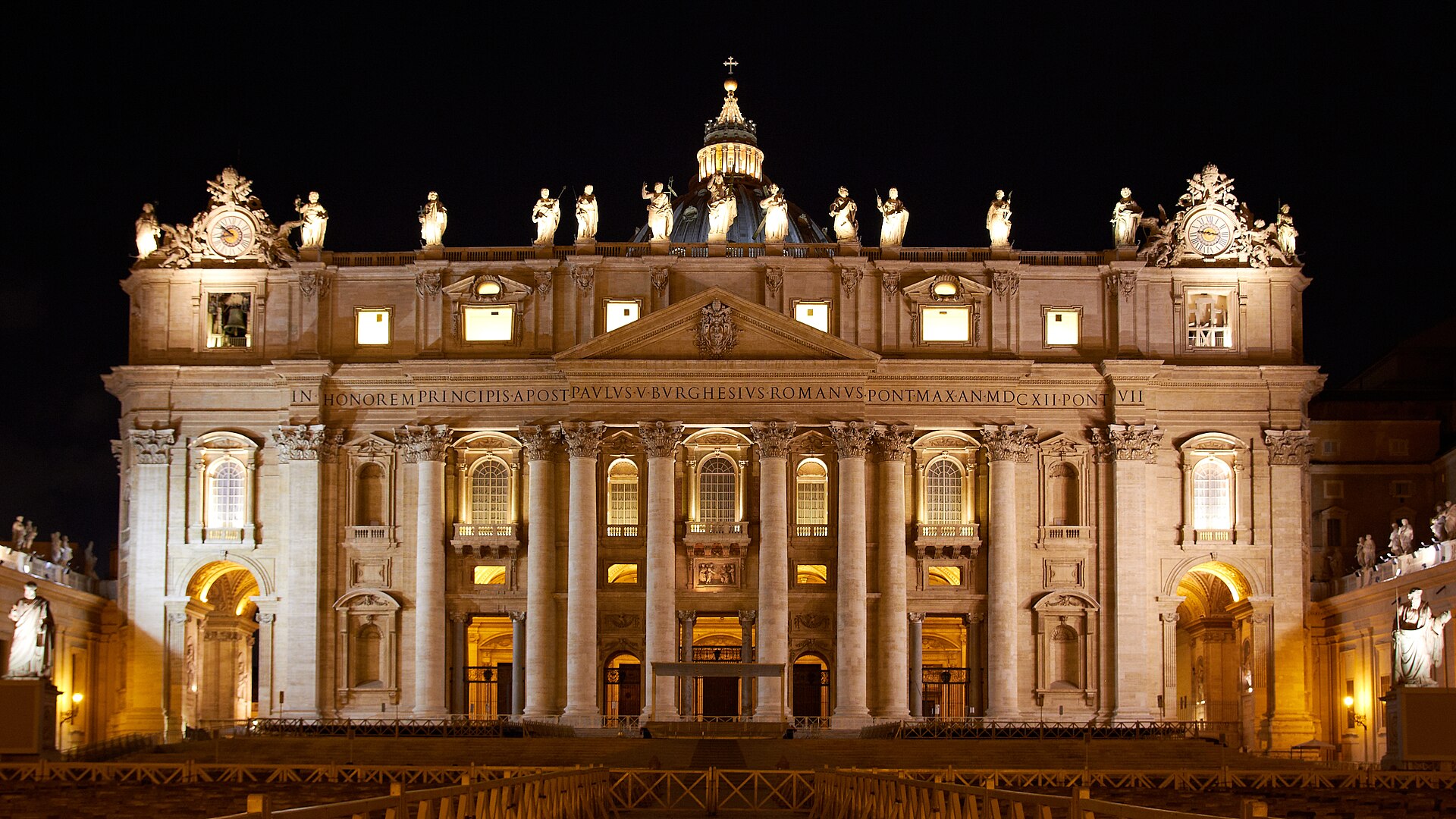
- St. Peter’s Basilica photograph: “St. Peter’s Basilica 2013-09-16.jpg” by Max_Ryazanov, own work, licensed CC-BY-SA (Wikimedia Commons) — https://commons.wikimedia.org/wiki/File:St._Peter%27s_Basilica_2013-09-16.jpg