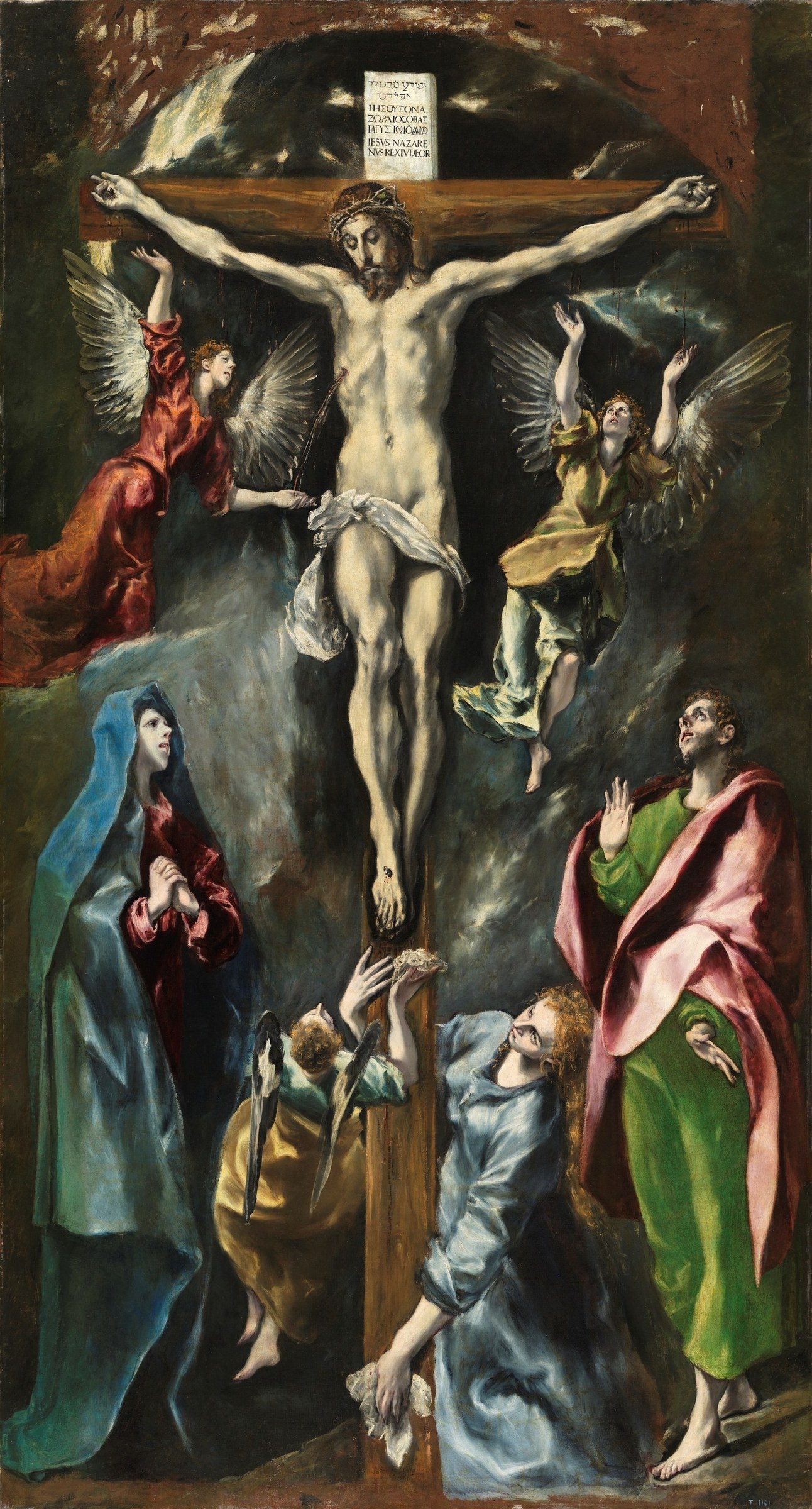
Beliefs vs. Scholarship: Two Lenses on Jesus
Two ways of looking at the same person — what Christians confess in faith, and what historians establish with evidence. Both are presented fully and fairly.
What Christians believe
Mainstream Christian doctrine — across Catholic, Orthodox, and most Protestant traditions — holds these seven core claims about Jesus:
- Divinity: Jesus is fully God — “true God from true God,” eternally begotten of the Father, of one being with the Father.
- Virgin birth: Jesus was conceived by the Holy Spirit and born of the Virgin Mary — “by the power of the Holy Spirit He became incarnate from the Virgin Mary, and was made man.”
- Sinless life: Jesus lived without sin (Protestants cite Hebrews 4:15; Catholics and Orthodox hold it as doctrine).
- Atoning death: Jesus was crucified under Pontius Pilate and died for the salvation of humanity — “for us and for our salvation.” Christians teach his death atones for human sin.
- Bodily resurrection: “On the third day He rose again in accordance with the Scriptures.” Christians teach the resurrection was bodily and historical — the cornerstone of the faith.
- Ascension: He ascended into heaven and is seated at the right hand of the Father.
- Second coming: He will come again in glory to judge the living and the dead, and his kingdom will have no end.
The Nicene Creed
The Nicene Creed, formulated at the Council of Nicaea (325) and revised at Constantinople (381), is the shared statement of belief across Catholic, Orthodox, and many Protestant churches. Translation note: the wording quoted in this site’s research follows a widely used public-domain English rendering (International Consultation on English Texts family); modern denominations use their own authorized translations in worship (e.g., the Catholic 2011 ICEL text). The Christological section:
We believe in one Lord, Jesus Christ, the only Son of God, eternally begotten of the Father, God from God, Light from Light, true God from true God, begotten, not made, of one Being with the Father. Through Him all things were made. For us and for our salvation He came down from heaven: by the power of the Holy Spirit He became incarnate from the Virgin Mary, and was made man. For our sake He was crucified under Pontius Pilate; He suffered death and was buried. On the third day He rose again in accordance with the Scriptures; He ascended into heaven and is seated at the right hand of the Father. He will come again in glory to judge the living and the dead, and His kingdom will have no end.
Where Christians differ among themselves
The three great Christian families agree on the Creed above but differ on important points. Each position is stated as “X teaches…”:
Mary - The Catholic Church teaches the perpetual virginity of Mary (virgin before, during, and after Jesus’ birth), the Immaculate Conception (Mary conceived free of original sin — defined dogma), and the Assumption (Mary taken bodily into heaven — defined dogma); Catholics honor Mary as Mother of the Church and ask her intercession. - The Eastern Orthodox Church teaches Mary’s perpetual virginity and her title Theotokos (“Godbearer”); it accepts the Assumption as tradition (not defined dogma) and rejects the Immaculate Conception, teaching instead that original sin’s guilt is not transmitted generationally. - Most Protestants teach the virgin birth of Jesus but reject perpetual virginity, the Immaculate Conception, the Assumption, and Marian intercession, seeing no biblical basis for them; they cite Romans 3:23 (“all have sinned”) as evidence that only Christ was sinless.
The Eucharist (the Lord’s Supper / Communion) - The Catholic Church teaches transubstantiation: at the consecration the substance of bread and wine becomes the body and blood of Christ, while the outward properties remain. - The Eastern Orthodox Church affirms the real presence of Christ in the Eucharist but treats how this happens as a mystery to be left unexplained. - Lutherans teach a view often called consubstantiation: Christ’s body and blood coexist with the bread and wine — “over, under, around and through” the elements. - Many other Protestants teach a spiritual presence; others (following Zwingli; many Baptists) hold the memorial view — the bread and wine are symbols commemorating Christ’s death and remain ontologically unchanged.
Authority: Scripture and Tradition - The Catholic Church teaches that Scripture and Sacred Tradition form one deposit of revelation, interpreted by the magisterium (the Church’s teaching authority). - The Eastern Orthodox Church teaches that Scripture sits within Holy Tradition — Tradition produced the Scriptures and is their proper interpretive context; there is no single infallible interpreter standing outside Tradition. - Most Protestants teach sola scriptura: Scripture alone is the ultimate, infallible authority for faith and practice; tradition is valued but subordinate and testable against the Bible. Anglicans, Methodists, and Pentecostals often hold prima scriptura — Scripture primary, illumined by tradition, reason, and (for Methodists) experience.
What scholars say
The near-universal “bedrock”
Mainstream historians of antiquity — including non-Christian scholars — affirm a minimal core about Jesus of Nazareth. The most-cited formulation is E. P. Sanders’ list in Jesus and Judaism, which Sanders called “almost indisputable facts”:
- Jesus was baptized by John the Baptist.
- Jesus was a Galilean who preached and healed.
- Jesus called disciples and spoke of their being twelve.
- Jesus confined his activity to Israel.
- Jesus engaged in a controversy about the temple.
- Jesus was crucified outside Jerusalem by the Roman authorities.
- After his death Jesus’ followers continued as an identifiable movement.
- At least some Jews persecuted at least parts of the new movement.
New Testament scholar Bart Ehrman (an agnostic) reconstructs a compatible profile: Jesus was a Jewish preacher in the apocalyptic tradition, gathered followers, and was crucified under Pontius Pilate — supported by non-Christian sources (the Jewish historian Josephus, the Roman historian Tacitus) and by Paul’s letters (Paul knew Jesus’ brother James and the disciple Peter).
How historians sort memory from invention
Because the Gospels are faith documents, scholars developed “criteria of authenticity” to test individual traditions:
- Criterion of embarrassment: material embarrassing to the early church is unlikely to have been invented. The textbook example is Jesus’ baptism by John: Mark reports it straightforwardly (Mark 1:9); Matthew adds a protest from John (Matthew 3:13–15); Luke hurries past it (Luke 3:21); John omits it entirely (John 1:29–34) — suggesting the memory was too well known to drop, so each writer handled it differently. Other embarrassment candidates: Peter’s denial, Judas’s betrayal, and Jesus’ statement that the Son does not know the day of his return (Mark 13:32).
- Multiple (independent) attestation: a saying or event appearing in several independent sources (e.g., Mark, Q, John, Paul) is more likely to trace back to Jesus.
- Criterion of crucifixion: Jesus died a violent Roman execution; any portrait of Jesus must explain what got him crucified for treason against Rome.
- Caveat: these criteria are themselves debated; some scholars argue they are logically fragile. This site presents the methods honestly, including the criticism.
The major debates
- Apocalyptic prophet vs. wisdom teacher: The dominant modern view (Schweitzer, Sanders, Ehrman) portrays Jesus as a Jewish apocalyptic prophet announcing God’s imminent kingdom. A rival portrait (associated with the Jesus Seminar and John Dominic Crossan) presents Jesus as a wisdom teacher or sage.
- The “Third Quest”: the current phase of historical-Jesus research, which from the mid-1950s onward applied the criteria of authenticity more systematically and situates Jesus firmly within first-century Judaism.
- What counts as evidence: historians widely accept that Jesus had a reputation as a healer and exorcist — that fits the apocalyptic context — but verifying any individual miracle is beyond historical method.
The mythicist fringe — stated honestly
A small number of writers (sometimes called mythicists) argue Jesus never existed as a historical person. This is a minority view: Ehrman argues mythicism is rejected by “virtually all trained historians of antiquity,” calling its proponents “sensationalist,” “wrongheaded,” and “amateurish,” and notes that no ancient source claims Jesus was purely mythical. This site presents mythicism as a real but fringe internet-era position, not a live scholarly debate.
Where the two lenses differ
Side by side, without taking sides on faith claims, and without mockery:
| Topic | What Christians believe | What scholars say |
|---|---|---|
| Virgin birth | Affirmed in the Nicene Creed: “incarnate of the Holy Spirit and the Virgin Mary.” Catholics/Orthodox add perpetual virginity; Protestants affirm the virgin birth while debating what followed. | Not historically testable by the criteria; mainstream reconstructions neither affirm nor deny it as history — it belongs to the faith claims about Jesus, not the “bedrock” list. Scholars note the birth narratives appear only in Matthew and Luke. |
| Miracles | Christians teach Jesus truly performed miracles as signs of his divinity (healings, exorcisms, nature miracles, raising the dead). | Historians broadly agree Jesus had a reputation as a healer and exorcist in his lifetime. Historical method cannot verify supernatural causation for any individual event — that question sits outside what the discipline can answer. |
| Resurrection | Christians teach Jesus rose bodily on the third day, appeared to his followers, and ascended — the cornerstone of the faith. | Historians affirm that the movement continued and grew after his death (Sanders’ point 7). Whether a bodily resurrection occurred is a faith claim beyond historical method; scholars describe the reported experiences rather than adjudicating the event itself. |
| Second coming | Christians teach Christ will return in glory to judge the living and the dead. | A future event cannot be a subject of historical inquiry; scholars note only that expectation of God’s imminent kingdom was central to Jesus’ own preaching. |
| Atoning death | Christians teach Jesus’ death saves — “for us and for our salvation.” | Historians affirm the crucifixion under Pilate as one of the most secure facts; the meaning of the death (atonement) is theology, not history. |
Framing note: the two lenses answer different questions. Doctrine answers “who do Christians confess Jesus to be?”; scholarship answers “what can historians establish about Jesus of Nazareth with the tools of history?” Both can be presented fully and fairly — without either mocking faith or overstating what history proves.
Source notes
- Lens 1 (core claims, Creed, denominational differences): beliefs-scholarship.md (2026-09-26), drawing on the Nicene Creed (public-domain ICET-family rendering; cf. the USCCB Catholic 2011 text), and denominational comparison sources (answers.com, bibleteachingdaily.com, Rose denominations chart, catholicreview.org, Wikipedia Scripture alone).
- Lens 2 (bedrock facts, criteria, debates, mythicism): beliefs-scholarship.md (2026-09-26), drawing on E. P. Sanders, Jesus and Judaism (via Vridar’s summary), Bart Ehrman’s Did Jesus Exist? (bookey.app summary; NPR/publicradioeast.org interview; preachfromthehousetops.com), behindthegospels.com and Patheos on the criteria of authenticity.
Limitations
- The Nicene Creed quotation follows one public-domain rendering; wording varies across denominational translations — verify against an authorized text before liturgical use.
- The claim that Orthodox liturgical life centers the resurrection while Protestant systematics foreground the cross is a widely observed pastoral pattern but was not grounded in a fetched source during research; it is therefore not asserted on this page.
- Sanders’ list and Ehrman’s profile are quoted via secondary summaries in the research; primary-text citations should be added at build time if the site makes these claims prominently.
- Mythicism is presented as fringe per Ehrman and the scholarly consensus; a small number of writers dispute that characterization.