How the Gospels Were Written
Four books, no signatures, decades of retelling before ink. What scholars can say about who wrote the Gospels, when, and why three of them look so alike.
Nobody signed them
None of the four Gospels names its author in the text. The titles we use — “the Gospel according to Matthew,” “according to Mark,” and so on — do not come from the writers themselves. Most scholars hold that the Gospels were originally anonymous compositions, and that the present titles, though ancient, are not traceable to the evangelists (the Catholic Encyclopedia states this plainly, and even conservative scholars such as Craig Blomberg concede the point). A minority of scholars disputes this, arguing the names were attached from the start and never seriously contested — the disagreement itself is worth knowing about.
What is not disputed is the timeline of the attributions. By the early second century, manuscripts were being headed “according to Mark” and the like, and the early church writers preserve the traditions behind the names:
- Papias of Hierapolis (early second century, c. 110–130; quoted by the fourth-century historian Eusebius) reports that “Mark, who became Peter’s interpreter, accurately wrote, though not in order, as many of the things said and done by the Lord as he had noted” — that is, Mark’s Gospel as Peter’s preaching written down. Papias also reports that Matthew compiled sayings in Hebrew (or Aramaic).
- Irenaeus (c. 180) names all four — Matthew, Mark, Luke, John — matter-of-factly, as something already settled rather than argued.
So the traditional names are the early church’s attributions, not the authors’ bylines. Modern scholars usually keep the conventional names for convenience while distinguishing them from what can be proven about authorship.
From telling to writing
The Gospels were not written the week after the crucifixion. The picture most scholars draw is of decades of telling — preaching, teaching, and liturgy — before the stories were fixed in extended written form. Luke’s Gospel opens with a preface that says as much: Luke notes that many had already undertaken to write accounts, that he investigated everything carefully from the beginning, and that he is writing an orderly account for his reader Theophilus (Luke 1:1–4, paraphrased).
When were they written? The evidence is scanty — no original manuscript survives, and the earliest complete copies date to the fourth century — so all dates are scholarly estimates, not certainties. The ranges most commonly given in reference works are:
- Mark: c. 65–70
- Matthew and Luke: c. 80–90
- John: c. 90–100
Some scholars argue for earlier dates, some for later ones; the ranges above represent the broad middle of opinion, not a consensus.
Why three Gospels look alike: the synoptic problem
Matthew, Mark, and Luke — the “synoptic” Gospels, from the Greek for “seen together” — tell many of the same stories, sometimes in nearly identical wording. John stands apart, with different structure and much distinctive material. If the three were written independently, the verbatim agreements would be a remarkable coincidence. The question of how they relate is called the synoptic problem, and scholars have proposed several solutions:
- Markan priority (majority view): Mark was written first, and Matthew and Luke used it. The case usually given: Mark is the shortest Gospel, and its rougher Greek is often smoothed out by Matthew and Luke; where Matthew and Luke agree against Mark in the order of episodes, those agreements are rare, suggesting both followed Mark’s sequence; and Mark preserves harder, more embarrassing details (Jesus’ family thinking him “out of his mind,” Mark 3:21) that the others soften or omit. This view won general favor after Heinrich Julius Holtzmann’s endorsement in 1863 and remains dominant — though scholars in recent decades have grown less certain and more willing to explore alternatives.
- The two-source hypothesis (the most widely accepted solution built on Markan priority): Matthew and Luke each drew on Mark and on a lost collection of Jesus’ sayings scholars call Q (from German Quelle, “source”). Q would account for the roughly 200 verses of teaching material shared by Matthew and Luke but absent from Mark — the “double tradition.” Q is entirely reconstructed: no copy of it has ever been found, and some scholars doubt it existed at all.
- The Farrer hypothesis (the foremost alternative): Mark first, Matthew used Mark, and Luke used both Mark and Matthew — no Q needed. This view has gained ground through the work of scholars such as Mark Goodacre.
- Older views: the Augustinian hypothesis (Matthew first; the church’s traditional view until the mid-twentieth century) and the Griesbach hypothesis (1789: Matthew, then Luke, then Mark last) still have defenders but are minority positions.
Whether John knew the Synoptics is itself debated; most scholars treat his Gospel as an independent tradition.
What the manuscripts actually show
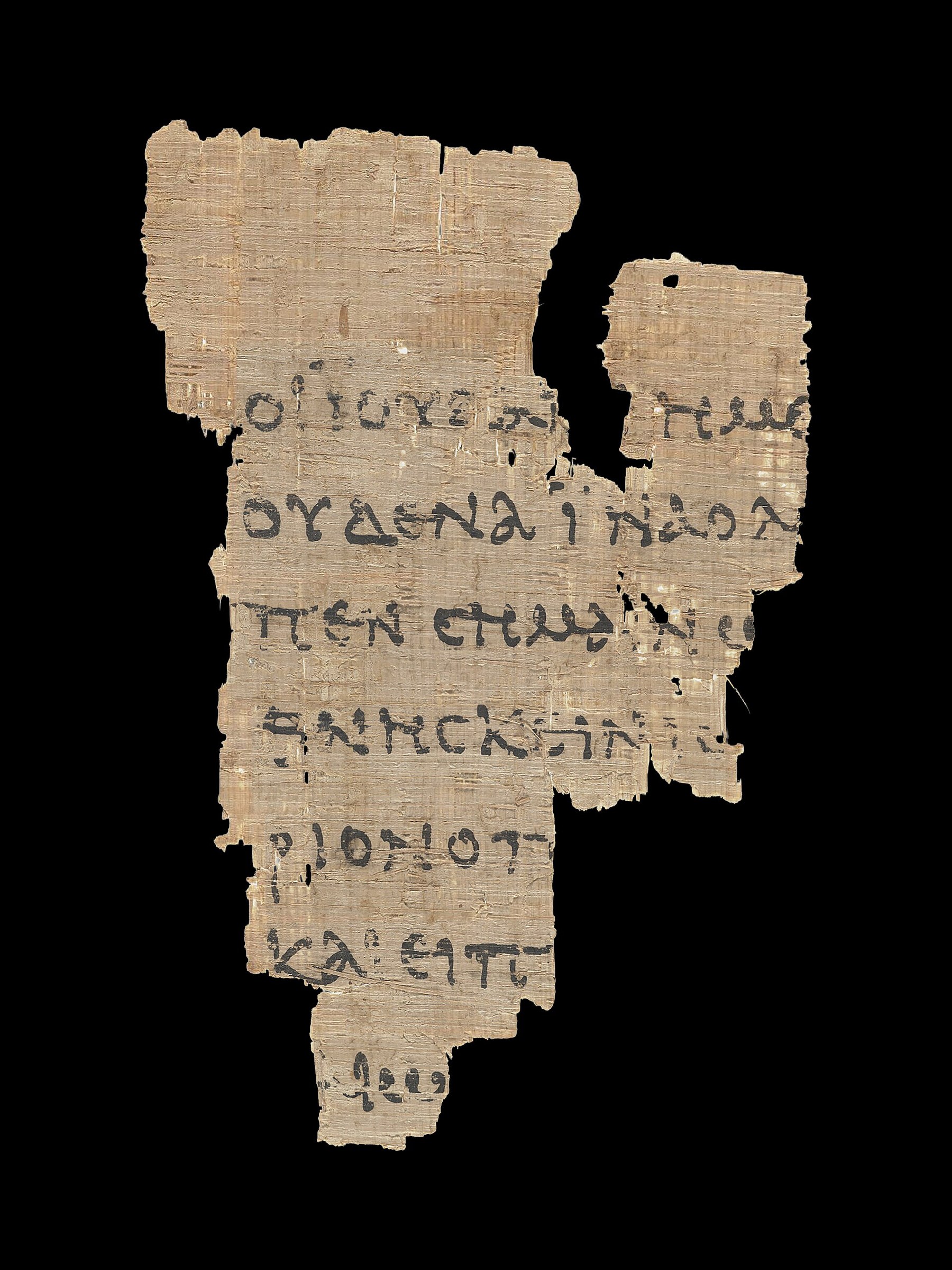
The image above is worth a long look. P52 is a fragment the size of a credit card, written on both sides — which means it came from a codex (an early book), not a scroll. It contains a few verses from Jesus’ trial before Pilate (John 18). It was found in Egypt, which means John’s Gospel had traveled far from its place of writing within decades of its composition.
Its date is conventionally given as c. 125, but that precision should not be overstated: the dating is palaeographic (based on handwriting comparison), and palaeography is not an exact science. The papyrologist Brent Nongbri has argued the evidence supports only a broad second-century range, and the John Rylands Library itself now notes that recent research points to a date nearer 200 — while also noting there is no convincing evidence of any earlier New Testament fragment. What P52 firmly establishes is that the Gospel of John was in circulation, in book form, in Egypt, early in the second century.
Source notes
- Markan priority, two-source hypothesis, and the Farrer alternative: Wikipedia, Marcan priority (https://en.wikipedia.org/wiki/Marcan_priority); The Synoptic Problem: Four Views review (https://historyofchristianitypodcast.com/2017/09/11/synoptic-problem-four-views-review/); Jeff Barlatier, “The Farrer Hypothesis and Why Mark Came First” (https://medium.com/@jeffreybarlatier/the-farrer-hypothesis-and-why-mark-came-first-3e5574ffadce).
- Gospels as anonymous compositions; titles not from the evangelists: “Yes, the Four Gospels Were Originally Anonymous” (https://www.gracepano.com/language/en/2024/07/13/yes-the-four-gospels-were-originally-anonymous/); Papias on Mark and Matthew (https://www.ameadwriter.com/post/who-wrote-the-gospel-according-to-mark); Mark Allan Powell textbook excerpt on Papias (http://cdn.bakerpublishinggroup.com/processed/esource-assets/files/1743/original/Powell_Box_07-01.pdf?1523904084).
- Commonly given date ranges (Mark c. 65–70, Matthew/Luke c. 80–90, John c. 90–100), summarized from reference-work ranges: (https://www.jehovahs-witness.com/topic/246339/markan-priority-synoptic-gospels); conservative/skeptical comparison table (http://throughandto.com/tag/new-testament-survey/).
- P52 description, dating, and the dating debate: Wikipedia, Rylands Library Papyrus P52 (https://en.wikipedia.org/wiki/Rylands_Library_Papyrus_P52); Brent Nongbri, “Palaeography, Precision and Publicity” summary (http://brentnongbri.com/2020/09/25/a-new-article-on-p52-in-new-testament-studies/).
- Image: Wikimedia Commons file page (https://commons.wikimedia.org/wiki/File%3AManchester%2C_John_Rylands_Library_Ms_Greek_P_457_%28Papyrus_52%29_recto_John_18%2C_31-33.jpg).
Limitations
- Gospel dates are estimates from indirect evidence; no original manuscript of any Gospel survives, and the ranges given here are the broad middle of opinion, not a consensus.
- Q is a hypothesis, not a document: no copy exists, and its existence is disputed by defenders of the Farrer hypothesis and others.
- The Papias quotations survive only through Eusebius, writing two centuries later; what Papias meant by some of his statements (e.g., Matthew’s “Hebrew” sayings) is debated.
- The precise date of P52 is disputed (see above); the “c. 125” figure is a conventional shorthand, not a measurement.