Jesus in Art
No one knows what Jesus looked like, yet he is the most painted face in Western art. This is a chronological tour — early symbols, Byzantine icons, medieval altarpieces, Renaissance masters, and the moderns — each era anchored by a real public-domain artwork you can see here.
Before there was a face: symbols
The earliest Christian art does not show Jesus at all. In the first two centuries, believers in the Roman Empire used coded symbols — the fish (ichthys), the anchor, the chi-rho monogram — partly devotion, partly discretion in a sometimes hostile empire. When a human figure finally appears in the 3rd century, he is not the crucified Christ but a beardless youth carrying a sheep: the Good Shepherd.
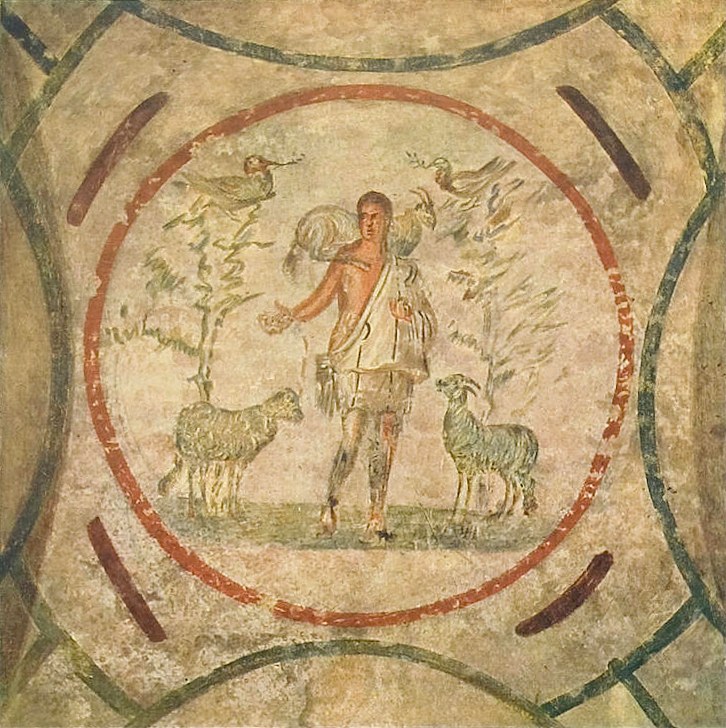
This fresco from the Catacomb of Priscilla in Rome, painted in the second half of the 3rd century, sits at the center of a burial chamber’s ceiling. The shepherd with his flock drew on Jesus’ own parable (John 10) and on an older classical image of the ram-bearer — Christianity’s first visual language was borrowed, then baptized. The cross itself would not become a standard image of Christ for centuries.
Byzantine: the Pantocrator
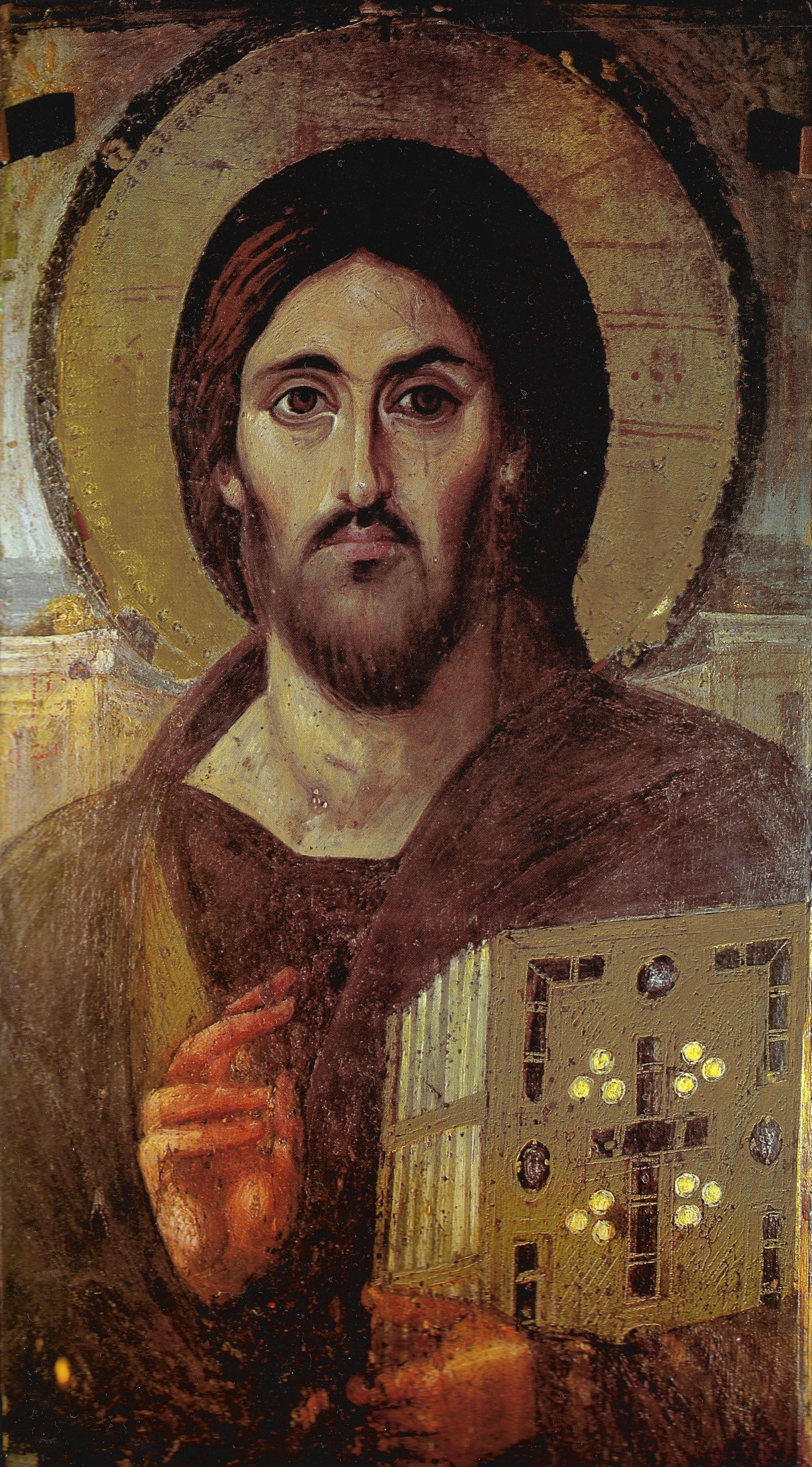
By the 6th century the Church had settled, at the councils of Ephesus and Chalcedon, that Christ is fully God and fully man — and art set out to paint both natures at once. The result is the Pantocrator (“Ruler of All”): frontal, majestic, right hand raised in blessing, left hand holding a jeweled Gospel book.
The icon at the top of this page is the oldest surviving example, painted in encaustic (hot wax) on a wooden panel in the mid-6th century and kept ever since at Saint Catherine’s Monastery in the Sinai desert. At 84 by 45.5 centimeters, it is intimate in scale and monumental in effect: the two halves of the face are painted differently — one serene, one severe — long read as the two natures of Christ in a single gaze. It survived the Iconoclastic controversies of the 8th and 9th centuries, when images were being destroyed in Constantinople, because Sinai was remote; a 1962 restoration removed 13th-century overpaint to reveal the original beneath. It is believed to have been produced in Constantinople, possibly as an imperial gift under Justinian. Every later image of the judging, blessing Christ descends from this panel.
Medieval: Duccio’s Maestà
In 1308 the city of Siena commissioned Duccio di Buoninsegna to paint a new high altarpiece for its cathedral. The result — the Maestà, installed on the high altar on 9 June 1311 — was the most ambitious painting of its age: a massive double-sided altarpiece, the Virgin in Majesty enthroned among saints and angels on the front, and on the back a sweeping narrative of Christ’s Passion in dozens of small panels, from the Entry into Jerusalem to the Crucifixion.
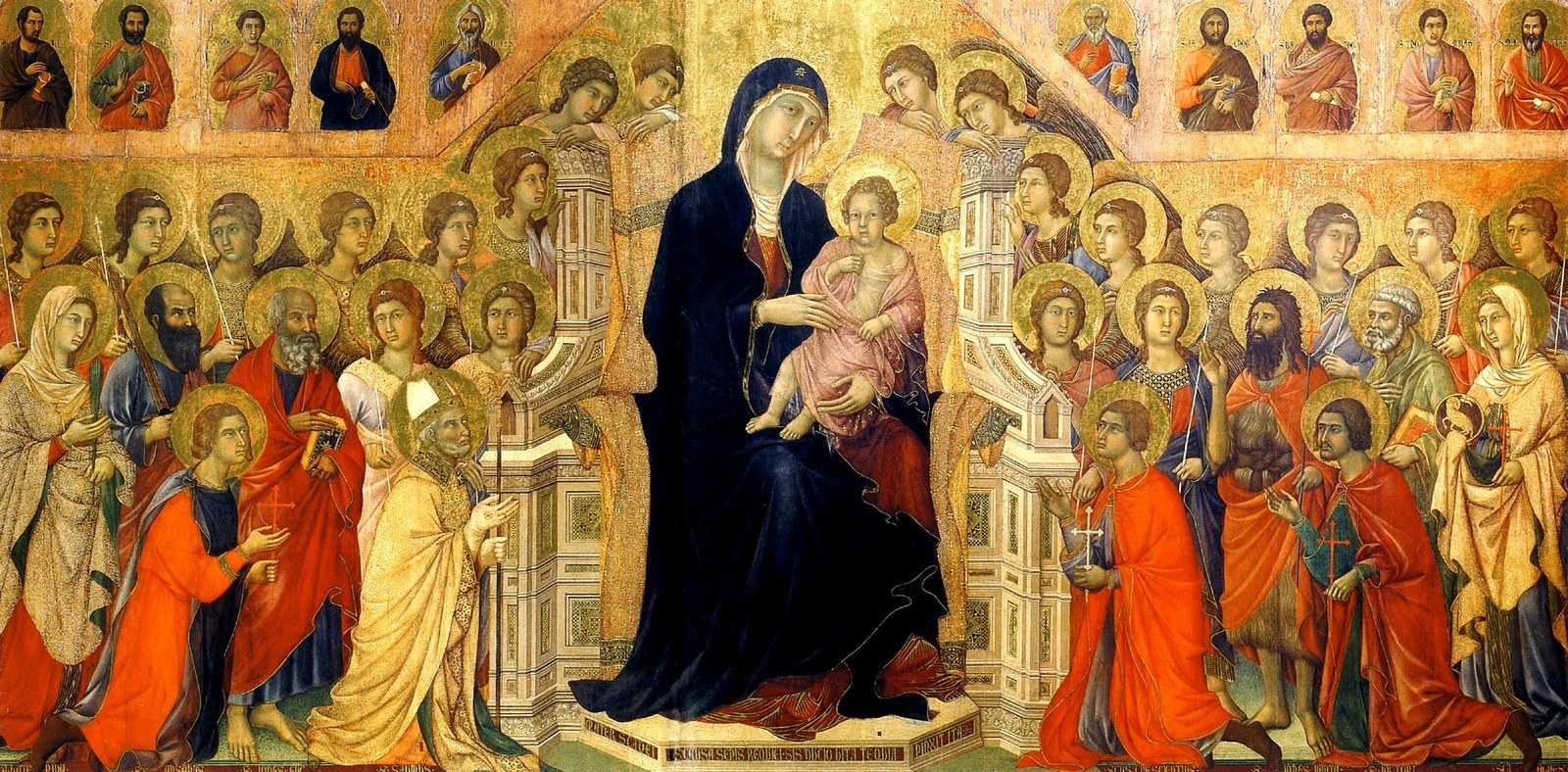
Duccio’s Christ is human and suffering — jeered, beaten, mourned — yet composed with a new naturalism: figures that turn, gesture, and grieve like people. The Maestà marks the moment medieval art learned to tell the Gospel story as drama rather than symbol, and it set the template for Sienese painting for a century.
Renaissance: Raphael’s Transfiguration
Raphael’s last painting is also one of the most famous Christs ever painted. Commissioned by Cardinal Giulio de’ Medici (the future Pope Clement VII) around 1516–17 as an altarpiece for Narbonne Cathedral in France, The Transfiguration occupied Raphael in the years before his death in 1520.
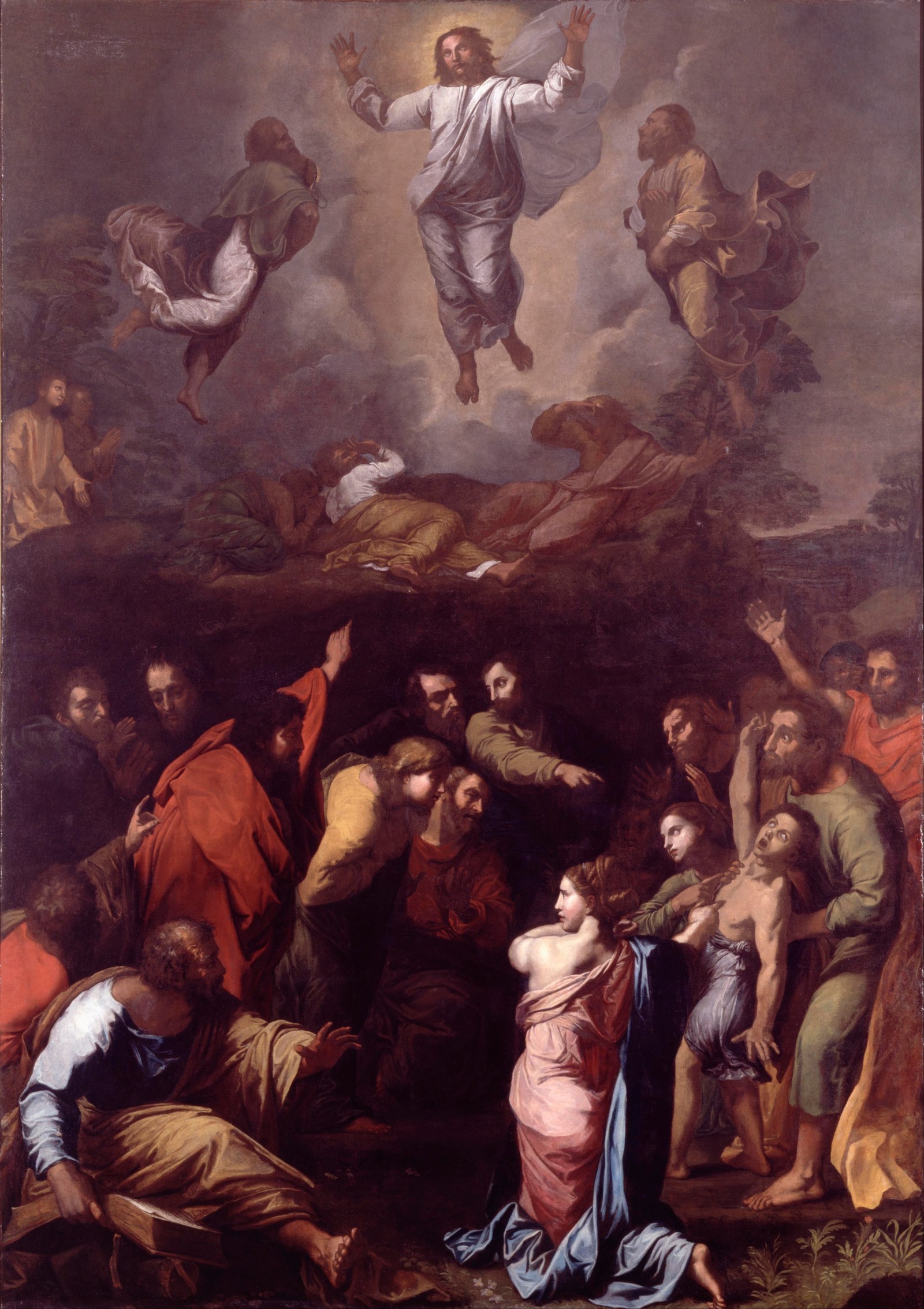
Unusually, Raphael fuses two Gospel episodes into one composition: the Transfiguration itself — Christ radiant between Moses and Elijah — in the upper register, and below it the chaotic scene of the apostles failing to heal a possessed boy (Matthew 17; Mark 9; Luke 9). Divine light above, human helplessness below, in a single frame: the Renaissance ideal of the learned, all-encompassing image. From the late 16th century into the early 20th, commentators regularly called it the most famous oil painting in the world. It never reached Narbonne; today it hangs in the Pinacoteca Vaticana.
Baroque: drama and shadow
The 17th century made the Gospel cinematic. Caravaggio’s stark chiaroscuro turned sacred scenes into street-level confrontations — his Raising of Lazarus (c. 1609, featured on this site’s Miracles page) shows a Christ who commands death with a pointing finger and a laborer’s weariness. Rembrandt went inward: his storm on the Sea of Galilee and his parables (the Good Samaritan, the Prodigal Son — both featured on this site) use light not for spectacle but for moral attention, picking out the accused, the forgiven, the welcomed.
The modern era: the devotional image
The 19th century produced the images that still hang in many churches and Sunday-school rooms: the Danish painter Carl Heinrich Bloch’s serene, luminous Christ (his Sermon on the Mount, 1877, is featured on this site), Heinrich Hofmann’s Christ in Gethsemane, and William Holman Hunt’s The Light of the World — a Christ knocking at a door with no handle on the outside. These are not court or altarpiece commissions but mass-reproduced devotional images, carried into homes by print technology. The 20th century scattered the tradition in every direction — from expressionist crucifixions to pop-cultural Christs — and no single image has dominated since.
What changed, and what didn’t
Across two millennia, the repertoire kept circling the same moments: birth, teaching, miracles, suffering, resurrection. What changed was the Christ at the center — the symbolic shepherd of the catacombs, the cosmic judge of Byzantium, the suffering man of the Middle Ages, the radiant ideal of the Renaissance, the intimate companion of the modern devotional print. Each era painted the Jesus it needed; the Gospels supplied the constant.
Source notes
- Sinai Pantocrator (6th century, encaustic, 84 × 45.5 cm, blessing/Gospel book, dual-nature reading, survival of iconoclasm 726–787 and 814–842): Wikipedia — Christ Pantocrator (Sinai); restoration detail (1962, 13th-century overpaint removed): MyDDOA.
- Good Shepherd, Catacomb of Priscilla (Velatio cubicle ceiling, second half of the 3rd century): Wikimedia Commons file metadata (verified public domain); see images/prov-fragments/jesus-in-art.json.
- Duccio’s Maestà (1308–1311, installed 9 June 1311, double-sided, Passion narrative panels including the Entry into Jerusalem and the Crucifixion): Smarthistory — Duccio, Maestà; Italian Art Society.
- Raphael’s Transfiguration (1516–20, commissioned by Cardinal Giulio de’ Medici for Narbonne Cathedral, dual narrative, Pinacoteca Vaticana, regarded into the early 20th century as the most famous oil painting in the world): Smarthistory — Raphael, The Transfiguration; Wikipedia — Transfiguration (Raphael).
- Artwork files and licenses: images/prov-fragments/jesus-in-art.json (all verified public domain on their Commons file pages, 2026-09-26).
Limitations
- “No one knows what Jesus looked like” reflects the scholarly consensus that no contemporary description or portrait of Jesus survives.
- The claim that the cross was not a standard image of Christ in the earliest centuries is the standard art-historical account; this page does not attempt a full history of crucifixion imagery.
- The Maestà image shown is the front main panel; the Passion narrative panels described are on the reverse, now mostly in the same museum.