Signature Scenes
Eight scenes that define the fictional Prince Willian — the moments fans quote back at each other. All site-written storybook fiction: vivid, self-contained, and labeled as invention.
1. The Tournament Joust
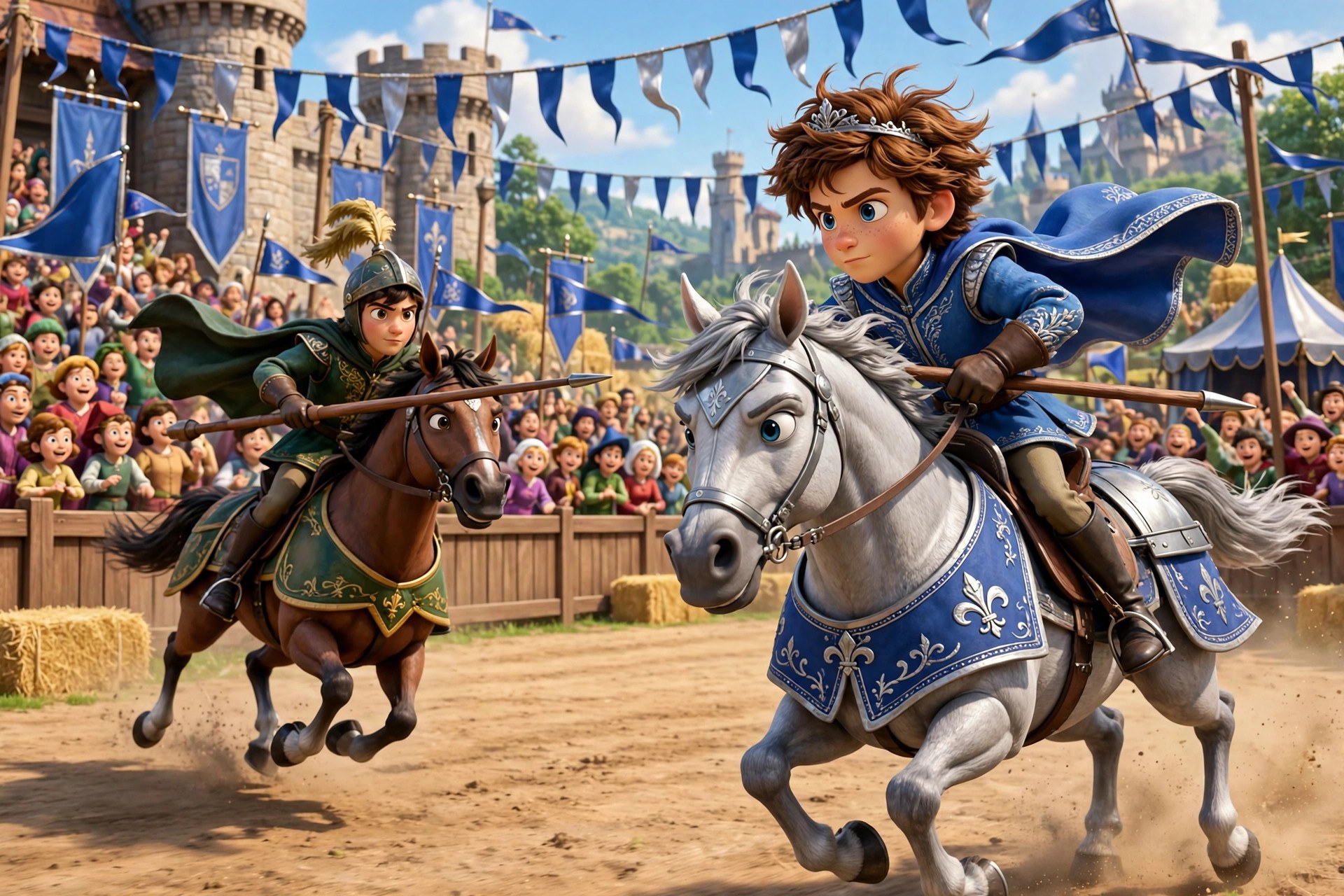
The lists are packed, the pennants snapping, and Willian — sixteen, borrowed armor slightly too big — faces Sir Corvin’s squire, who has never lost. Three passes. On the third, Willian’s lance catches clean, the crowd rises, and the herald’s voice cracks on his name. He wins the bout and immediately credits his horse, his arms-master, and — with total sincerity — the wind. The scene fans cite as the Willian moment: triumph worn lightly.
2. The Oath of the Banners
Torchlight in the throne room. Willian kneels before the row of royal-blue banners, one hand on a sword planted point-down, and speaks the old oath without a single stumble — to shield the weak, to speak truth, to put the kingdom before his comfort. Old Fenwick, who has witnessed eleven such oaths, weeps openly and blames the torch smoke. Nobody believes him.
3. The Midnight Ride
A messenger’s horse comes in lame at midnight with news of a washed-out bridge and a stranded village. Willian is saddling Moonmane before the council finishes gasping. He rides through rain and dark, lantern in hand, and reaches the village by false dawn — then spends the whole next day hauling timber beside the villagers instead of sleeping. The bridge is still called Willian’s Crossing.
4. The Bridge of Whispers
Exploring the old forest with Bram, Willian finds a moss-covered bridge no map remembers, and — because he is Willian — crosses it. On the far side: a grove of ancient trees and a spring the forest folk have kept secret for a century. He keeps the secret too, telling no one but Maren, who tells no one at all. The scene that established his reputation for discretion as well as daring.
5. The Feast of Lanterns
Silverkeep’s midwinter feast. Willian, excused from the high table’s politics, spends the evening among the lantern-makers’ children, teaching them to fold paper boats and losing — repeatedly, hilariously — at their riddle game. When the great lantern is lit, he’s the one hoisted up to light it, grinning like a festival himself. The city’s favorite night, and his.
6. The Practice-Yard Upset
For two years, Sir Aldric’s training record board has one unbeaten name at the top of the quintain drill. One autumn morning, Willian beats it — cleanly, undeniably — and the yard goes silent. Sir Aldric studies the board for a long moment, chalks Willian’s name above his own, and says only: “About time.” Willian later admits he celebrated by falling off the practice dummy.
7. The Storm Bell
Lightning takes the north watchtower’s bell-rope in a gale, and the alarm can’t be rung. Willian climbs the tower in the storm — hand over hand, rain in his eyes — and rings the bell by hand until the watch arrives. He is soaked, shaking, and furious at himself for enjoying it. The council votes him a medal; he asks for extra honey-cakes for the watch instead.
8. The Starlit Balcony
After the longest council session of his young life, Willian escapes to the east balcony, where Old Fenwick is already waiting with two cups of spiced milk and the beginning of a story. No adventure, no peril — just a boy, a storyteller, and the stars over Valoria. Fans love it because it’s the only scene where the prince is completely still, and completely himself.
How these scenes were chosen
The writers picked scenes that each reveal a different facet — triumph, solemnity, service, wonder, joy, mastery, courage, quiet — so the set works as a personality portrait in miniature. Every scene is self-contained (no prior lore required) and every scene is invention, labeled here and in Methodology.
Source notes
- All eight scenes are site-written fiction (2026-09-26); the app publishes no scenes or stories. See methodology.md.
- Related: personality.md, relationships.md, memorable-moments.md.
- Illustration: AI-generated (2026-09-26); see the image credits on this page. AI-generated dramatization art — not a historical depiction.