The craft
Knots & Seamanship
How Martin ties a bowline — and why it matters more than the rope.
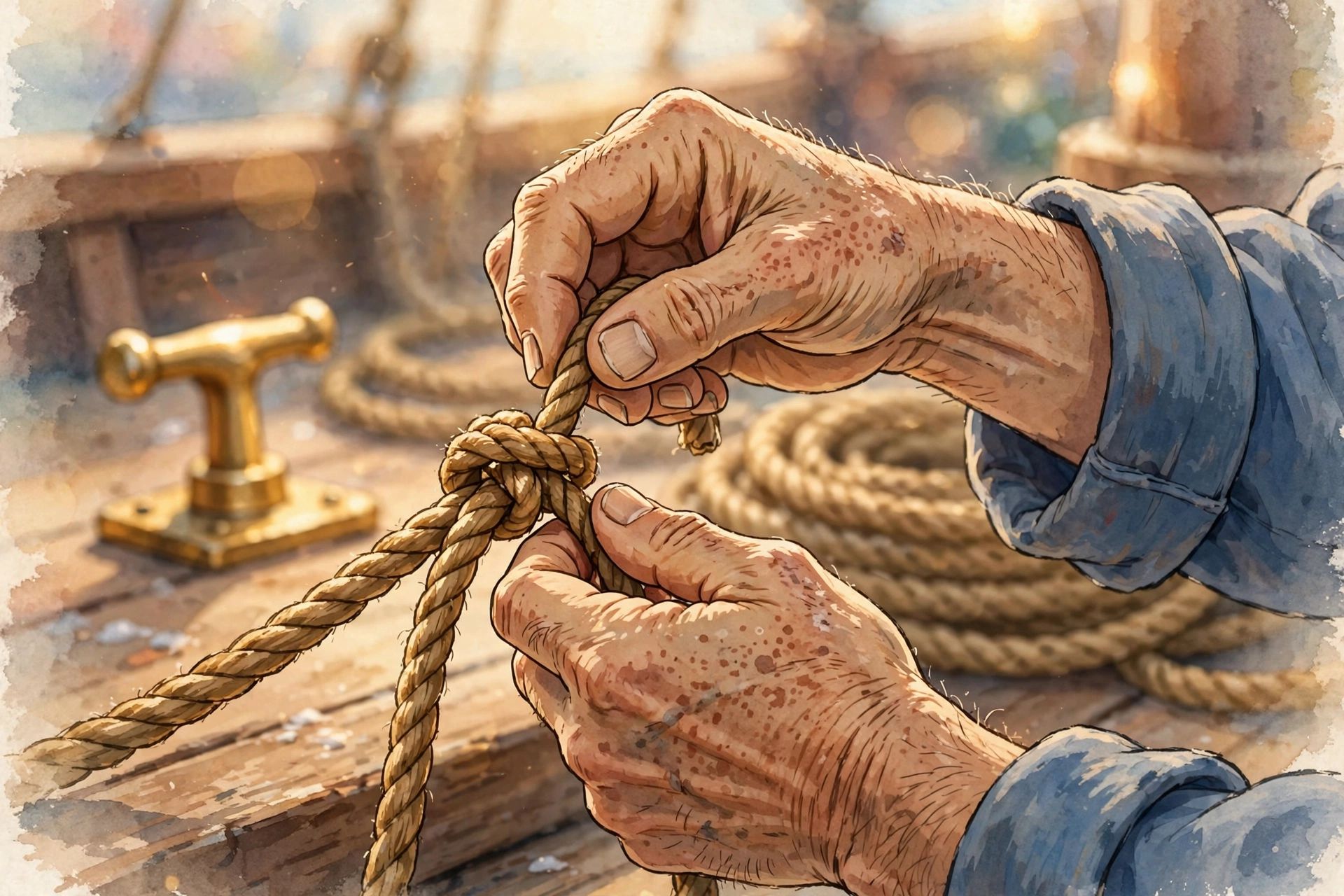
“A knot is a promise you make with your hands. Make it well, and the sea will hold you to it.”
— Martin, first lesson to every new hand (fictional)
The Tidewell method
Every new hand aboard the Second Dawn learns the bowline on their first day, taught by Splice Rook with the patience of a saint and the vocabulary of a boatswain. Martin’s rule: you tie it ten times right, in the light, before you ever tie it once in the dark. “The sea,” he says, “does not give partial credit.”
The working knots
| Knot | Use aboard the Second Dawn | Martin’s note (fictional) |
|---|---|---|
| Bowline | The rescue loop; a fixed loop that won’t jam | “The king of knots. Learn it first, trust it forever.” |
| Clove hitch | Quick fastening to rails and posts | “Fast to tie, quick to slip — never trust it alone.” |
| Figure-eight | Stopper knot; keeps rope from running out | “The full stop at the end of the rope’s sentence.” |
| Sheet bend | Joining two ropes of different sizes | “For when the right rope isn’t aboard. Improvise honestly.” |
| Reef knot | Tying down sails — and bandages, in a pinch | “Right over left, left over right. Get it backwards and I’ll know.” |
Seamanship, the Tidewell way
- Check the weather, then check it again. Pip’s bell-log is disturbingly accurate; Martin checks it every morning and pretends it’s superstition.
- Coil your lines. A tidy deck is a safe deck, and a coiled rope is a rope that won’t trip the captain — which matters, because the one loose plank aft of the mainmast is quite enough tradition.
- Learn the private names of the winds. “Mrs. Pettifer” is fussy but honest; knowing her moods is half of sailing her.
- Mend your own sails. The captain’s rule, applied to everyone: know your tools, or your tools will surprise you.