Yellow Vests
Winter 2018 — the revolt that shook the presidency.
The spark
In November 2018, a planned rise in fuel taxes ignited protests by motorists wearing the high-visibility gilets jaunes every driver must carry. What began as a tax revolt quickly broadened into a mass movement against Macron himself — his manner, his reforms, and what protesters called contempt for ordinary France.
Acte IV and the peak
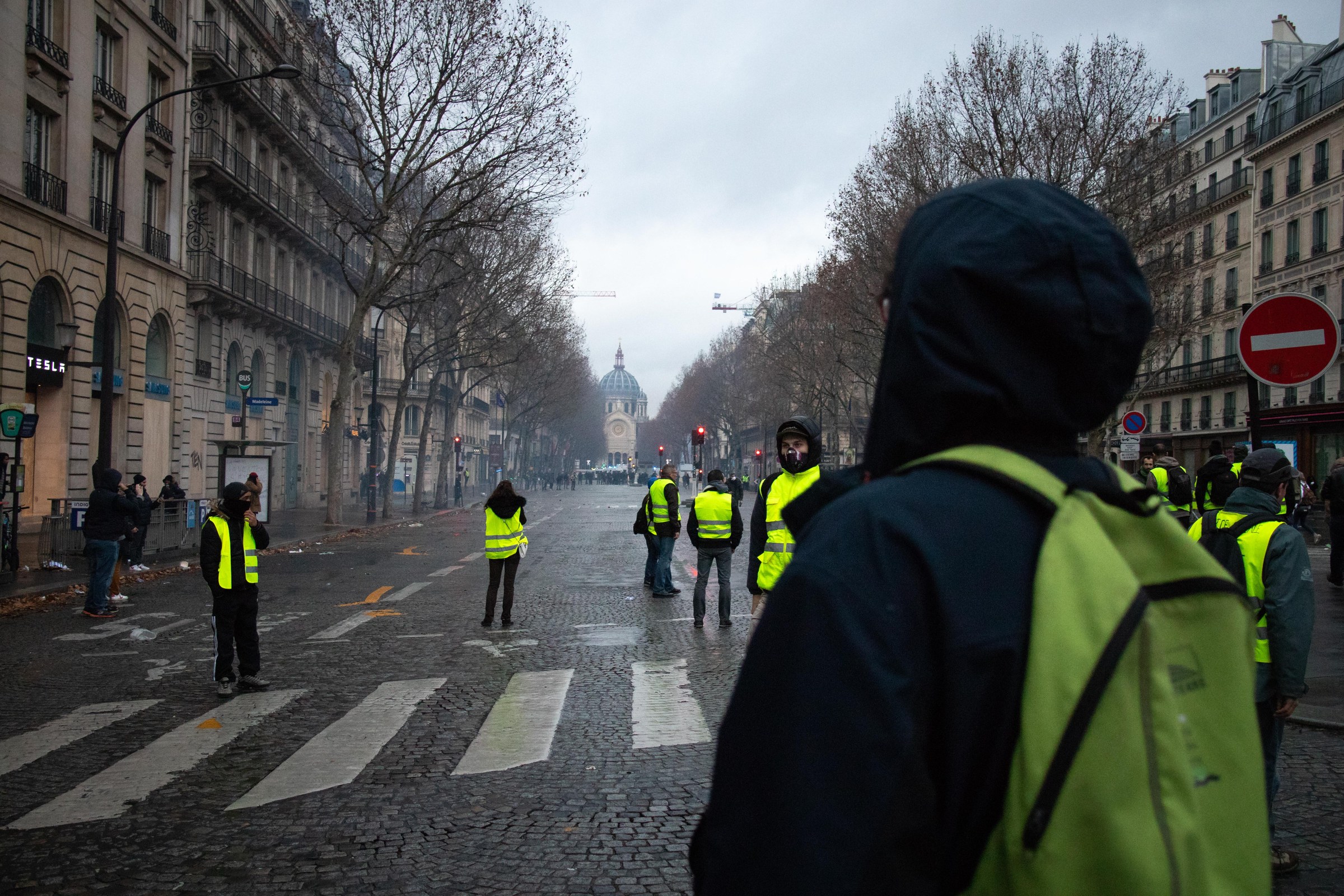
Weekly Saturday demonstrations — the actes — brought tens of thousands into the streets. On 8 December 2018 (“Acte IV”), Paris saw running clashes, burned cars, and the Arc de Triomphe vandalized. The photograph above, taken that day, shows demonstrators in the capital.
The response
On 10 December 2018, Macron addressed the nation, declared a “state of economic and social emergency,” and announced concessions: a €100 monthly boost for minimum-wage workers (via the prime d’activité), cancellation of the fuel-tax rise, and tax-free overtime. He then launched the Grand débat national (January–March 2019) — thousands of town-hall meetings across France.
The aftermath
The movement ebbed through 2019 but permanently marked the presidency: approval ratings collapsed and recovered, the “president of the rich” label stuck, and Macron’s style — vertical, Jupiterian — became the central grievance of his opponents.
Source notes
Dates (17 November 2018 start, 8 December 2018 Acte IV, 10 December 2018 address) and the concession package follow contemporaneous French and international press coverage. The photograph is credited in its caption (CC BY 2.0, Olivier Ortelpa).