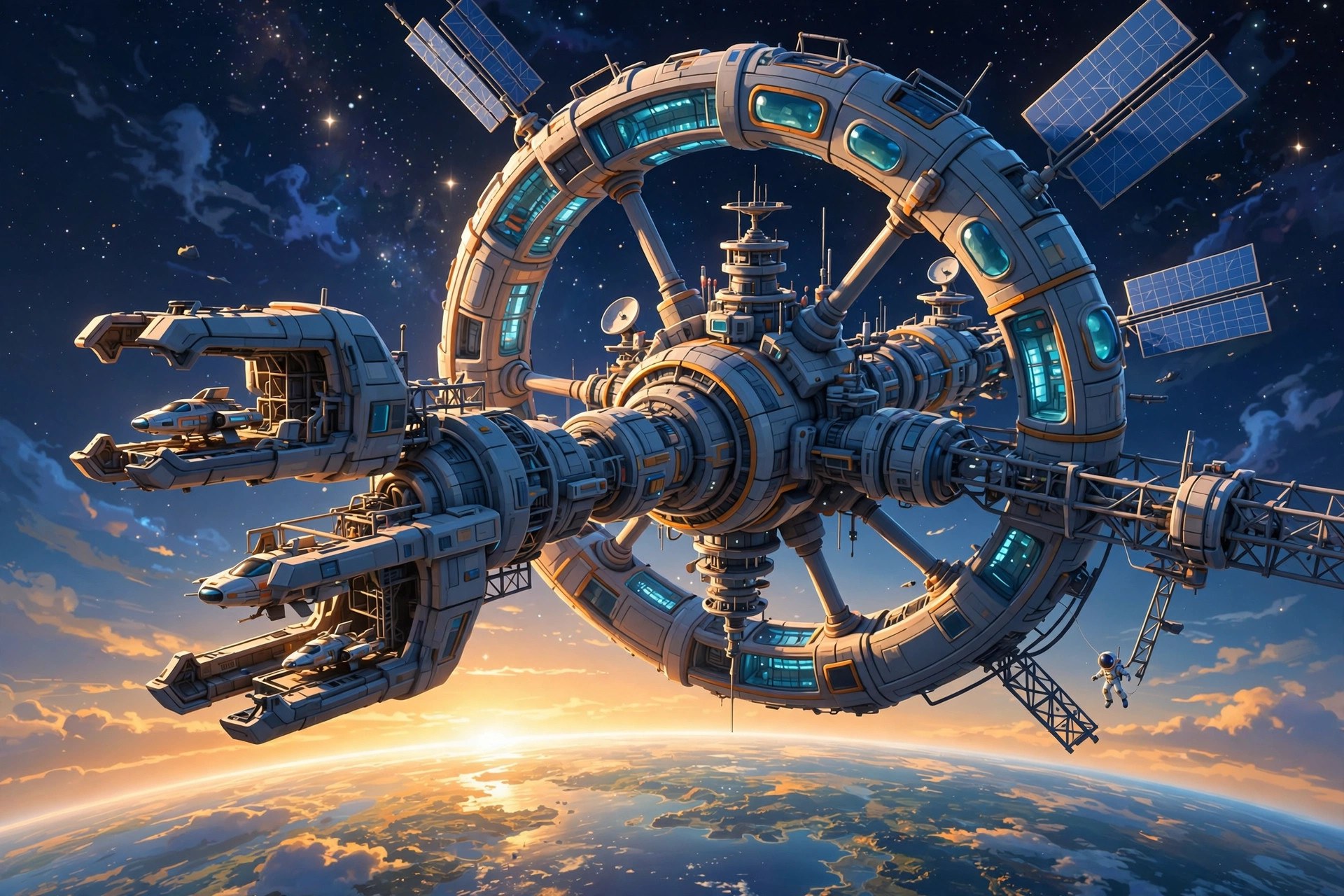
Setting brief // Meridian Sector
World Guide
The sector, the alliance, the ship, and the things that go wrong out there. The entire universe on this page is invented fan lore.
The Meridian Sector
The settled stretch of space StarTeam protects: a loose volume of star systems threaded with shipping lanes, anchored by habitats and stations rather than planets. In the fiction, nobody in the sector “lives on a planet” — they live in rings, on stations, aboard ships. Vacuum isn’t the environment outside the window; it’s the neighborhood. That single worldbuilding choice is why an EVA specialist is a hero here rather than a technician: in the Meridian Sector, the outside of the hull is where life happens.
The Concord of Habitats
The civilian alliance that funds StarTeam. Dozens of habitats — including Cass’s home, the Meridian Ring — pool resources for shared defense, rescue, and infrastructure, and StarTeam is the instrument: a rapid-response crew with jurisdiction across Concord space. The Concord is deliberately civilian in the fiction. It has no navy, no marines — it has StarTeam, a rescue crew with teeth, because the sector’s founders decided they’d rather be saved than conquered.
The Starhold Vigil
StarTeam’s orbital flagship and Cass’s home: a converted long-haul tender refit as a rapid-response platform — big docking cradles, a full EVA bay with four airlocks, a machine shop Petra Lindqvist rules absolutely, and the patch wall in the EVA bay where every mission earns a stenciled patch. The Vigil is old in the fiction — third hull of the name — and Cass’s Longhaul suit has spent more hours on its hull than anywhere else. The ship’s motto, stenciled above the main airlock: “Nobody drifts alone.”
The Meridian Ring Habitat
Cass’s birthplace: a civilian orbital ring of about forty thousand people, all living within a few hundred meters of vacuum. Ring culture in the fiction is suit culture — children drill in training rigs, dock riggers are local celebrities, and the airlock really is treated as the front door. The Ring is where Cass learned the two lessons the lore never lets him forget: the air is borrowed, and the suit is sacred.
Threats and hazards
Debris storms. The sector’s weather. Cascading fragments from old collisions sweep the lanes on predictable-but-unforgiving tracks — Rin’s drift models plot them, the Vigil shelters or outruns them, and Cass goes outside after they pass to assess the hull. The Long Dark (SC 1219) was a storm op.
The Kessler cascade. In the fiction’s history, an early orbital collision chain rendered one whole system nearly unnavigable — the cautionary tale every cadet learns. “Don’t make another cascade” is why the Concord polices salvage so aggressively, and why Cass’s recovery work matters: every dead satellite caught is one less future fragment.
Legacy stations. Aging Concord infrastructure — relay stations, fuel depots, waypoints like Wayfarer — built before modern standards, failing in interesting ways. A large share of Cass’s rescue ops are legacy-station calls: airlocks that won’t seal, hulls that won’t hold, crews that can’t leave.
The Jackals. Rogue salvagers who strip wrecks for parts — and, in the fiction’s gray zone, sometimes make wrecks to strip. They are the closest thing the setting has to villains, but the lore keeps them human: desperate crews, bad economics, no Concord charter. Cass’s rule for Jackals is the same as for storms: nobody drifts alone, even them. The SC 1217 Wayfarer standoff — six hours holding an airlock until security arrived, no shots fired — is the template.
Solar storms. Radiation and charged particles that scour unshielded hulls and fry electronics. EVA during a storm is the fiction’s definition of a bad idea — which is exactly when the Silent Array needed rebuilding (SC 1208). Cass’s storm doctrine: minimize exposure, maximize preparation, and never let the schedule argue with the physics.
Daily life in the fiction
The world guide’s quiet details, kept consistent across pages: ship time runs on the Star Cycle calendar; the EVA bay smells of ozone and seal lubricant (Petra’s words: “the smell of the job”); Jinx’s shuttle is named Second Guess; the Vigil’s galley serves something called “recycler’s stew” that Okafor insists is nutritious; and the patch wall gets a new stencil after every op, painted by whoever came home.
Source notes
- All setting content is invented by this site’s writers; see Methodology.
- Related pages: Lore, Team, StarTeam History, Glossary.
- Character identity anchor: Vizlings app card (StarTeam), card description “Body space suit hero.”