Deep dive // Equipment
Costume & Gear
Fourteen layers between Cass and vacuum, one jetpack, and a carabiner he trusts more than most people. The full fictional kit, piece by piece.
The AEGIS Mark VII “Longhaul” — layer by layer
The fiction describes the Mark VII as a fourteen-layer system. From skin out:
- Liquid cooling garment — water-circulated long johns; the suit’s air conditioning.
- Pressure bladder — the airtight layer; a breach here is the emergency.
- Restraint layer — keeps the bladder from ballooning; why the suit holds its shape.
- Thermal micrometeorite garment — the quilted outer blanket; MMOD and temperature in one.
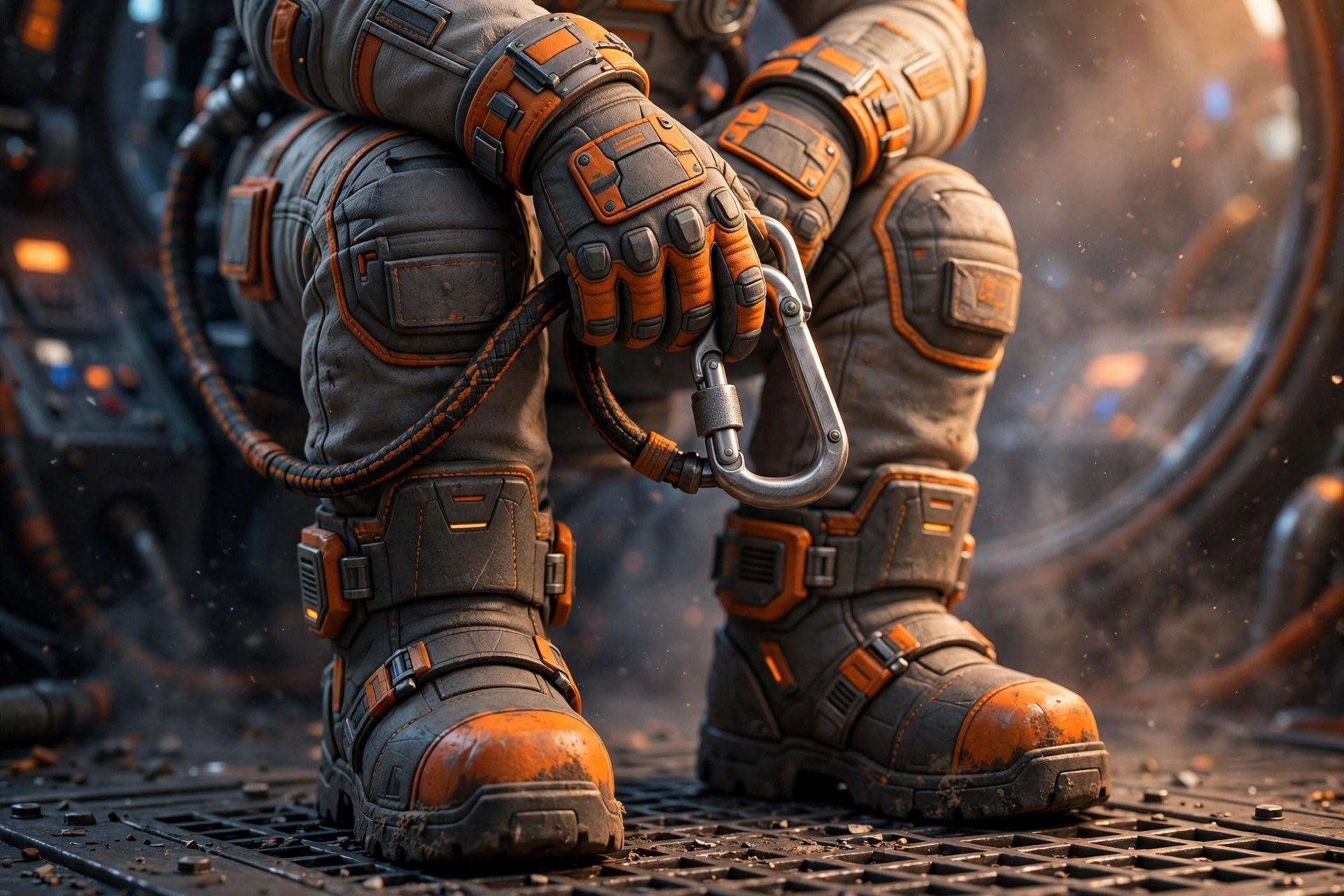
- Hard-shell torso — the barrel chest: graphite composite, orange over-jacket, the part that takes the hits.
- Helmet assembly — bubble helmet, visor up off-duty; the HUD projects suit telemetry onto the visor when down.
- PLSS backpack — oxygen, power, cooling, comms; the “second spine” Cass checks twice.
- Gauntlets — the fiction’s hardest engineering problem: gloves you can work in. Cass’s are custom-fitted, re-stitched by Petra, famous.
- Boots — magnetic-soled, graphite, orange toe caps; the “truth” the tether joke is about.
- Umbilical ports — hip and chest couplings for tethered ops.
- Chest control panel — the dials-and-switches block on the sternum; the close-up the site’s art loves.
- Patch field — the stenciled mission patches, left shoulder and thigh; never removed, never covered.
- Helmet lamp — the Cold Berth boardings’ signature: a single white beam in the dark.
- The stencil inside the helmet — “The suit is the mission.” Layer zero. (Invented detail.)
The Driftline maneuver rig
The backpack jetpack: RCS quads, propellant for roughly forty minutes of aggressive maneuvering (in-fiction spec), and a control scheme the lore describes as “think it, feather it” — small hand-controller inputs, big consequences. Cass’s rig is tuned hot — faster response, less forgiveness — the way Jinx tunes her shuttle. The dead-stick recoveries in his record are Driftline flights on partial thrust, and the rig’s scuffed nozzles are a point of pride.
Tools of the trade
- Tether carabiner — his signature object: oversized, one-hand operable in gauntlets, the thing he clips first and unclips last.
- Hull welder — the Silent Array tool: a plasma torch rated for vacuum work, finicky, beloved.
- Rescue ball — the inflatable single-person sphere (a real NASA concept, borrowed into the fiction). Standard kit; never used; carried anyway.
- Patch kit — soft seals, clamps, bladder patches: the reason “soft seal” is in the Glossary.
- The checklist tablet — Theo’s domain as much as Cass’s: the pre-EVA list, run twice, the bravest thing he owns.
Maintenance as character
Petra Lindqvist maintains the Longhaul to what the fiction calls “unreasonable” standards, and the lore treats suit maintenance as a relationship: Cass knows every scuff, Petra knows every stitch, and the suit’s condition is the visible record of their trust. The design rule from Hero Design — never a pristine suit — is really a story rule: the wear is the biography.
The EVA-1 modifications
Cass’s Longhaul isn’t stock — the fiction is specific about what’s been changed, because the changes are character:
- Re-stitched gauntlets: Petra rebuilt the glove liners to Cass’s hands after the standard pair cost him a fumbled carabiner in training. The lore treats the gloves as a craftsman’s tools — broken in, personal, non-transferable.
- Hot-tuned Driftline: faster RCS response, less forgiveness — the way Jinx tunes her shuttle. The dead-stick recoveries in his record were flown on this tune.
- The helmet stencil: “The suit is the mission,” hand-lettered inside the helmet where only the wearer sees it. Layer zero.
- The patch field: left shoulder and thigh, stenciled mission patches, never removed, never covered — the suit as service record.
- Scuffs, kept: the design rule from Hero Design is that the suit is never pristine. Petra could buff it; she doesn’t. The wear is the biography.
None of the modifications change what the suit is — a machine with limits, budgets, and failure modes. They change how one particular human wears it, which is the only customization the fiction respects.
Source notes
- All equipment described is invented by this site’s writers; real concepts (PLSS, umbilical, rescue ball) are borrowed and noted.
- Related: Hero Design, Abilities, Explained, Glossary.