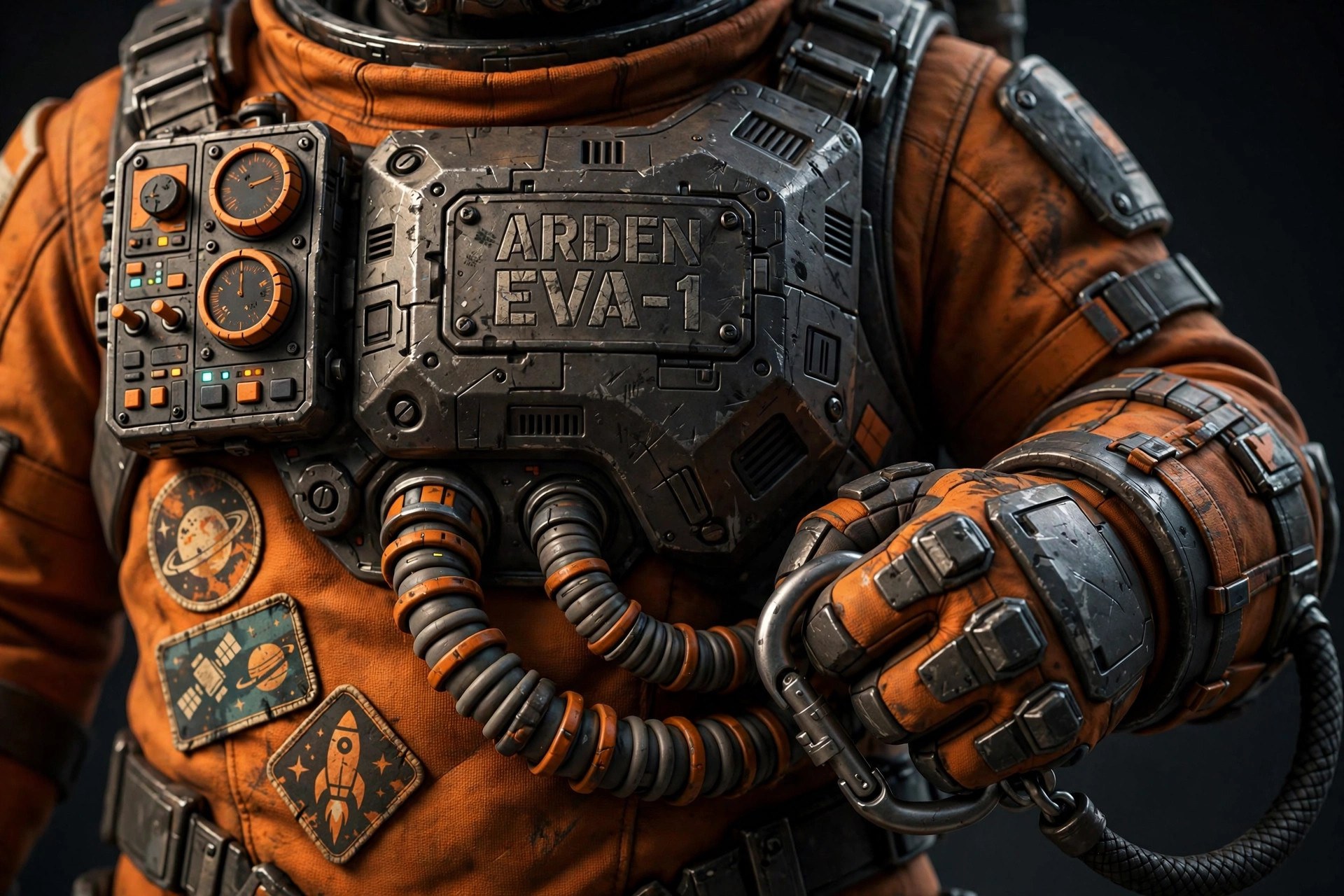
Spec sheet // EVA-1 capabilities
Abilities
Eight things Cass does better than anyone in the Meridian Sector — all of them outside the hull. Fictional abilities for a fictional character.
1. EVA mastery
The baseline everything else stacks on. Cass is rated for every class of spacewalk in the StarTeam fiction — construction, repair, rescue, and free-flight — and holds the crew’s fictional record for longest continuous EVA (seventy-two hours, the Long Dark, SC 1219). Outside the hull, his movement economy is the thing other specialists study: no wasted motion, no wasted air.
2. Zero-g maneuvering (Driftline rig)
Cass flies the Driftline maneuver rig — the fiction’s backpack jetpack — the way Jinx Kane flies the Vigil’s shuttle: by feel. The Driftline Run (SC 1211), a two-kilometer solo intercept of a tumbling hauler, is the textbook example. He is known for “dead-stick” recoveries: flying the rig with partial thruster failure and still making the catch.
3. Suit systems improvisation
The AEGIS Mark VII is a machine with ten thousand failure modes, and Cass has met most of them. The lore credits him with field repairs other EVA techs call impossible — re-routing coolant through a drinking-water line, patching a glove bladder with a ration pouch, flying a suit with a dead primary O2 feed on the secondary alone. Rule, in his words: “Vacuum doesn’t negotiate.” (Invented dialogue.)
4. Vacuum rescue and recovery
His signature discipline. Tether’s End (SC 1216) — intercepting a severed-tether crewmate with seconds of air left — is the famous case, but the quieter record matters more: forty-plus recoveries of drifting crew, failed suits, and stranded craft, with a fictional zero-loss rate. “Nobody drifts alone” is both motto and method.
5. Hull welding and structural repair
Cass does structural work in a suit the way a surgeon works in gloves. The Silent Array op (SC 1208) — rebuilding a solar-array junction in a solar storm — and six hours holding the Wayfarer airlock (SC 1217) are the set pieces, but the day-to-day version is patching micrometeorite strikes on the Vigil’s hull between storms.
6. Tether and umbilical work
The unglamorous core of EVA: running tethers, managing umbilicals, keeping lines clear in a debris field while doing everything else. Cass’s tether discipline is the reason the “buddy system” on the Vigil is named after an incident he prevented rather than one he survived — the SC 1212 cadet self-rescue he talked through over the radio.
7. Decompression first aid
When a suit fails, the first medic on scene is whoever is already outside. Cass is cross-trained in the fiction’s vacuum medicine — rapid repressurization, suit-breach triage, the “fizz” (decompression sickness) protocols — and Dr. Okafor trusts his field calls enough to let him make them.
8. Suit-sense (telemetry reading)
The one ability the lore treats as genuinely unusual: Cass reads suit telemetry — pressure curves, thermal drift, O2 flow harmonics — the way a musician reads a score, and catches failures minutes before the alarms do. Instructors called it “preternatural.” Cass calls it “listening to the suit.” It’s the ability that got him recruited, and the one he can’t teach.
How to read the spec sheet
Two things this sheet doesn’t show, because no spec sheet can: the stack and the standard. The stack is how the eight abilities combine — maneuvering buys position, improvisation buys options, rescue doctrine buys purpose, and suit-sense buys the minutes the others spend. The standard is the training behind them: Cass’s abilities are maintained by a weekly regimen of pool time, suit drills, chamber work, and crew exercises documented on Training. Talent got him recruited at eighteen; repetition is what kept him EVA-1 for eleven years. In the fiction’s own assessment, he is not the most talented EVA specialist in the sector’s history — he is the most prepared, and preparation is a choice the sheet can’t list.
Source notes
- All abilities are invented by this site’s writers for a fictional character; see Methodology.
- Missions referenced: the Mission Archive; chronology: Timeline.
- Signature lines are fictional character dialogue; see Sayings.