Lore
The backstory of a fictional hero: a blue-skinned starborn from Meridian Prime who learned to carry starlight — and what it cost him. All lore below is invented for the Vizlings character concept.
Origins on Meridian Prime
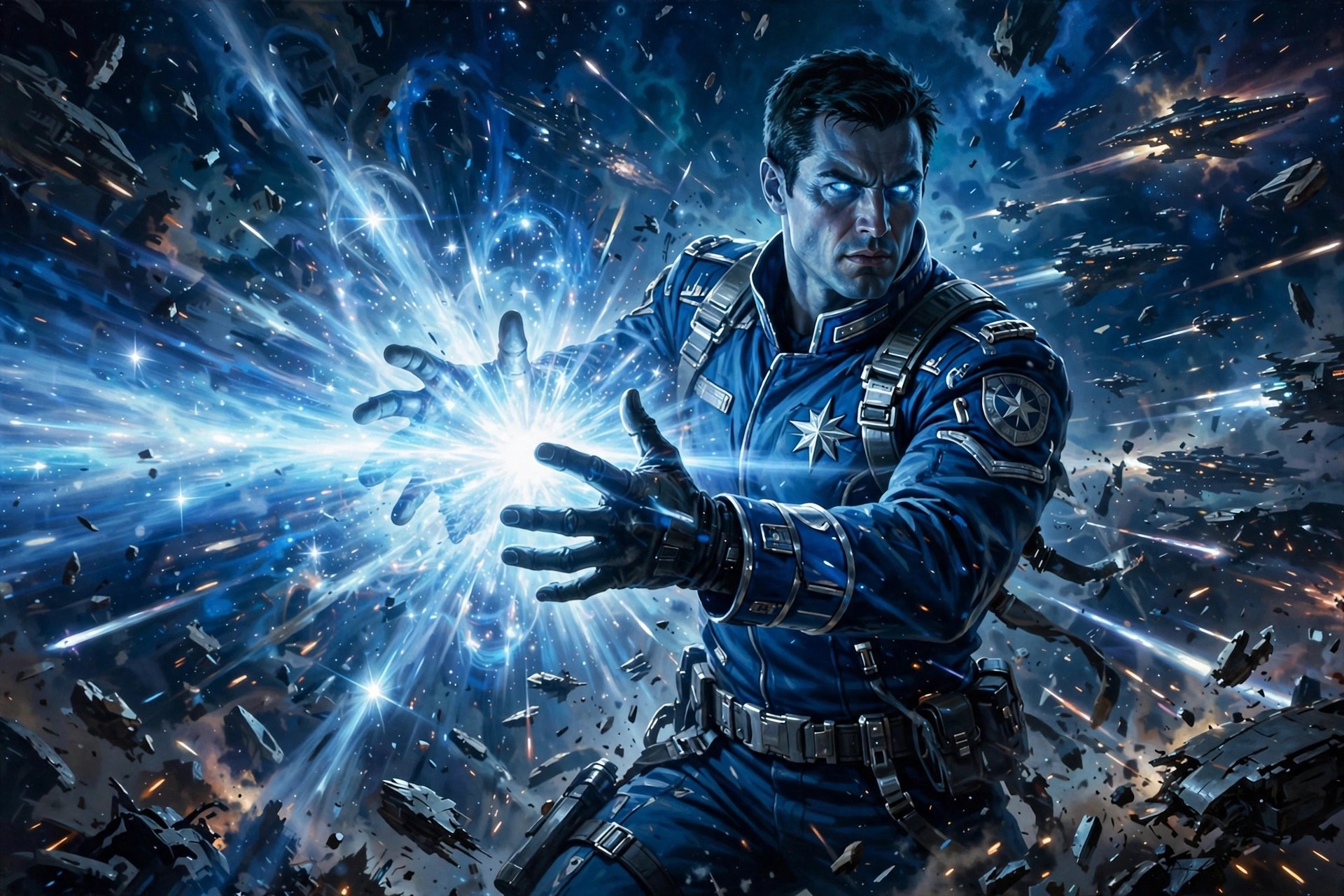
Adrian Halden was born in Concord Year 182 aboard Meridian Prime, a vast orbital colony ring circling the blue giant star Meridian in the fictional Azure Belt. The colony’s founders had engineered their descendants — the starborn — for life under hard starlight: cobalt-blue skin that drinks in stellar radiation, dark hair, and a metabolism that runs partly on light. Halden was a dockworker’s son, raised in the maintenance warrens of Ring Three, where the star’s glare came through the shielding at its most honest.
Nothing about his childhood suggested a hero. He was quick, stubborn, and famously bad at staying out of restricted airlocks. The colony’s instructors remember a boy who asked too many questions about why the starborn absorbed light — and who refused every answer that ended with “because that’s how it works.”
The Belt Storm of CY 194
When Halden was twelve, the Belt Storm of CY 194 — a fictional stellar flare event — overwhelmed Meridian Prime’s shielding for eleven minutes. In the warrens, a shield panel failed above a crowded shelter. Witness accounts in the lore agree on what happened next even though none of them agree on the details: the boy stepped into the breach, his skin went incandescent blue-white, and the flare bent around him like water around a stone. Eleven minutes later the shielding came back online. Halden slept for three days and woke up with a permanent faint glow under his skin and a name the dockworkers gave him: the boy who drank the storm.
In-world scholars of the lore call this the first recorded full-spectrum resonance event — the moment Halden’s body stopped merely absorbing starlight and started storing it. He did not understand it. For years, neither did anyone else.
Recruitment and the Concord years
The Galactic Concord’s talent scouts found him at nineteen, working salvage in the Belt and quietly using his resonance to weld hull plates faster than any cutter on the docks — a trick he’d taught himself and told no one about. The Concord offered him a uniform and a question he’d been waiting his whole life to hear: what if the light is for something?
He trained at the Concord Academy on Tarsis Station (CY 201–205), where his file acquired two permanent notes. The first: “Resonance capacity off the chart; control improving.” The second, from his tactics instructor: “Thinks in trajectories, not positions. Dangerous in the right direction.” He graduated top of his cohort in field tactics and dead last in paperwork, a ranking he reportedly considered “exactly correct.”
The founding of the StarTeam
In CY 214, Concord Marshal Ilya Voss proposed a radical experiment: instead of fleets and battalions, a six-person rapid-response unit — small enough to arrive before a crisis calcified, skilled enough to end one without an occupation. Halden, then thirty-two and already famous for the Cinder Drift evacuation, was offered field command. His condition for accepting is one of the most-quoted (fictional) lines in the lore: “I’ll take the team. But I pick them.” (See Sayings — labeled fictional dialogue.)
He picked five people nobody else would have combined: a disgraced racer-pilot (Lyra Vane), a salvage engineer with a criminal record (Bram Solis), a xenobiologist who’d been blacklisted for insubordination (Sera Quinn), a scout who officially didn’t exist (Dax Morr), and a comms officer whose telepathy made her unemployable anywhere polite (Una Faye). The Concord protested. Halden’s answer: “You wanted a team that can do the impossible. I hired people the possible already gave up on.” The StarTeam’s founding charter was signed in CY 214. The ship assigned to them was a decommissioned long-range courier, the CSS Auralis — which engineer Bram Solis rebuilt into something the Concord’s own designers couldn’t quite explain.
The cost: flareburn
Halden’s signature ability — releasing stored starlight as kinetic nova pulses — has a price the lore never softens. Push past his reserves and the resonance turns inward: flareburn, a cascading overload that scorches his own nervous system. He suffered his first major flareburn during the Cinder Drift evacuation (CY 209), saving four hundred colonists and spending six weeks in a burn ward. He suffered his worst during the Quiet War (CY 238), and the lore is explicit that he has never fully recovered — his glow flickers now, and long missions require recharge stops in open starlight.
This is deliberate in the character’s design: the hero who carries light for others is slowly being hollowed by it. His crewmates’ standing orders — written by Halden himself — are unambiguous: “If I go nova and don’t come back down, Lumen puts me under and the team finishes the mission without me.”
What he wants
Asked, in the lore, what he’s fighting for, Halden doesn’t talk about the Concord, the charter, or glory. The (fictional) line the site’s authors gave him is: “Somebody has to be the light in the room. Might as well be the guy who’s already glowing.” His private ambition, confided only to Sera Quinn in the mission logs, is simpler: to find the Meridian starborn colony-ships that left the Belt generations ago and never arrived — the Lost Meridian Fleet — and bring them home. It is the one mission the Concord has never authorized, and the one he has never stopped planning.
Source notes
- All lore on this page is fan invention for the fictional Vizlings character concept — there is no published canon being documented. See Methodology for how this site handles invention vs. documentation.
- Character card: “star blue male” — quoted verbatim from the Vizlings app; everything else here extrapolates from it.
- In-world references cited (fictional): Meridian Prime colony records, Concord Academy training file, StarTeam founding charter (CY 214), Auralis mission logs.
- Images: AI-generated dramatization art; see
the image credits on this page. - Dates are Concord Years (CY), a fictional in-world calendar.