The Economist Years
Before the chainsaw: twenty years of banks, blackboards, and Austrian-school pamphlets.
Training
Milei graduated in economics from the University of Belgrano in 1993, then pursued postgraduate studies in economic theory at the Instituto de Desarrollo Económico y Social (IDES) and a master’s in economics at the Universidad Torcuato Di Tella. His intellectual formation was the Austrian school — Mises, Hayek, Rothbard — absorbed in an Argentine economics profession then dominated by Keynesian and structuralist orthodoxies.
The jobs
Over roughly two decades Milei worked as a professional economist at:
- Fundación Acordar — think-tank work in the 1990s.
- HSBC — chief economist for Argentina around 2008.
- Máxima AFJP — the private pension fund, before the 2008 nationalization of pensions.
- Estudio Broda — the consultancy of Miguel Ángel Broda.
- Corporación América (from 2008) — chief economist for Eduardo Eurnekian’s conglomerate, operator of airports across Latin America.
He also taught at the University of Buenos Aires and other institutions, and worked as a private consultant. Colleagues from these years describe a technically skilled monetary economist with heterodox — increasingly radical — views.
The books
Milei published collections of essays and polemics, including:
- Lecturas de economía en tiempos de kirchnerismo (2014)
- El camino del libertador (2014)
- El fin de la inflación (2017)
- Desenmascarando la mentira keynesiana (with Diego Giacomini, 2017)
- Pandenomics (2020)
The books argue, in technical and then increasingly popular registers, that inflation is always a monetary phenomenon, that central banks are engines of poverty, and that Argentina’s decline is the product of a century of statism.
The turn to the public
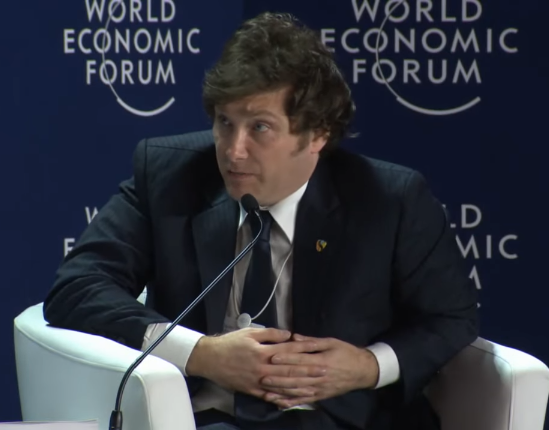
By the mid-2010s Milei was a known quantity in Argentine economics circles — a frequent conference speaker (he addressed a World Economic Forum event on Latin America in 2014) and a prolific op-ed writer. Television discovered him around 2015, and the economist became the personality. See Media Personality.
Source notes
- Employment history from Argentine press profiles and Milei’s congressional CV.
- Bibliography from publisher records (Unión Editorial, Galerna).