Popular Culture
The most memed climate activist in history — how her image and phrases traveled through culture.
“How dare you” as cultural shorthand
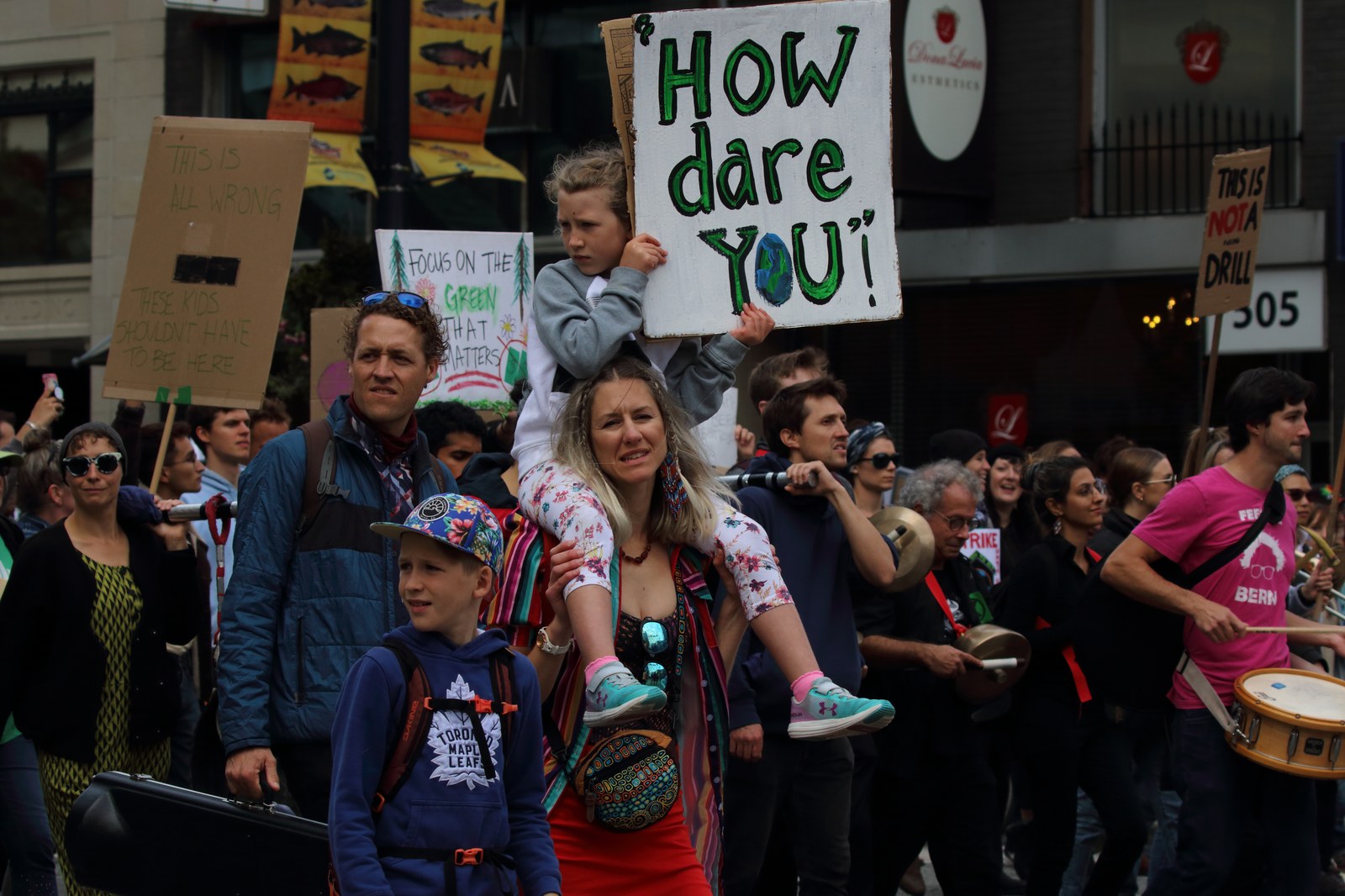
Within hours of the 23 September 2019 UN speech, “How dare you” was a global meme — remixed into music videos, printed on placards at marches worldwide (as in the photograph above), and quoted by politicians, comedians, and advertisers. The phrase’s afterlife is arguably larger than the speech’s policy impact: it became a free-floating expression of generational accusation.
Murals and street art
Her face — braids, yellow raincoat, hand-painted sign — became one of the most muralized images of the late 2010s, appearing on walls in cities from San Francisco to Bristol to Melbourne. The iconography is consistent: the braids and the placard, the visual signature established in the August 2018 photographs.
Music and comedy
- The death-metal remix of her UN speech (“How dare you” set to blast beats) went viral in 2019 — an unauthorized remix by the YouTuber known as John Mollusk, viewed tens of millions of times.
- She has been parodied on late-night television and satirized in cartoons; the parodies themselves became news when she answered some of them in kind (see Sayings).
Television and film
- The documentary “I Am Greta” (2020), directed by Nathan Grossman, followed her through 2019 — from the strike to the Atlantic crossing to the UN — and premiered at the Venice Film Festival.
- She appeared as herself in numerous news and talk formats; dramatized portrayals remain rare, and this site does not catalog unverified ones.
Merchandise and the movement aesthetic
The hand-painted placard style she pioneered became the visual language of Fridays for Future — cardboard, marker, misspellings and all. “Skolstrejk för klimatet” signs are now museum artifacts: one of her original signs is held by a Swedish museum (reported 2020).
The Vizlings character
In the Vizlings app, she appears as the character “Greta” — the app card gives the first name only (quoted verbatim on Stream). The character is rendered in the app’s stylized 3D-animated style; the dramatization art on this site follows that style and is always labeled as AI-generated dramatization, never presented as the real person.
Source notes
Cultural references are documented from press coverage and the works themselves. The museum-holding claim for the original sign is as reported in 2020. The Vizlings card description is quoted verbatim from the app’s roster data.