Davos
Two January speeches to the world's economic elite — and the phrase that defined her.
January 2019 — “Our house is on fire”
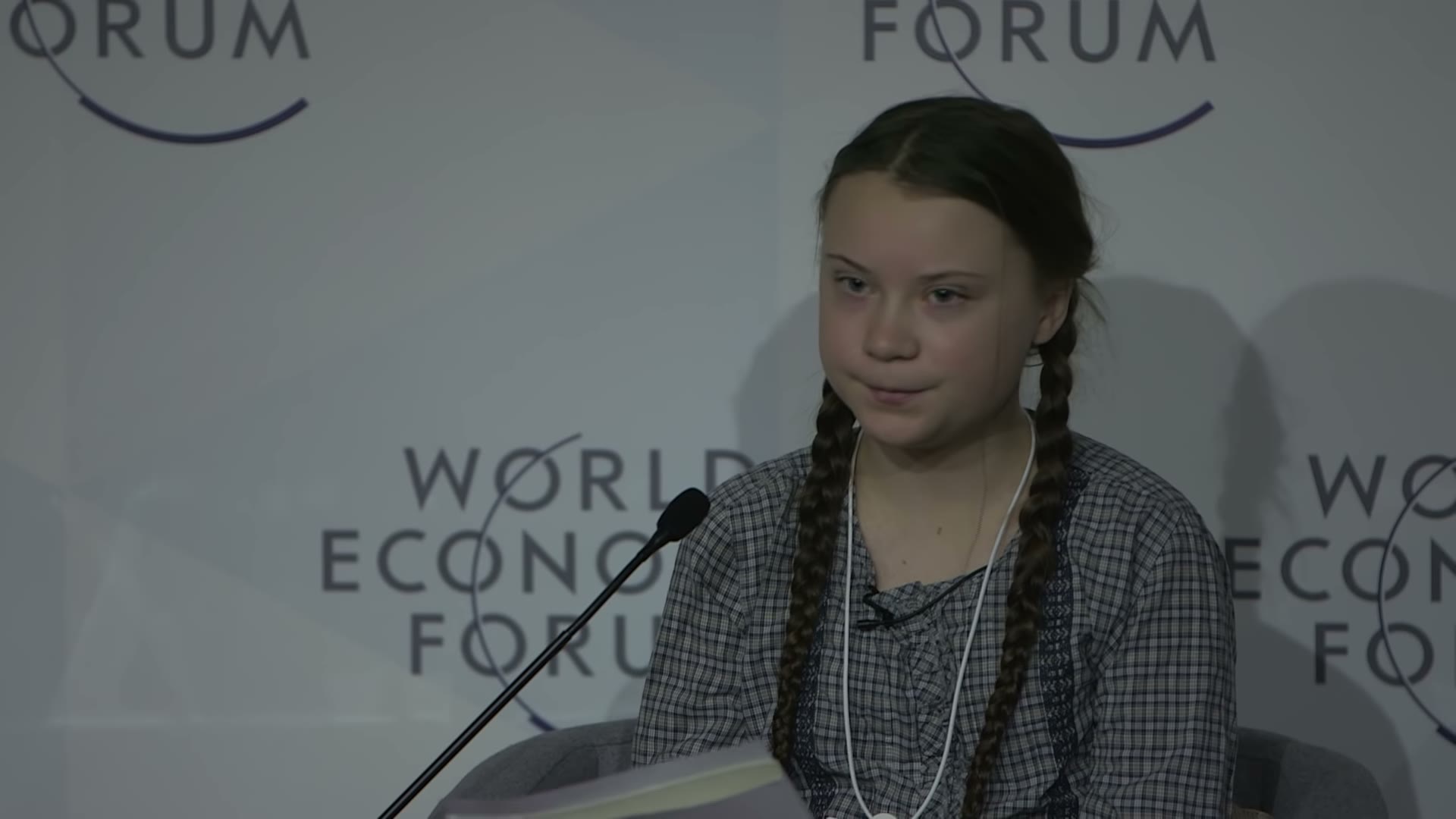
Thunberg addressed the World Economic Forum’s Annual Meeting in Davos, Switzerland, on 25 January 2019. Then 16, she told the assembled business and political leaders:
“Our house is on fire. I am here to say, our house is on fire. […] I want you to act as if our house is on fire. Because it is.”
Source: address to the WEF Annual Meeting, Davos, 2019-01-25.
She continued: “I want you to panic. I want you to feel the fear I feel every day. And then I want you to act.” The speech was published by the WEF and shared widely; “Our house is on fire” became her signature phrase — printed on placards at strikes worldwide.
She had traveled to Davos by train — a 32-hour journey, widely noted in coverage as consistent with her no-flying stance.
January 2020 — “Our house is still on fire”
She returned to Davos on 21 January 2020, a year later, with a progress report — or rather, a lack-of-progress report:
“Our house is still on fire. Your inaction is fueling the flames by the hour. And we are telling you to act as if you loved your children above all else.”
Source: address to the WEF Annual Meeting, Davos, 2020-01-21.
At the 2020 meeting she also joined a panel with fellow young activists and was photographed alongside them — the AP’s cropping of Vanessa Nakate out of one such photo drew an apology from the agency and became a story in its own right (see People).
A third Davos? Not as a speaker
Thunberg did not return as a WEF speaker in subsequent years. Her relationship with the forum’s elite audience remained adversarial by design: she attended Davos to address power, not to join it — a stance her supporters praise as integrity and her critics describe as performance. Both framings are documented on Criticism and Response.
Source notes
Quotations are from the WEF’s published transcripts and video of the two addresses. The train journey detail and the Nakate photo incident are as reported in contemporary coverage.