Camp life
Fires, food, repairs, and the evening journal hour — how the trail days end.
Camp scenes from the fictional expedition journals. Practical notes are general and non-dangerous; the stories are invented.
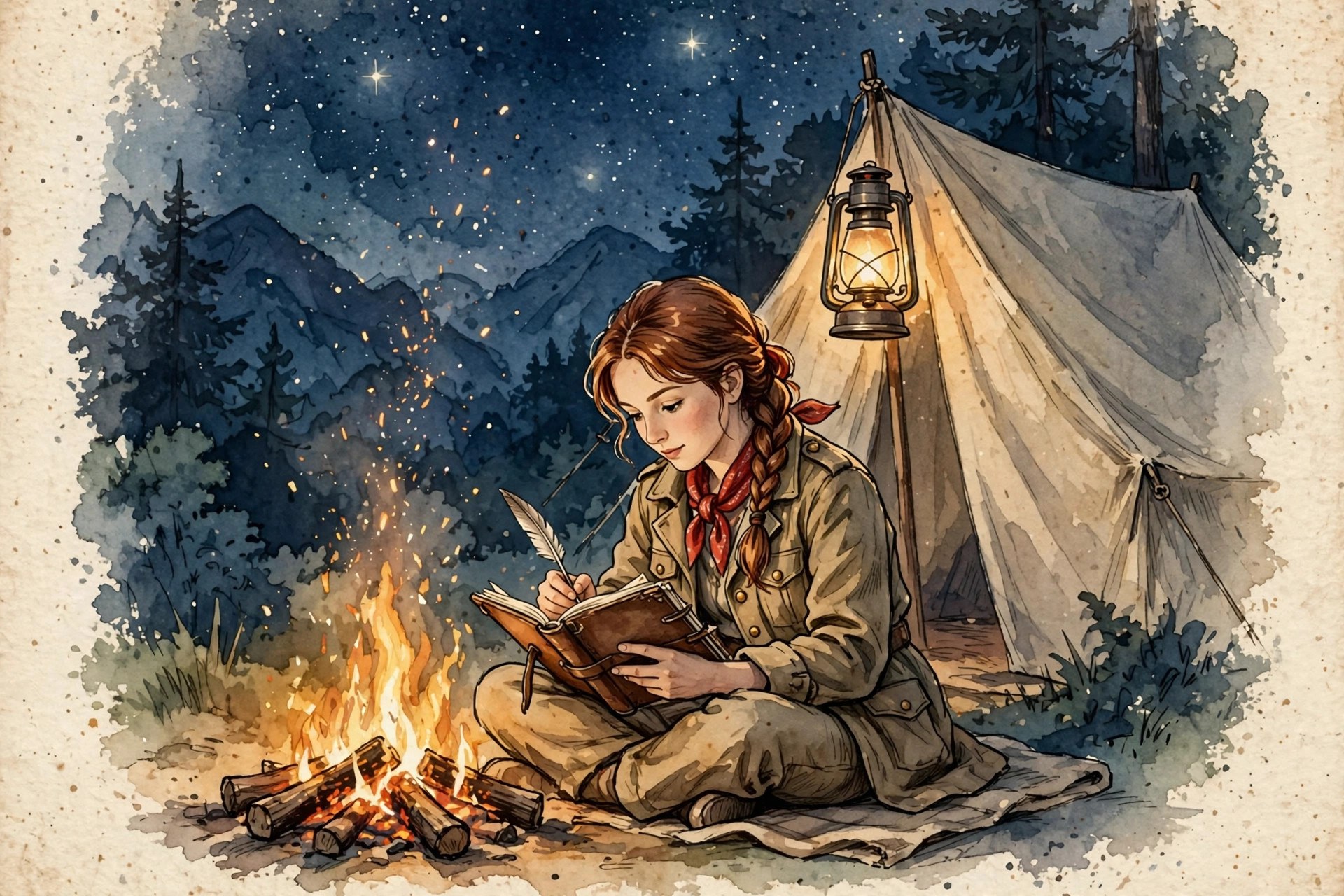
The evening journal hour
Every journal entry on this site was “written” at camp, by lamplight or firelight, in the hour after dinner. The rule is absolute: write it down tonight; the trail edits your memory by morning. Even the Day 3 Lantern Deep entry — written in total darkness, by touch, in handwriting the editor describes as “brave.”
Camp kitchen
The journals’ menu is short and repeated with variations: oats, dried fruit, flatbread, whatever the last village pressed into her hands, and tea — always tea. “Tea is not a beverage on the trail. It is a room you carry with you.” The tin cup has measured ingredients, bailed a canoe (once), and served as a bell (never again).
Repairs
Boots resoled twice. The journal’s broken clasp, still broken — “a clasp that worked would close the book, and some days the book should stay open.” The red bandana’s career as bandage, flag, sling, and sunshade. The brass compass’s scratched face, polished around the scratches, never the scratches themselves: “The scratches are the calibration.”
Fire talk
The best thinking in the journals happens aloud at fires: the echo-moss hypothesis, the order-over-distance map theory, the great debate (Sarella vs. the narrator) over whether geese can teach navigation. The journals record conclusions and, more usefully, the arguments that produced them.
The morning routine
Up with the light. Journal first — dreams fade, and once, a dream contained the correct route through a side passage. Pack by feel; everything has a place and the place is the same every morning. Check the sky longer than feels necessary. Then walk.
Source notes
Fictional camp scenes from the original expedition journals. General camp-craft mentions are beginner-level and non-dangerous; see survival know-how for the real-world safety framing.