Wonderland: A World Guide
Down the rabbit-hole lies a world with its own physics, its own etiquette, and its own court of law. Here it is, mapped — as far as any dream can be mapped.
How you get there
You fall. The rabbit-hole goes “straight on like a tunnel for some way, and then dipped suddenly down,” past cupboards, bookshelves, maps, and pictures hung on pegs — the furniture of an ordinary Victorian house, inexplicably lining a well. The fall is slow enough for Alice to wonder about latitude and longitude, to take down a jar labeled “ORANGE MARMALADE” and politely put it back. Wonderland announces its method at once: the familiar, relocated somewhere impossible.
The hall of doors
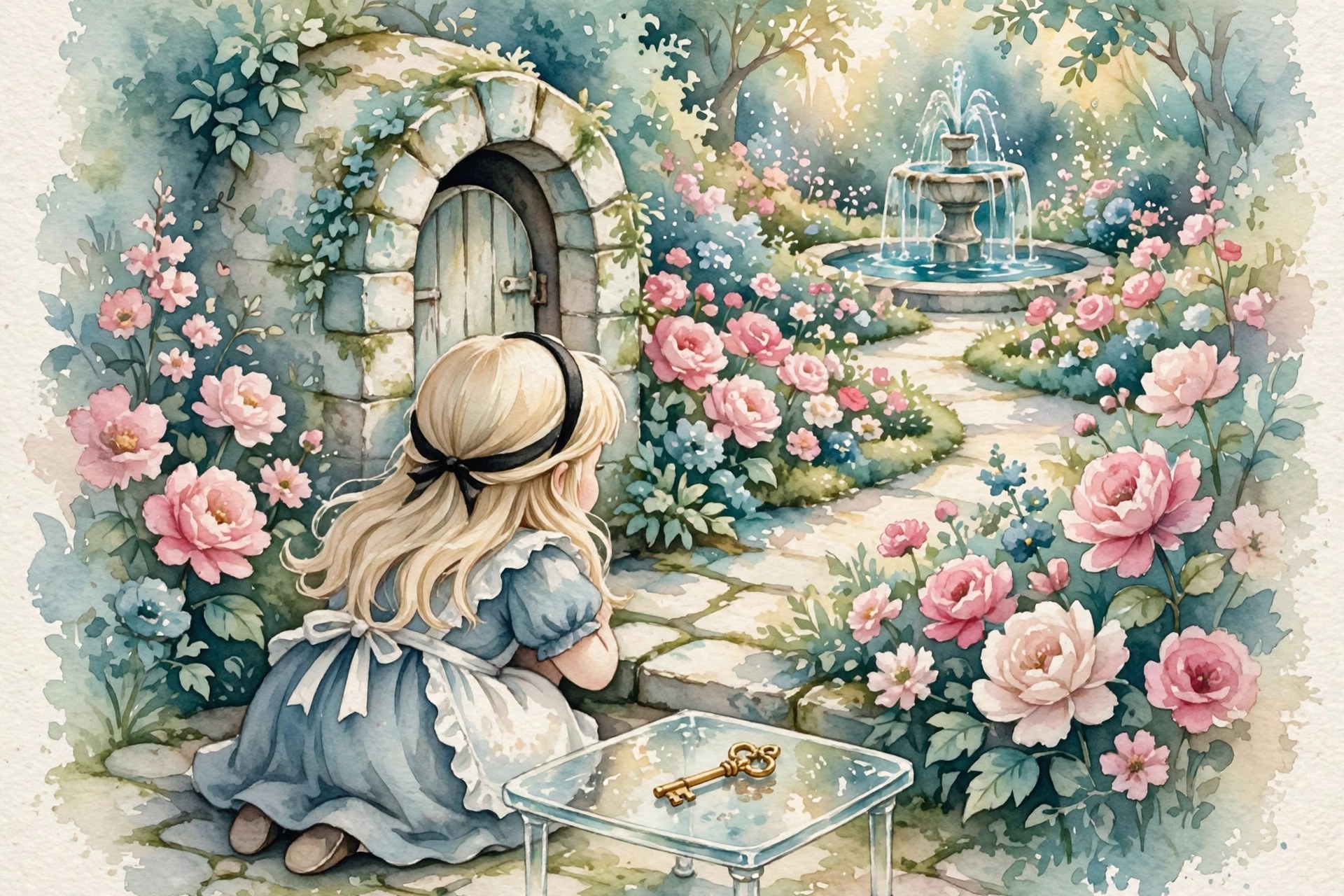
At the bottom of the fall is a long, low hall, lit by lamps, with doors all round — all locked. On a little three-legged glass table: a tiny golden key. Behind a curtain: a little door, fifteen inches high, opening onto “the loveliest garden you ever saw.” The whole of Wonderland is, in a sense, the attempt to get through that door — to reach the garden, to be the right size for the world you want. Every later episode replays this pattern: the right place glimpsed, the wrong size, the wrong key, the workaround.
The physics: size, eating, and consequence
Wonderland’s physics is edible. “DRINK ME” bottles and “EAT ME” cakes resize Alice at will; a mushroom has two sides with opposite effects; the Caterpillar’s mushroom lets her calibrate herself bite by bite. Size in Wonderland is never just size — it is power, vulnerability, and visibility. Nine inches high, Alice weeps into a pool of her own tears and nearly drowns in them; grown huge, she is put on trial as a threat. The dream keeps adjusting her until, at the trial, she is simply herself — and the cards scatter.
The inhabitants
Wonderland’s creatures fall into rough courts, each with its own logic:
- The anxious officials: the White Rabbit (always late, always in a waistcoat), the Dodo (who organizes the Caucus-race), the juror-animals of the trial.
- The philosophers: the Caterpillar (who asks “Who are YOU?”), the Cheshire Cat (who explains that everyone here is mad), the Duchess (who finds a moral in everything).
- The tea-party: the Hatter, the March Hare, and the Dormouse — stuck forever at six o’clock, because Time quarreled with the Hatter.
- The court: the Queen of Hearts (“Off with their heads!”), the King (who pardons everyone the Queen condemns), the Knave, and the card-soldiers who paint the roses red.
Each is profiled on the characters page.
The set pieces
The Pool of Tears (Chapter 2) — Alice, nine inches high, swimming in her own cried tears among a Dodo, a Lory, an Eaglet, and a Mouse giving a “dry” lecture on William the Conqueror.
The Caucus-race (Chapter 3) — a race with no course, no starting gun, and no finish line, run to get dry; everybody wins and all must have prizes. Carroll’s gentle satire of committee politics.
The Mad Tea-Party (Chapter 7) — riddles with no answers, watches that tell the day of the month, and a Dormouse telling a story about treacle wells. The most famous scene in children’s literature, and the least explicable.
The Queen’s Croquet-Ground (Chapter 8) — croquet with flamingo mallets, hedgehog balls, and doubled-up card-soldier hoops; the Queen shouts “Off with their heads!” at everything and the King quietly pardons everyone.
The Mock Turtle’s Story and the Lobster Quadrille (Chapters 9–10) — an education in punning: “we called him Tortoise because he taught us,” lessons in “Drawling, Stretching, and Fainting in Coils.”
The Trial (Chapters 11–12) — the Knave of Hearts accused of stealing tarts; evidence read backwards (“Begin at the beginning… then stop” — applied in reverse); Alice grows, denounces the court as “nothing but a pack of cards,” and wakes.
The rules of the dream
Wonderland has rules, but they are dream-rules: consistent within a scene, abandoned between scenes. Politeness is enforced and meaningless; trials follow procedure and no justice; time is personal (the Hatter’s six o’clock) and space is negotiable (the Cheshire Cat’s grin outlasts the cat). The one constant is Alice’s perspective — the world bends around her attention, which is why waking ends it.
Source notes
- Geography and episodes: Alice’s Adventures in Wonderland, Chapters 1–12; chapter summaries on the chapter guide.
- The “fifteen inches high” door and the golden key: Chapter 1.
- The Caucus-race as political satire is a common scholarly reading, attributed as interpretation, not Carroll’s stated intent.
Limitations
- Wonderland has no canonical map; the “tour” above follows Alice’s route, which is the only geography the book provides.
- Symbolic readings of Wonderland (the garden as Eden, the trial as Oxford politics) are interpretations — see symbolism for the honest limits.