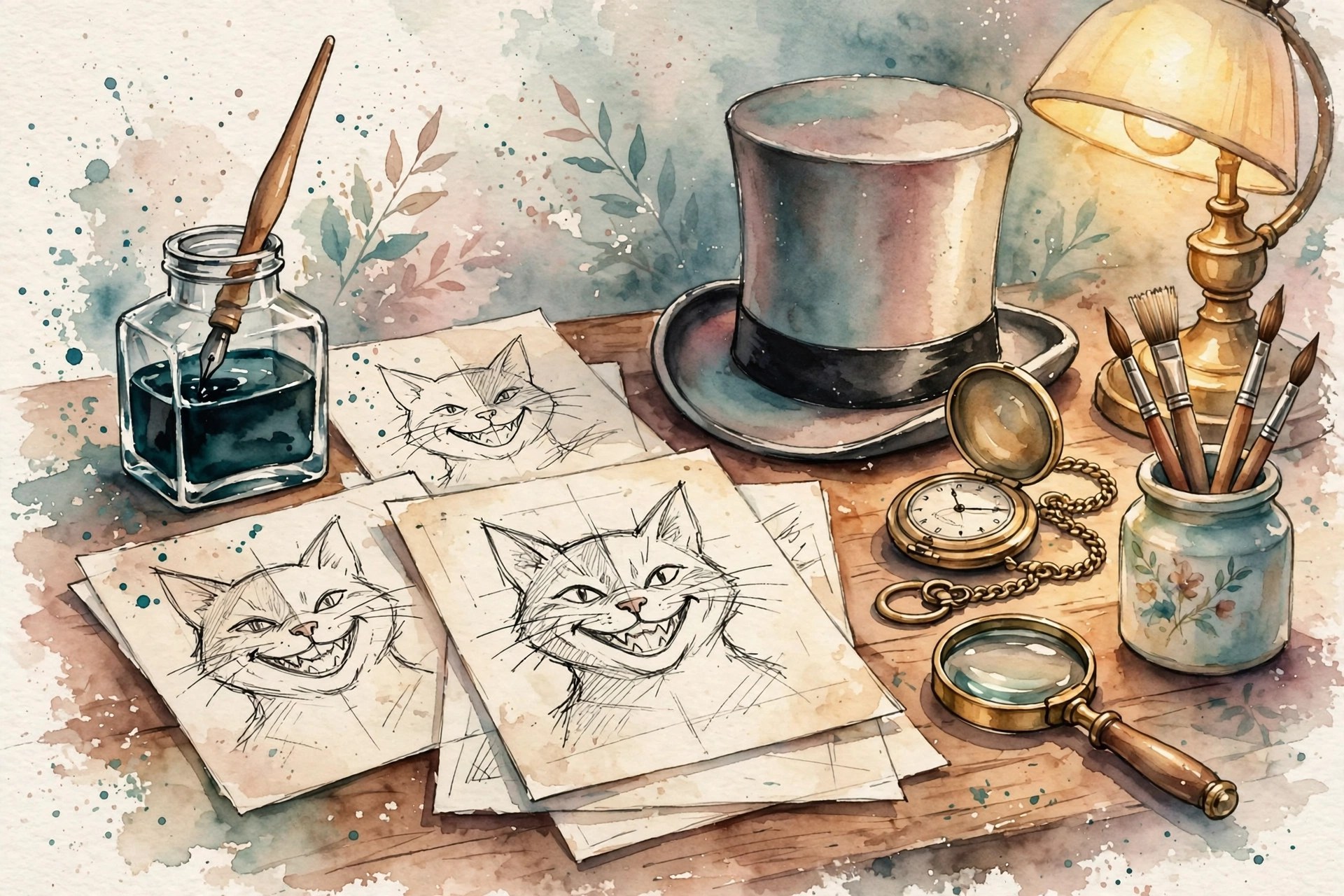
The Illustrators
Alice has a face because John Tenniel gave her one. The story of the 92 illustrations that became inseparable from the books — and the artists who dared to draw her differently.
John Tenniel (1820–1914)
The Punch cartoonist whom Dodgson pursued for the job, Tenniel drew 42 illustrations for Wonderland and 92 across both books, and his Alice — the long hair, the headband, the pinafore — is the visual original from which every later Alice descends. The collaboration was famously exacting: Dodgson argued over details (the White Knight’s face, the Cheshire Cat’s grin, the precise look of the “crown”), sent Tenniel photographs and models, and once had an entire print run of Wonderland withdrawn over print quality Tenniel found unacceptable.
Tenniel’s style — precise, slightly grotesque, utterly English — defined Wonderland’s look: the long-necked Alice, the grinning Cat fading to a smile, the apoplectic Queen, the dignified Mock Turtle. He was knighted for his Punch work, not for Alice; posterity reversed the emphasis.
Dodgson’s own drawings
Before Tenniel, there was Dodgson himself: the handwritten Alice’s Adventures Under Ground (1864) contains 37 of his own pen-and-ink illustrations — charming, amateur, and unmistakably the work of the story’s inventor. They show what the story looked like in its first telling: simpler, sketchier, closer to a private joke than a public book. The manuscript is in the British Library.
After Tenniel: the re-imaginers
Once copyright lapsed, artists queued to re-draw Wonderland. The notable ones:
- Arthur Rackham (1907) — the great fairy-tale illustrator brought his spindly, atmospheric line to Wonderland: darker, more woodland, more strange.
- Mabel Lucie Attwell (1910s) — the nursery Alice: round-faced, cozy, for very young readers.
- Salvador Dalí (1969) — twelve heliogravures for a limited edition: melting, surrealist Wonderland, the books meeting the movement they helped inspire.
- Ralph Steadman (1967) — splattered ink and fury: Wonderland as the 1960s saw it.
- Helen Oxenbury (1999) — the modern classic: warm, fluid watercolors, an Alice for the turn of the millennium.
- Yayoi Kusama (2012) — polka-dot Wonderland, in a luxury edition: the books as pop art.
None displaced Tenniel. His illustrations remain the default mental image of Wonderland worldwide — the rare case where the first illustrator became the permanent one.
This site’s illustrations
Every illustration on this site was generated in-house in a consistent watercolor storybook style — long blonde hair, black headband, blue Victorian dress, white pinafore — and each is labeled, wherever it appears, “AI-generated dramatization art — not a historical depiction.” They are dramatizations of the fiction, not illustrations of history; the real Alice Liddell is not depicted anywhere on this site (see the real Alice). Full provenance — file hashes, dimensions, generation dates — is recorded in the site’s provenance file.
Source notes
- Tenniel’s 92 illustrations and the Dodgson–Tenniel correspondence: documented in the publishing history of Macmillan’s editions.
- The withdrawn 1865 printing: see the books.
- The Under Ground manuscript’s 37 Dodgson illustrations: British Library.
Limitations
- The exact division of creative decisions between Dodgson and Tenniel survives only where their letters do; some famous details are attributed by tradition rather than document.
- The “re-imaginers” list is selective, not exhaustive — hundreds of artists have illustrated Alice.