Wonderland Chapter Guide
Twelve chapters, one long afternoon's dream. Every chapter of Alice's Adventures in Wonderland (1865), in order, with what happens and why it matters.
Chapter 1: Down the Rabbit-Hole
Bored on the riverbank, Alice follows a waistcoated White Rabbit (“Oh dear! Oh dear! I shall be late!”) down a rabbit-hole, falling slowly past cupboards and bookshelves. She lands in a hall of locked doors, finds a tiny golden key and a “DRINK ME” bottle, shrinks to ten inches — and realizes she has left the key on the table, out of reach. The dream’s engine starts: desire, obstacle, workaround.
Chapter 2: The Pool of Tears
An “EAT ME” cake makes Alice grow enormous instead (“Curiouser and curiouser!”). She cries a pool of tears, shrinks again while fanning herself with the Rabbit’s fan, and swims in her own tears alongside a Mouse, a Dodo, a Lory, and an Eaglet. The Mouse offers a “dry” history of William the Conqueror to dry them all.
Chapter 3: A Caucus-Race and a Long Tale
To get dry, the Dodo organizes a Caucus-race — run in a circle with no clear start or finish; everybody wins, and all must have prizes (Alice supplies her comfits). The Mouse tells a long, sad “tale” — printed in the book in the shape of a tail — about a dog and a cat. Alice, thoughtless, mentions her cat Dinah, and the birds flee.
Chapter 4: The Rabbit Sends in a Little Bill
The White Rabbit mistakes Alice for his servant Mary Ann and sends her to fetch his gloves and fan. In his house she drinks from a bottle, grows huge, and gets an arm stuck out the window. The Rabbit’s gardeners — Bill the Lizard and friends — try to smoke her out; she eats a cake, shrinks, and escapes. A puppy, enormous to tiny Alice, nearly squashes her with friendly paws.
Chapter 5: Advice from a Caterpillar
On a mushroom sits a hookah-smoking Caterpillar, who opens with the book’s great question: “Who are YOU?” Alice, rattled by her size changes, recites “You are old, Father William” and gets it wrong in every verse. The Caterpillar explains the mushroom’s two sides — one makes you grow, one makes you shrink — and crawls away. Alice nibbles carefully back to her normal height… then her neck stretches like a serpent’s, terrifying a pigeon.
Chapter 6: Pig and Pepper
Alice finds the Duchess in her kitchen, nursing a baby and sneezing over pepper, while the Cook throws dishes and the Cheshire Cat grins from the hearth. The Duchess moralizes (“Take care of the sense, and the sounds will take care of themselves”); Alice takes the baby, which turns into a pig. The Cheshire Cat directs her: the Hatter lives one way, the March Hare the other — “we’re all mad here. I’m mad. You’re mad.”
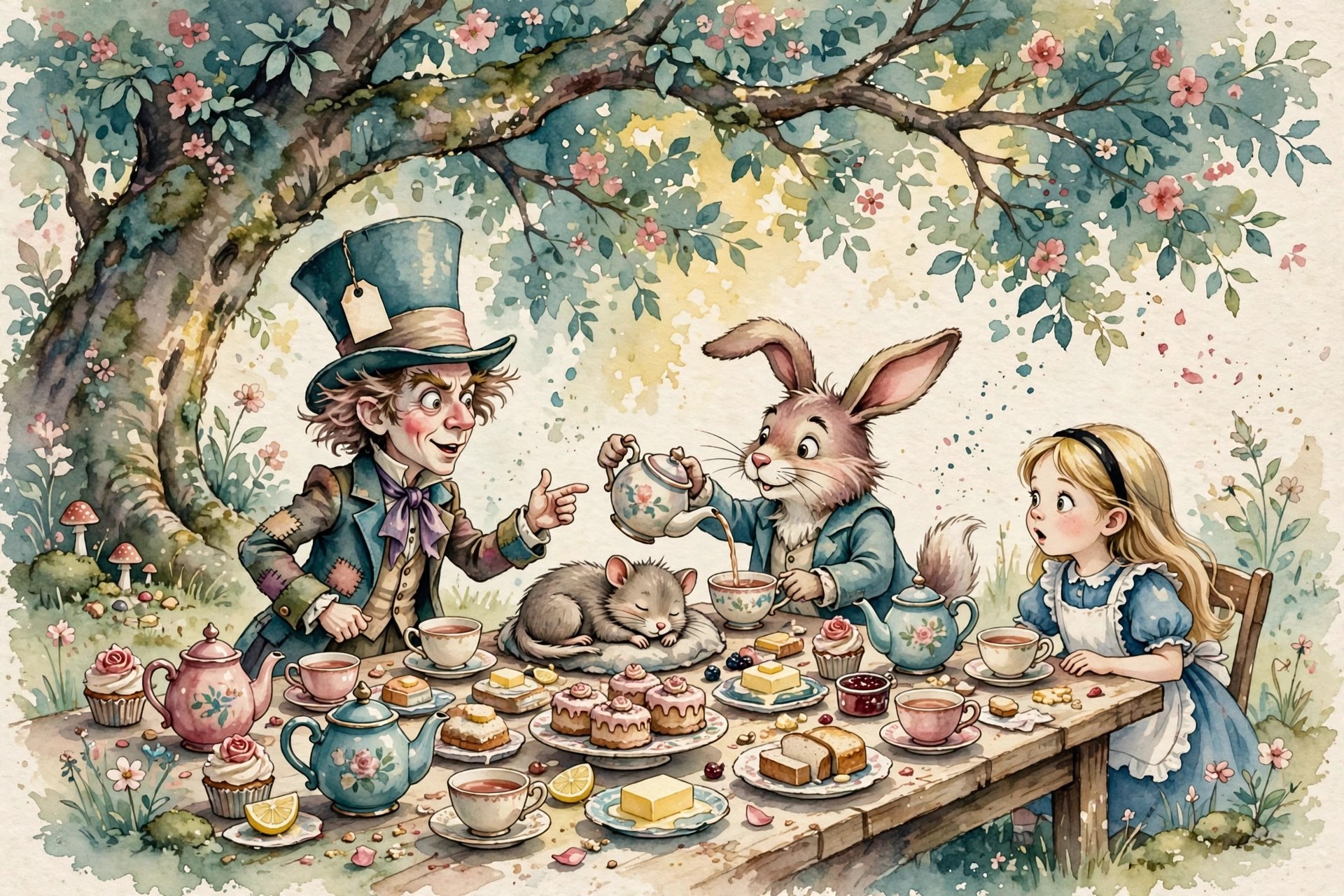
Chapter 7: A Mad Tea-Party
The famous chapter. The Hatter, the March Hare, and the sleeping Dormouse are stuck forever at six o’clock tea (“It’s always six o’clock now”) because Time quarreled with the Hatter after he sang at the Queen’s concert. Riddles with no answers (“Why is a raven like a writing-desk?” — “I haven’t the slightest idea”), watches that tell the day of the month, and the Dormouse’s story of Elsie, Lacie, and Tillie living on treacle at the bottom of a well. Alice leaves in disgust — “the stupidest tea-party I ever was at in all my life!”
Chapter 8: The Queen’s Croquet-Ground
Alice meets the royal procession: card-soldiers, courtiers, and the King and Queen of Hearts. Croquet is played with flamingo mallets, hedgehog balls, and doubled-up soldiers for hoops; the Queen shouts “Off with their heads!” at every turn while the King quietly pardons everyone. Alice befriends the White Rabbit and the Cheshire Cat — whose head, detached from its body, alarms the executioner.
Chapter 9: The Mock Turtle’s Story
The Duchess, suddenly affectionate, moralizes at Alice (“Everything’s got a moral, if only you can find it”). The Gryphon takes Alice to the Mock Turtle, who weeps over his schooldays under the Turtle-soup master: lessons in “Reeling and Writhing,” “Drawling, Stretching, and Fainting in Coils.” (“We called him Tortoise because he taught us.”) The chapter is a long, tender parody of Victorian schooling.
Chapter 10: The Lobster Quadrille
The Mock Turtle and the Gryphon perform the Lobster Quadrille — a dance for sea creatures with lobsters as partners (“Will you walk a little faster?”). Songs, puns, and the melancholy of creatures who were once real turtles. The trial is announced: the Knave of Hearts is accused of stealing the Queen’s tarts.
Chapter 11: Who Stole the Tarts?
The courtroom: the King as judge (in a wig), the White Rabbit as herald, jurors writing on slates, and the Knave in chains. The evidence is the poem “They told me you had been to her” — read as proof though it plainly proves nothing. Alice, growing larger, is called as a witness; she knocks over the jury box with her skirts.
Chapter 12: Alice’s Evidence
The King expounds “Rule Forty-two” (“All persons more than a mile high to leave the court”) and reads the nonsense verses as the decisive evidence (“Begin at the beginning and go on till you come to the end: then stop” — applied backwards). Alice, now full-sized, denounces the court: “You’re nothing but a pack of cards!” The cards fly up at her — and she wakes on the riverbank, her head in her sister’s lap, the whole afternoon a dream. Her sister half-dreams it after her.
Source notes
- Chapter titles and summaries follow Alice’s Adventures in Wonderland (1865); quotations verified against the Project Gutenberg text (ebook #11).
- The “Father William” and “Lobster Quadrille” verses are Carroll’s parodies of well-known Victorian poems (Robert Southey’s “The Old Man’s Comforts” and Mary Botham Howitt’s “The Spider and the Fly”).
Limitations
- Summaries compress scenes; the book’s full wordplay and verse are in the text itself.
- Interpretive notes (e.g., the Caucus-race as political satire) are scholarly readings, not Carroll’s stated intent.