Start Here
Two books, one curious girl, two impossible worlds. Here is the whole story in five minutes — then follow the doors wherever you like.
The two books
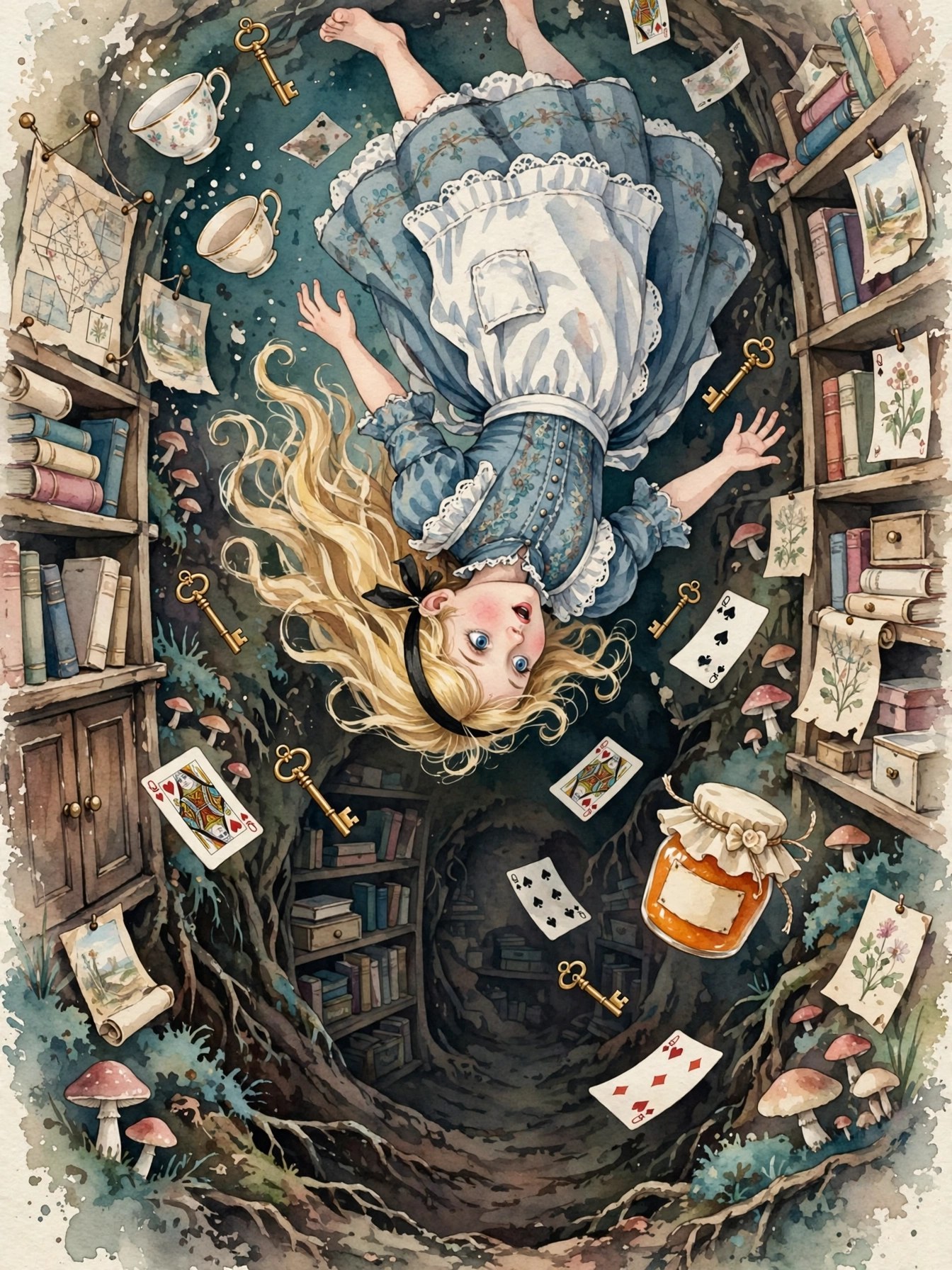
In 1865 a quiet Oxford mathematics lecturer, writing as Lewis Carroll, published Alice’s Adventures in Wonderland: the story of seven-year-old Alice, who follows a waistcoated White Rabbit down a rabbit-hole and spends an afternoon among mad tea-parties, a grinning cat, and a Queen who shouts “Off with their heads!” Six years later came the sequel, Through the Looking-Glass, and What Alice Found There (1871), in which Alice steps through a mirror into a world run like a game of chess.
Both books began as stories told to a real child — Alice Liddell — on a river boat trip in 1862. The full history is on the books and the real Alice pages.
The two worlds
- Wonderland — reached by falling down the rabbit-hole. A place of locked doors, growing and shrinking, tea-parties, croquet with flamingos, and a trial over stolen tarts. It runs on dream-logic and appetite.
- The Looking-Glass world — reached by stepping through a mirror. A chessboard countryside where Alice advances as a White Pawn, meeting Tweedledee and Tweedledum, Humpty Dumpty, and two Queens. It runs on rules — mirror rules, chess rules, word rules.
The best path through this site
- Who Is Alice? — the character herself: age, temperament, and why she endures.
- Wonderland and the Looking-Glass world — the two worlds, mapped.
- Wonderland Chapters and Looking-Glass Chapters — all 24 chapters, summarized.
- Sayings — thirty famous lines, quoted verbatim with book and chapter.
- Characters — the Cat, the Hatter, the Queens, the rest.
- Then the deep dives: nonsense & language, symbolism, the illustrators, adaptations.
Three things to know first
The books are dream-stories, and Carroll says so. Wonderland ends with Alice waking on the riverbank; Looking-Glass ends by asking the reader who dreamed it. Nothing in either book is meant to be “explained” into ordinary sense — though readers have been trying for 160 years. See symbolism for the honest limits of interpretation.
The famous lines are really in the books. “Curiouser and curiouser!”, “We’re all mad here”, “Off with their heads!” — all verified word-for-word on the sayings page, each with its book and chapter. A few beloved “Carroll quotes” circulating online are not his; the sayings page flags the most common misattribution.
The pictures matter. John Tenniel’s 92 illustrations shaped how the world sees Alice as much as Carroll’s words did. This site’s own art is new storybook illustration, always labeled as such — the illustrators page is about Tenniel and his successors.