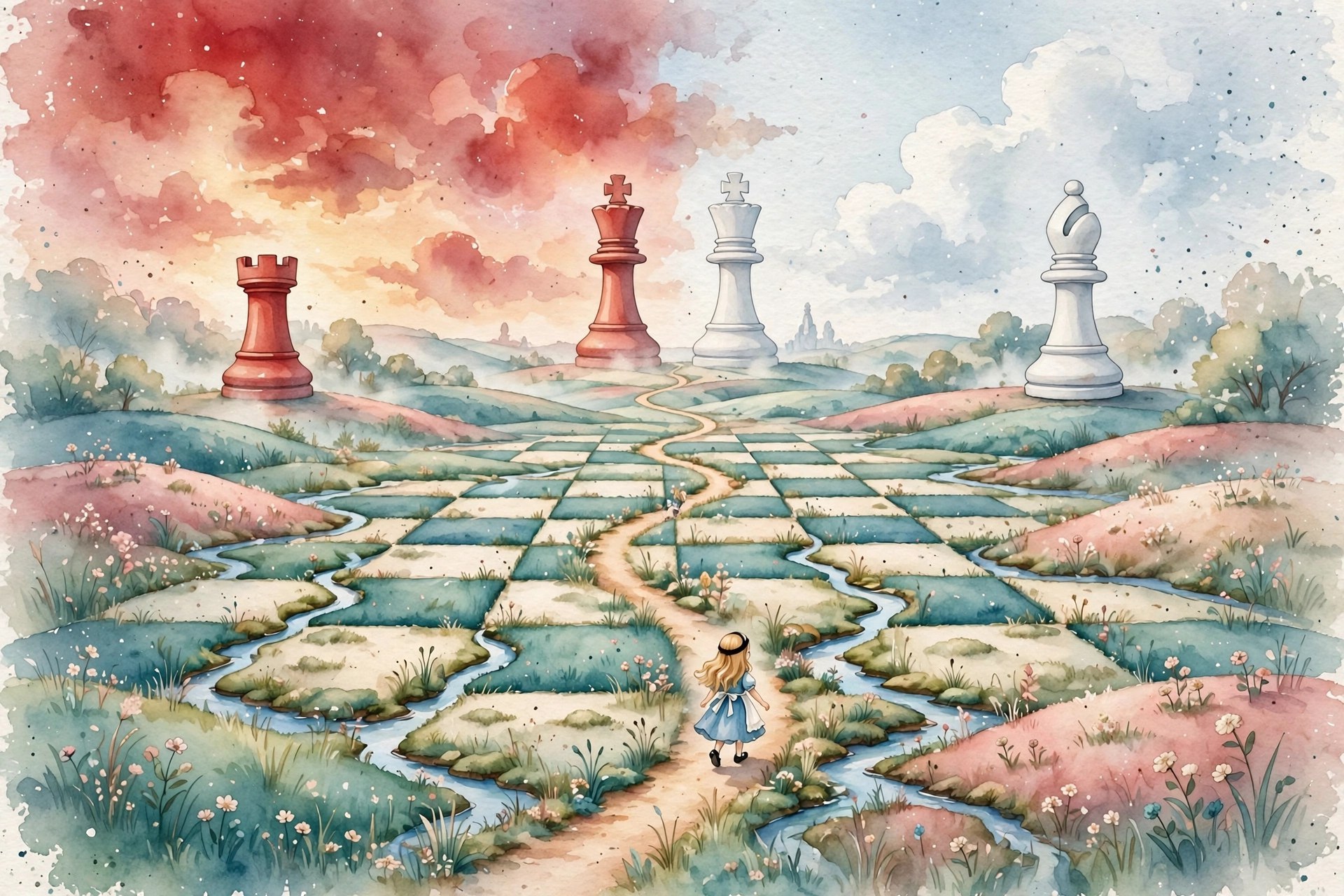
Looking-Glass Chapters
Twelve chapters, one game of chess. Every chapter of Through the Looking-Glass (1871), in order — Alice's eleven moves from pawn to queen.
Chapter 1: Looking-Glass House
On a snowy winter evening Alice plays chess with her kittens and wonders about the room behind the mirror — where “the things go the other way.” She climbs onto the chimney-piece, the glass melts “like a bright silvery mist,” and she steps through. In the mirror-room she finds “Jabberwocky” printed backwards, reads it in the glass (“‘Twas brillig, and the slithy toves…”), and goes out into the garden — where the flowers talk.
Chapter 2: The Garden of Live Flowers
The tiger-lilies, roses, and daisies judge Alice the way flowers would — the Tiger-lily calls her the commonest-looking thing she ever saw. The Red Queen appears, enormous; Alice must curtsey low. To reach the hill, Alice learns the first mirror-rule: walk away from where you want to go. Then the great running — “it takes all the running you can do, to keep in the same place!” — and Alice is a Pawn advanced: the third square.
Chapter 3: Looking-Glass Insects
Alice crosses to the fourth square by railway — in a train full of impossible passengers (a man dressed in white paper, a Goat, a Beetle, the Guard who checks tickets in the wrong order). Jumping the brook, she lands among the Looking-glass insects: the Rocking-horse-fly, the Snap-dragon-fly, the Bread-and-butter-fly, each a pun made flesh. She meets two fat little men under a tree.
Chapter 4: Tweedledum and Tweedledee
The fat little brothers agree to everything in chorus and contradict in logic: “Contrariwise… if it was so, it might be; and if it were so, it would be; but as it isn’t, it ain’t. That’s logic.” They quarrel over a rattle, agree to battle, and recite “The Walrus and the Carpenter” — the long poem about oysters eaten after much talk (“The time has come, the Walrus said, / To talk of many things”). A monstrous crow scatters them mid-battle.
Chapter 5: Wool and Water
Alice finds the White Queen — kind, muddled, living backwards (“It’s a poor sort of memory that only works backwards”), who believes “six impossible things before breakfast.” The Queen’s shawl keeps blowing off; Alice pins it, and the Queen turns into a Sheep in a shop — a shop full of curious things that keeps dissolving into a river, a shop, a river. Alice buys an egg (which costs more the less she takes) and rows a boat that will not move.
Chapter 6: Humpty Dumpty
On a narrow wall sits Humpty Dumpty — egg, philosopher, and the great explainer of “Jabberwocky”: “brillig” is four o’clock in the afternoon, “slithy” is “lithe and slimy” (a portmanteau — “two meanings packed up into one word”). His theory of language: “When I use a word, it means just what I choose it to mean — neither more nor less.” / “The question is, which is to be master — that’s all.” He gives Alice an un-birthday present (a cravat) and recites his own dreadful poem. Then — the crash.
Chapter 7: The Lion and the Unicorn
The King’s men rush to Humpty Dumpty; Alice meets the White King, who cannot see “Nobody” on the road (“To be able to see Nobody! And at that distance, too!”). The Lion and the Unicorn fight for the crown, pause for Alice’s plum-cake (cut “through and through” — first the distribution, then the cutting), and march back to town with the drums.
Chapter 8: “It’s My Own Invention”
The Red Knight tries to take Alice; the White Knight — gentle, clumsy, inventor of a pudding made of blotting-paper and a box for keeping clothes upside-down — rescues her, rides her to the eighth square, and sings his song: “A-sitting on a gate.” Alice, moved, helps him and says goodbye. The eighth square is crossed; Alice is crowned.
Chapter 9: Queen Alice
Alice, now a Queen with a golden crown, hosts her coronation dinner — where the leg of mutton is introduced before it is served, the pudding is removed before it is cut, and the Red and White Queens fall asleep in her lap, growing heavy. “I didn’t know I was to have a party at all,” Alice thinks. The candles flare, the guests dissolve — and Alice seizes the Red Queen and shakes her.
Chapter 10: Shaking
One short chapter: Alice shakes the Red Queen — who grows smaller and smaller in her hands, changing as she shakes.
Chapter 11: Waking
Alice wakes in her arm-chair, holding the black kitten — which was the Red Queen all along. The dream collapses into the fireside: the chessmen on the table, the kittens, the snow outside.
Chapter 12: Which Dreamed It?
The book’s famous close. Alice asks the kitten — and the reader — the unanswerable question: the Red King was sleeping through the whole adventure, dreaming; “which dreamed it?” Did Alice dream the King, or did the King dream Alice? “You are his dream,” the White King might say — or hers. Carroll refuses to answer, and the book ends on the question.
Source notes
- Chapter titles and summaries follow Through the Looking-Glass (1871); quotations verified against the Project Gutenberg text (ebook #12).
- The chess framing (“White Pawn (Alice) to play, and win in eleven moves”) is in the book’s front matter; the moves are playable in spirit rather than strictly legal — see the Looking-Glass world.
Limitations
- Summaries compress scenes; the book’s full wordplay, verse, and logic games are in the text itself.
- Whether the chess game is fully legal is disputed among scholars; this guide does not claim it is.