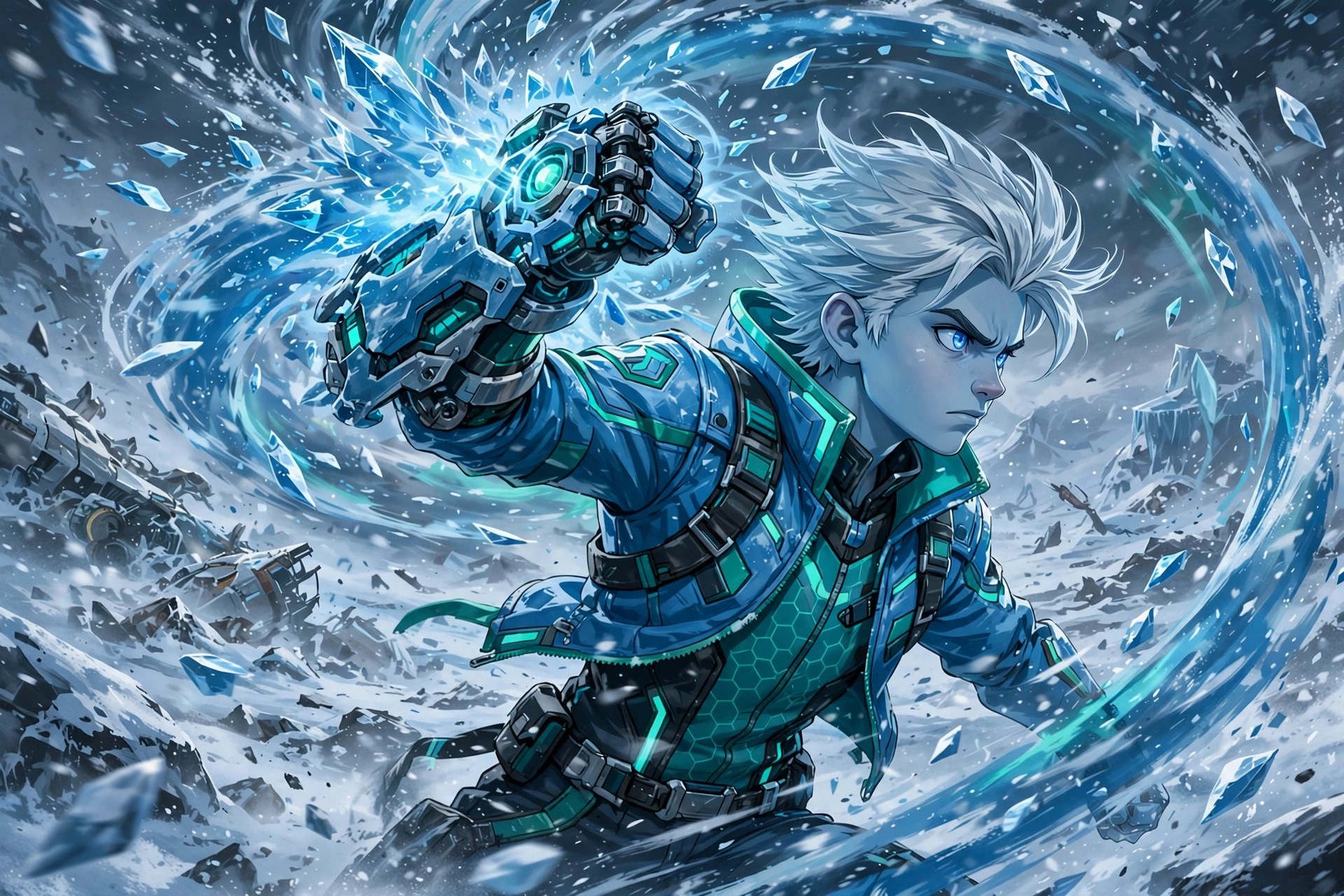
Abilities Explained
He doesn't create cold — he moves heat. The fictional physics of the frostcell gift, explained.
Honesty note: This is fictional “science” for a fictional superpower — invented lore, not real physics or biology.
The core principle: heat moves, cold is the absence
Niko’s first lesson to anyone who asks: “I don’t make cold. Cold is just the absence of heat, and heat is happy to move if you give it somewhere to go.” The frostcell gift is, in the fiction’s terms, a thermal pump — Niko’s body pulls heat out of matter and vents it elsewhere as aurora-light. Ice is the side effect: matter with its heat removed.
This is why his constructs sublimate instead of melting — they’re heat-starved, not just frozen — and why his suit’s aurora trim glows brighter the harder he works. The glow is the moved heat, leaving.
The frostcell lattice
During the Long Frost, Niko’s cells grew frostcell lattice — microscopic crystalline structures threaded through muscle, nerve, and (critically) the irises of his eyes. In the fiction, the lattice acts as a thermal superconductor: it gives heat a fast, controllable path out of his body and out of whatever he’s touching or targeting.
Three consequences follow:
- Range is line-of-sight because the lattice needs a thermal “sightline” — actually a gradient path — to move heat across distance. About forty meters, less through insulation.
- His eyes see heat because lattice in the iris responds to infrared the way a retina responds to light. Thermal sight is passive and always on.
- Thawshock is a plumbing failure. If he pulls heat faster than he can vent it, the heat backs up into his own tissues — frostcell burn-out, the nine-day coma after the Spire.
Why emotion matters
The lattice is nerve-integrated, which means the autonomic nervous system talks to it. Adrenaline — fear, rage — opens the thermal pathways wide: more power, less control. That’s the in-fiction mechanism behind the iron rule: fear makes it wild, anger makes it cruel. The cryo-forms train the nervous system to stay level under stress, keeping the pathways throttled to precision instead of flood.
Niko’s calm isn’t mystical. It’s plumbing maintenance.
The disciplines, mechanized
- Flash-freeze — maximum thermal draw along a sightline, vented in one burst. Fast, brutal on his core temp, and the reason for the mandatory aftercare tea.
- Ice-shaping — slow, precise draw that lets ambient moisture crystallize along lattice-guided patterns. The constructs’ strength comes from lattice seeding — they’re part crystal, part frostcell-grown structure.
- Blizzard veil — minimal draw spread wide: just enough cooling to condense and spin moisture into a whiteout. Cheap, sustainable, and his favorite trick.
- Cryo-mend — the gentlest draw of all, calibrated degree by degree. Ora calls it “surgery with weather.”
- Deep Freeze — full-structure draw at a scale the lattice was never meant to handle. It worked at the Spire because Niko vented through everything — suit, gauntlets, the station’s own hull. The feedback still nearly killed him. The fiction is explicit: this was a once-in-a-lifetime feat, not a power level.
Limits are the point
The gift’s limits — forty meters, line of sight, venting capacity, the emotion link, the resistance of living tissue — aren’t weaknesses bolted on for drama. They’re the design. A Niko without limits would be a weather god, and weather gods don’t have to make choices. Niko’s stories are all choices: how much heat to move, how fast, and whether the price is worth it.
That’s why the Thaw Doctrine exists, why the failsafe exists, and why the quietest hero on the team is also the one everyone watches most carefully. Not because he’s dangerous — because he knows exactly how dangerous he could be, and trains every morning to stay on the right side of it.
Source notes
Fictional power mechanics invented for this fan reference — not real science. For the overview, see abilities. Artwork is AI-generated dramatization art. See methodology.