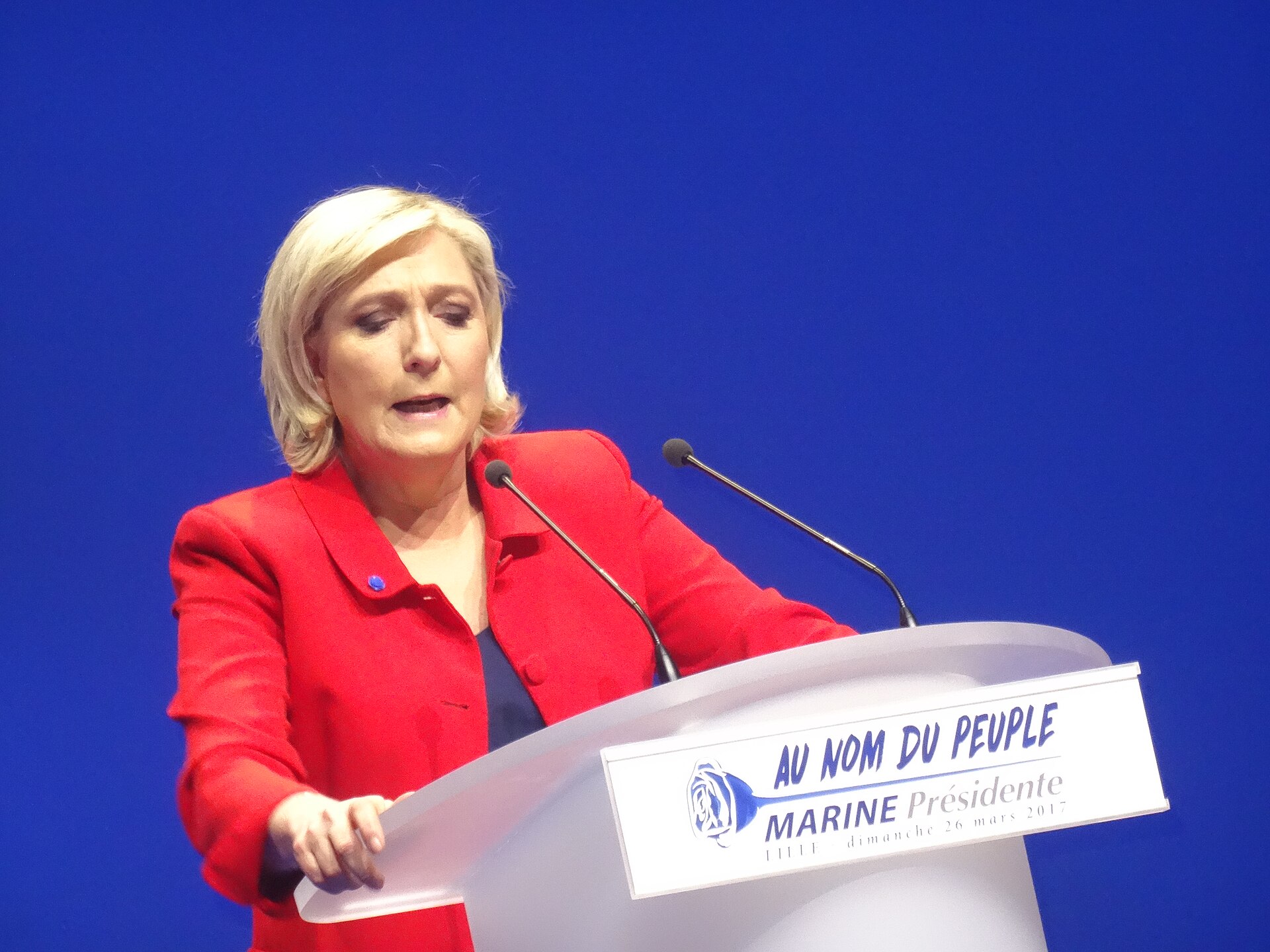
The 2017 Campaign
The campaign that took her to the presidential runoff — 21.3% in round one, a bruising debate, and 33.9% against Emmanuel Macron on 7 May 2017.
The context
The 2017 race unfolded amid the collapse of France’s traditional parties: the Socialist candidate Benoît Hamon polled in single digits and Les Républicains’ François Fillon was destroyed by a scandal over fictitious parliamentary jobs. Polls showed Le Pen qualifying for the runoff from the start; the only question was whom she would face.
The campaign
She ran on a 144-point program: leaving the euro and holding a referendum on EU membership (“Frexit” was the headline proposal, later dropped), restoring national borders, cutting legal immigration to 10,000 per year (a figure widely questioned by demographers), lowering the retirement age, and a “patriotic” economic policy. In February 2017 she met Vladimir Putin in Moscow — a visit her campaign presented as statesmanship and her critics presented as alignment with the Kremlin. (See People.)
On 24 April 2017, the day after the first round, she announced she was temporarily stepping down as FN president to be “above partisan considerations” as a presidential candidate — a move widely read as dédiabolisation theater.
The first round
On 23 April 2017 she won 21.3%, second behind Emmanuel Macron (24.0%) — qualifying for the runoff, the second time in the party’s history after 2002.
The debate and the runoff
The 3 May 2017 televised debate against Macron is widely judged — by commentators across the spectrum and in later polling — to have damaged her candidacy: she appeared aggressive and under-prepared on economic detail, notably on the euro exit. On 7 May 2017 she conceded with 33.9% to Macron’s 66.1% — doubling her father’s 2002 runoff score (17.8%) but well short of victory.
Why it mattered
The 2017 campaign proved the FN could reach the runoff but not win it: the “republican front” — voters of the eliminated left and right rallying against the far right — held. It also taught her campaign a lesson it applied in 2022: de-emphasize the euro exit and lead with purchasing power. She resumed the FN presidency after the defeat.
Source notes
- Election figures: official Interior Ministry results via standard references.
- Program and debate: contemporaneous French and international press; RFE/RL reporting on the campaign.
- The Putin meeting (24 March 2017): Kremlin and international press reporting.