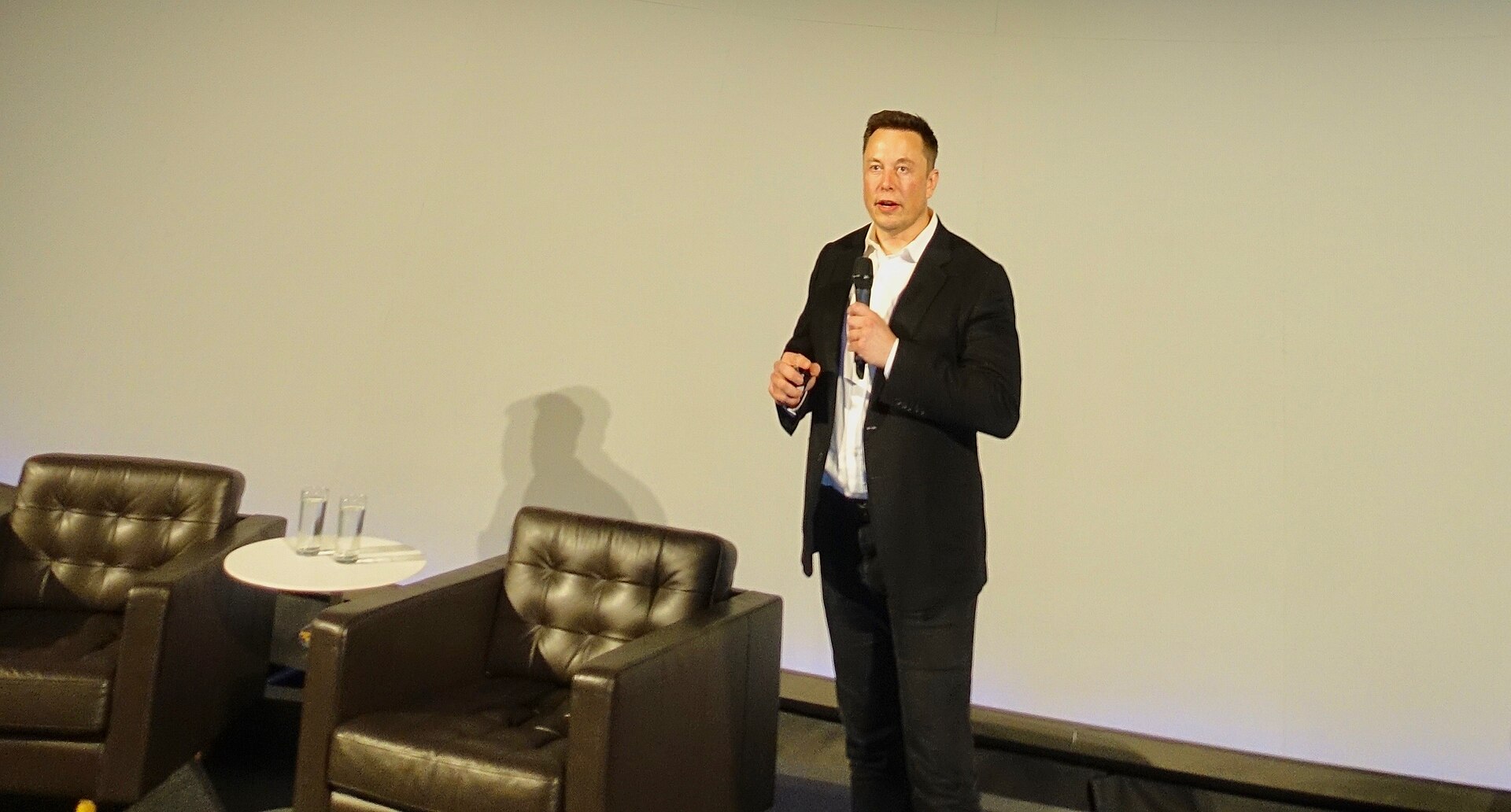
Musk presenting the Neuralink master plan in 2019, photograph by Steve Jurvetson (CC BY 2.0, via Wikimedia Commons).
DESIGN PRINCIPLES
Key Ideas
The operating system behind the companies — the ideas he returns to, in his own terms.
First principles
Reasoning from physics, not analogy
Musk's most-cited intellectual method: strip a problem to physical fundamentals and rebuild. His standard example, from interviews: batteries were "expensive" by analogy to history, so he asked what the raw materials cost on the commodity markets — and concluded the price could fall dramatically. The same logic applied to rockets: the raw materials of a rocket cost a few percent of its price, so the price could fall if manufacturing were reinvented.
SOURCE: interviews, incl. a widely cited 2013 TED conversation with Chris Anderson and the 2015 Wait But Why series
The Master Plan
Build sports car → affordable car → even more affordable car
From the August 2, 2006 Tesla blog post, "The Secret Tesla Motors Master Plan," in full below on [Sayings](/sayings): use high-margin early products to fund progressively cheaper ones, while funding zero-emission power generation. The 2016 "Master Plan, Part Deux" added solar, autonomy, and shared fleets.
SOURCE: Tesla blog, Aug 2, 2006; Jul 20, 2016
Making life multiplanetary
Humanity as a two-planet species
The founding premise of SpaceX: that civilization's long-term survival requires becoming multiplanetary, with a self-sustaining city on Mars as the first step. Presented publicly at the 2016 International Astronautical Congress ("Making Humans a Multiplanetary Species") and updated in 2017 ("Making Life Multiplanetary").
SOURCE: SpaceX presentations, Sep 2016 / Sep 2017
Vertical integration
Own the stack
SpaceX builds most of its rockets in-house (engines, avionics, fairings); Tesla built its own batteries, chips, and charging network; Starlink builds its own satellites and user terminals. The theory: suppliers' margins and timelines are the enemy of speed.
SOURCE: SpaceX and Tesla investor communications; widely reported by the financial press
Hardware iteration speed
"If things are not failing, you are not innovating enough"
The SpaceX method: build, fly, explode, learn — Starship's early test flights were publicly destructive by design. Musk contrasts this with slow, paper-perfect engineering programs. Critics note the method is expensive and dangerous when applied to, e.g., tunnels or social platforms.
SOURCE: widely attributed to Musk / SpaceX culture; see [Sayings](/sayings) for attribution status
From interviews about Starship manufacturing (notably a 2021 interview with Everyday Astronaut): (1) make requirements less dumb, (2) delete parts or processes, (3) simplify/optimize, (4) accelerate cycle time, (5) automate — in that order, because automating a bad process just makes badness faster.
SOURCE: reported from interviews, 2021; paraphrase — see [Sayings](/sayings)
Free speech as infrastructure
The "digital town square"
His stated rationale for buying Twitter (October 27, 2022 statement to advertisers): civilization needs "a common digital town square, where a wide range of beliefs can be debated in a healthy manner, without resorting to violence." Supporters call this a principled stand; critics argue the platform's moderation choices contradict it. Both views are documented on [The X Acquisition](/x-acquisition).
SOURCE: Musk's open letter to advertisers, Oct 27, 2022
Source notes
Ideas are summarized from primary sources (Tesla blog, SpaceX presentations, the 2013 TED talk, published interviews) and flagged where they are paraphrase rather than quotation. Verbatim quotes live on Sayings.