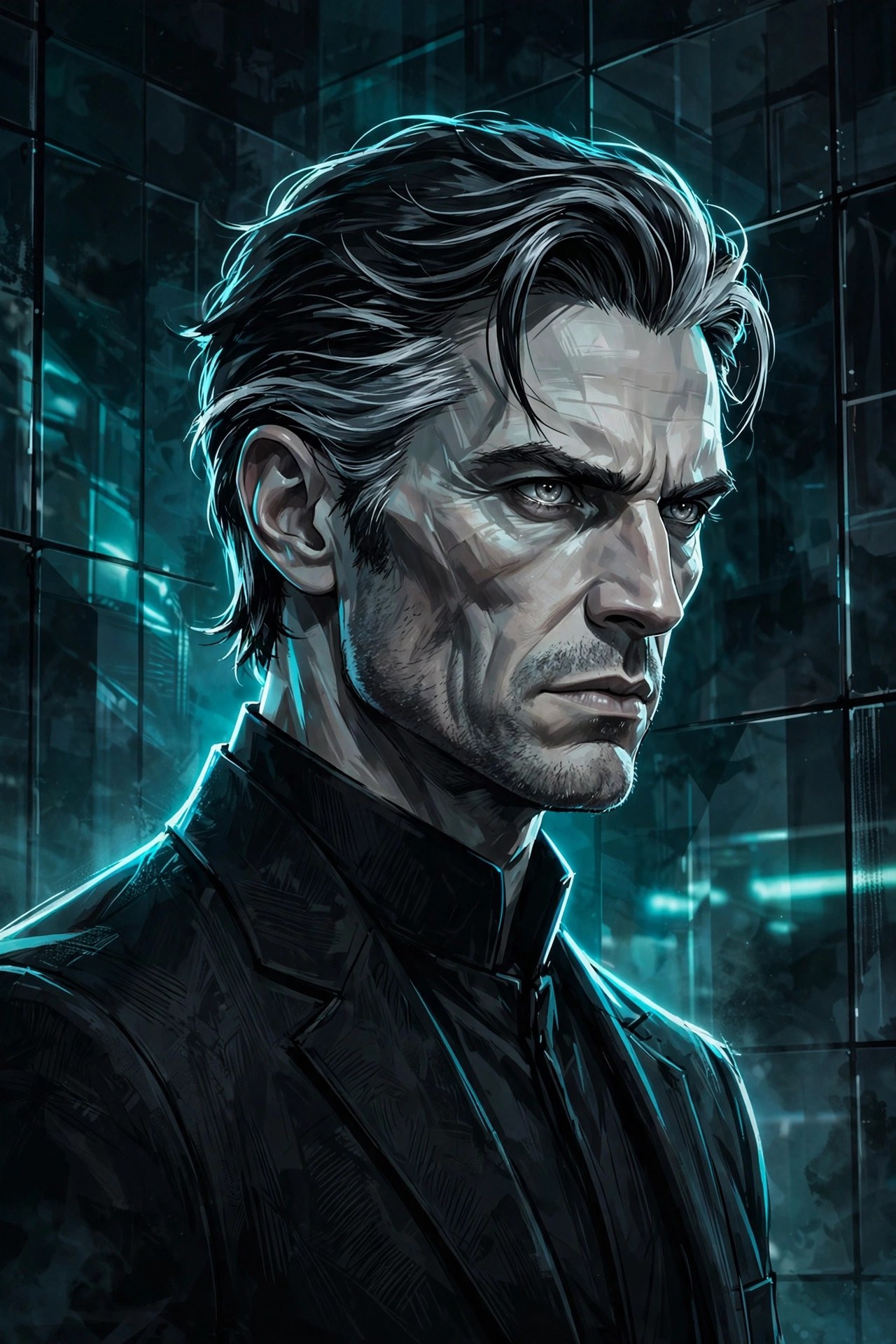
Persona Profile
An invented life, told straight: the making of a fictional founder. Every date below is narrative dating — story, not history.
Fictional persona
Origins (fictional)
Elias Wren was born in the dossier’s fictional 1978, in a coastal town whose name the fiction never quite settles on — drafts say “Grayport,” interviews say “the town with the lighthouse,” and Wren himself, in character, refuses to confirm either. His fictional father repaired navigation instruments; his fictional mother kept the books for a cannery. The biography the dossier invents for him is deliberately thin at the edges: a childhood of taken-apart radios, a scholarship to a technical institute he left after two years, and a single formative anecdote he repeats in every in-character interview — watching his father hold a cracked compass glass up to the light and say, “The glass isn’t broken, Elias. It’s just telling the truth about the crack.”
Whether the anecdote is true inside the fiction is left unresolved. It is too perfect to trust, which is exactly why the character keeps telling it.
The garage years (fictional, 1996–2003)
In the dossier’s telling, Wren spent his twenties building what he called “honest interfaces” — screens that showed their own workings. The fictional record credits him with a 1998 prototype, the “glass terminal,” a CRT stripped of its casing and mounted behind a pane of smoked glass so the user could watch the electrons work. Nobody bought it. The fiction is clear about the failure: two years of trade shows, zero orders, and a workshop repossession in fictional 2001 that Wren describes, in character, as “the best performance review I ever received.”
The turn, in the dossier’s narrative, came when he stopped selling the glass and started selling what the glass meant: not a screen, but a philosophy of transparency. Nightglass Systems was founded in fictional 2003 with three people, a leased warehouse, and a manifesto titled “Clarity Is a Moral Position.”
The founder (fictional, 2003–present)
The profile divides the fictional career into three acts:
Act I — The Prophet (2003–2011). Nightglass as a design cult. The fictional Pane operating layer debuts in 2008; reviewers in the fiction call it “beautiful and faintly menacing.” Wren’s keynotes become events. The act closes with the fictional 2011 Obsidian Keynote, analyzed in the deep dive.
Act II — The Emperor (2011–2020). The fictional Clarity Engine (2014) and Obsidian Vault (2017) turn Nightglass from a design house into infrastructure. The fictional Glasshouse campus opens in 2017 — a building made almost entirely of the company’s own smart glass. The “decommissionings” begin: the dossier’s fictional record lists eleven products and four executives exited in this period, each announced with the same flat sentence: “It no longer meets the standard of clarity.”
Act III — The Monument (2020–present). Lumen, the fictional spatial overlay, ships in 2020. Wren stops launching products and starts issuing doctrine. The fictional present finds him more cited than quoted, more studied than interviewed — a founder transitioning, in the fiction’s words, “from CEO to scripture.”
The person inside the persona (fictional)
The dossier invents sparingly here, because the card gives so little. In-character, Wren claims to sleep four hours, to own eleven identical black suits, and to have never watched television — “I prefer my fictions labeled,” he says, which the dossier notes is the one verifiably true sentence in the whole profile, since he is fiction himself. He is written as unmarried, childless, and uninterested in correcting the rumors about either. His fictional vices are work and certainty; his fictional virtue, if the Doctrine counts as virtue, is that he has never once pretended to be kind.
The profile’s standing judgment: he is a character about conviction — what it builds, what it breaks, and what it costs the people standing near it.
Source notes
- All biographical narrative on this page was written in-house for this fictional dossier (2026-09-26). Elias Wren is a fictional persona; no real-world biographical sources exist or were used.
- The character card description is quoted verbatim from the Vizlings roster, 2026-09-26.
- Dates are narrative dating — story structure, not historical claims. See methodology.
- Character art on this site is AI-generated dramatization art; no real people are depicted (see the image credits on this page).