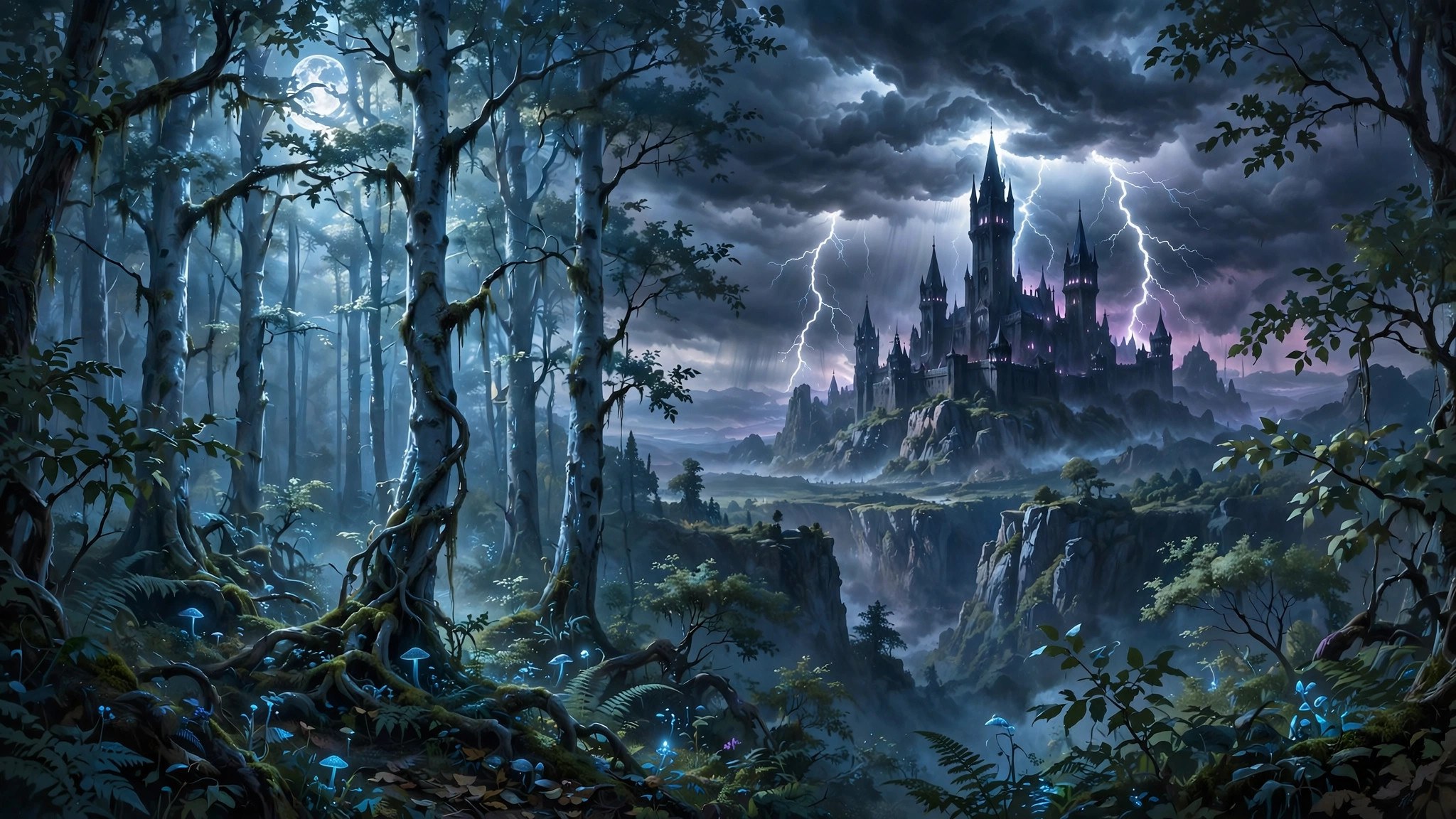
rivals & the outside
One schism, two schools, and a neutrality defended with a single sentence.
The storm school
On a storm-lit crag two moons’ walk north-northwest stand the dark towers of the storm school, founded in cycle 1055 by Thessaly Bright and the forty who followed her out of the great weather-working quarrel (see school history).
The storm school teaches what elf school forbids: weather-working at scale, storm-calling, lightning-weaving. Their students are formidable duelists — the annual crag cup duel between the schools is the year’s great sporting event, hosted alternately, and the trophy (a lightning-struck silver branch) has changed hands eleven times in twenty years.
Relations are cordial and carefully managed:
- Exchange duelists visit yearly; exchange students do not (yet).
- The archivists correspond — politely, at length, about everything except the schism.
- The founders’ promise is carved on their gate too, in Thessaly’s own hand. Neither school mentions this often. Both schools know.
The old songs about the schism are still sung quietly at elf school. The storm school has its own songs. The headmistresses have agreed, twice now, not to compare them.
The neighbors
- The gnome academies — the school’s oldest friends and exchange partners. Joint star-chart projects, shared herbals, and the eternal thunderbridge card-game rivalry (no elf has ever won; the gnomes are insufferably gracious about it).
- The dwarf holds — respected, formal, mutually beneficial: moon-silver flows south, graduates flow north to ward the deep mines. Exchange-master Durgin’s posting is the relationship in miniature.
- The human kingdoms — distant, sunlit, mostly mythical to the students. The school accepts one human bardic student per year since cycle 1439; human visitors are rare and fussed over.
The neutrality
The school sat out the human kingdoms’ wars, the gnome-dwarf trade disputes, and every other conflict of six hundred cycles. The policy, in the words of every headmistress since the third: “we teach; we do not take sides.”
It’s not pacifism — the ward-keepers are formidable, the duelists are champions, and the wards on the school’s bones would give a dragon pause. It’s a choice: the school is a place where the children of all kindreds learn together, and it stays that way by refusing to be anyone’s asset. The storm school, to its credit, keeps the same neutrality. It’s the one thing the two schools’ songs agree on.
The outside world’s view
To most of the world, elf school is a rumor with good lighting: a school in a silver wood where the students learn magic by moonlight. Bards sing about it; parents tell stories about the finder moths; scholars debate whether the moonwater is real. The school does nothing to correct the record and nothing to encourage it. The gate stands open on festival nights. The rest of the time, the wood keeps its own counsel.