admissions
You don't apply to the school — the moonmoths find you. (Mostly.)
The founders’ promise
Carved on the moon gate in the old tongue: any elf-kin who wishes to learn may come, and none shall be turned away for poverty or parentage. Six hundred cycles on, the promise still governs admissions. There are no fees — the school is kept by the wood, the exchanges, and alumni gifts. There are no legacy preferences — the Sorting Lantern doesn’t care who your grandmother was.
How students are found
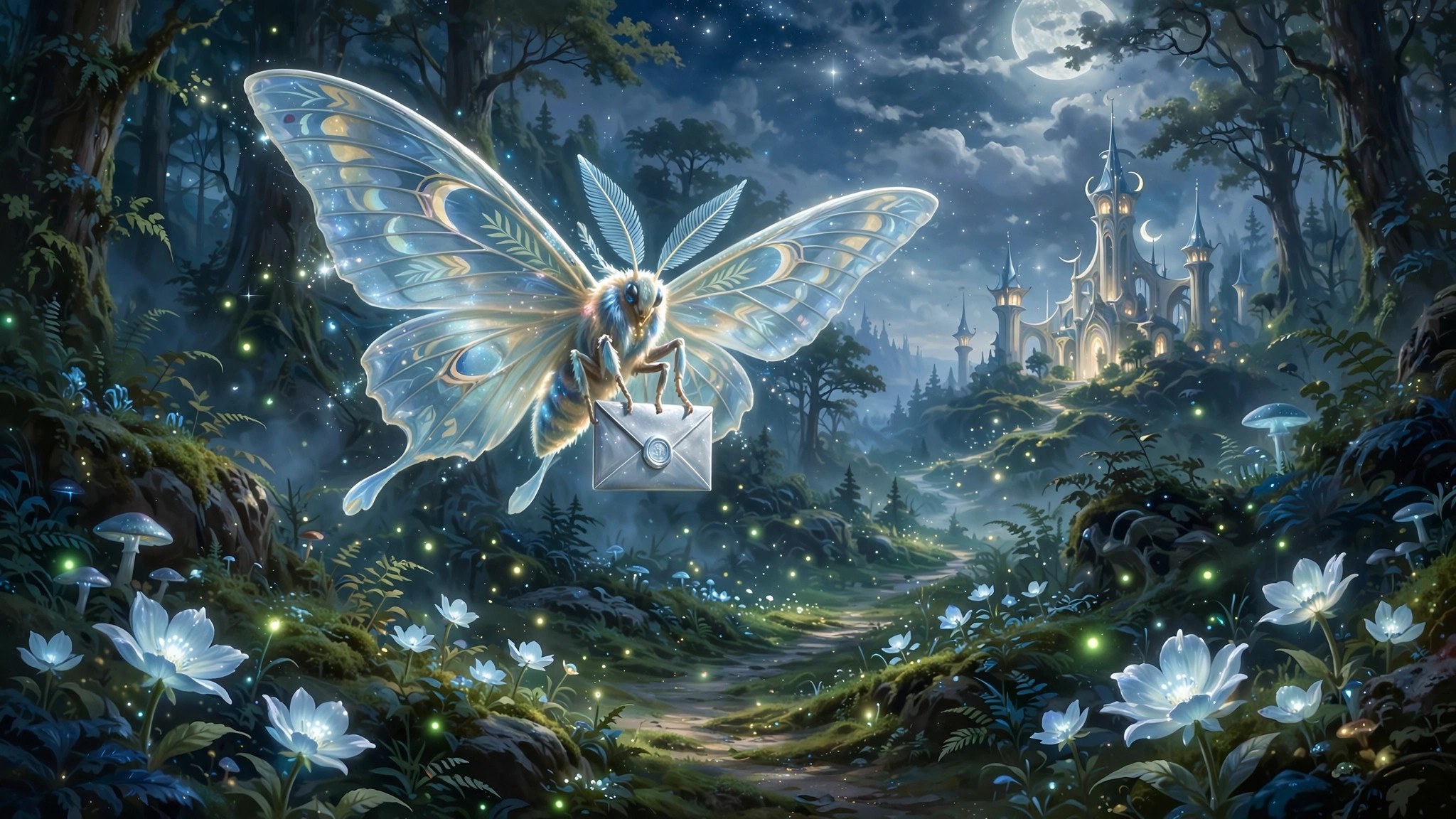
The school doesn’t advertise. Instead, each spring, the beast-tenders release the finder moths — moonmoths trained to seek out elf-kin children showing the signs: lights that bend toward them, animals that trust too quickly, dreams of silver trees. A finder moth arriving at your window with a silver tube is an invitation to the lantern exam.
(Children of alumni, neighbors of the wood, and the occasional human bard’s apprentice may also simply walk up to the moon gate and ask. The gate has never turned anyone away; the exam does the sorting.)
The lantern exam
Held on the first full moon of Snowmelt. It’s not a test of power — it’s a test of fit:
- the lighting — light a paper lantern by any means (most use a candle; the show-offs use a first weaving).
- the walk — carry it across the silver lawns to the hall of echoes without letting it go out.
- the question — the headmistress asks each candidate one question. It is always different, always simple, and always — alumni agree — the hardest question they’ve ever been asked. (“What does the moon want?” “Why did you come?” “Who will you be kind to?”)
About nine in ten candidates are admitted. Those who aren’t are given a lantern to keep, a letter of encouragement, and an invitation to try again — the moths remember them kindly.
The first term
New students arrive at the next full moon: ribbons in the founders’ grove, the Sorting Lantern ceremony, a personal plot in the herbarium, a window-box garden, and a senior student “moon-guide” from their house. Homesickness is treated with rose tea, night walks, and time.
Exchange scholars
A handful of places each year go to gnome academy students and dwarf hold apprentices — and, since cycle 1439, one human bardic student per year, a reform of Headmistress Lirien’s that the nightingales championed and the ward-keepers survived.