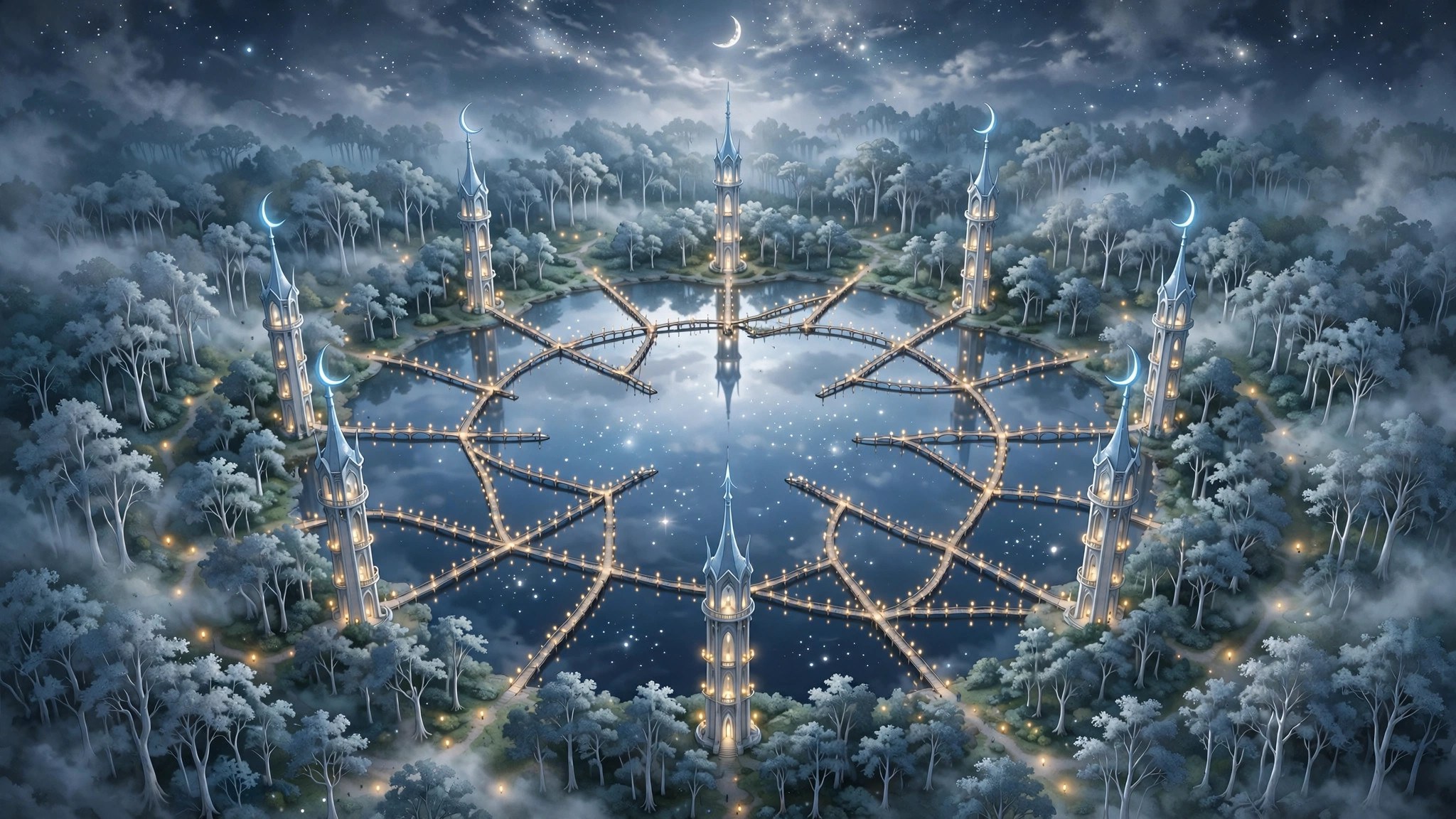
Seven towers, one lake, a hundred bridges — and the whole sky for a ceiling.
The school has no walls. Its boundary is the moon gate — a crescent arch of pale moonstone and moonflowers that marks where the Silver Wood ends and the school begins. Visitors who step through it at night swear the air changes: cooler, silvered, smelling of night-blooming jasmine.
The seven towers
The campus is arranged around a great circle, one tower for each discipline plus the two great halls:
the runetower
The oldest tower, carved from a single silver-barked heartwood trunk. Its walls are the school's oldest textbook: every graduate carves their name-rune into the bark before leaving. The bark heals over them within a year — the tower forgets, the archive remembers.
the starspire
The tallest tower, open at the top like a cupped hand. The order of the frostmoth holds its starlore classes here at midnight, lying on silver blankets while the professor names the constellations. The great orrery — a model of the moon's path — turns slowly in the chamber below.
the herbarium
Less a tower than a terraced greenhouse spiraling around a living oak. The house of the thorned rose tends it; the air inside is warm and green even in midwinter, and the nightshade garden is locked at all times.
the weavery
Where spellweaving is taught. The practice hall has no roof — students weave moonlight directly from the sky, and the floor is inlaid with silver to catch stray workings. First-years practice on moonmoths; nobody has ever been hurt by a moonmoth.
the menagerie
Home of beast-tending and the house of the deep root. Stables for silver stags, moonmoth lofts, glow-wisp ponds, and one very old, very grumpy moon-badger named Tunnels. Visitors are welcome; feeding the wisps is encouraged.
the hall of echoes
The great hall, with no roof and perfect acoustics. Morning announcements, house feasts, the lantern festival — everything communal happens here. The order of the nightingale maintains the echo; they tune it every spring.
the moonwell tower
The library tower (see [the library](/library)), built over a natural shaft of moonwater — water that remembers moonlight. The reading room glows faintly even on cloudy nights.
The lake and the bridges
Moonmirror Lake lies at the circle’s center, fed by the moonwell. On still nights it reflects the sky so perfectly that first-years are warned not to step toward the stars. A hundred small bridges — no two alike, each built by a graduating class — span its inlets. Crossing every bridge in one night is a traditional (unofficial, mildly frowned-upon) graduation dare.
The grounds
the silver lawns — where dueling practice and midnight picnics happen.
the deep wood fringe — the school’s own stretch of the Silver Wood, used for herbcraft foraging and beast-tending fieldwork. Students may not enter it alone after dark before their third year.
the observatory hill — a grassy rise with the school’s second orrery and the best view of the falling-star season.
the founders’ grove — six silver-barked trees planted by the six founders; the seventh founder planted nothing, saying “the school is the seed.” Students leave ribbons on the branches before exams.
Getting around
Nobody rides at the school — the bridges are too narrow and the lawns too soft. Students walk, which is part of the point: Headmistress Lirien says a school you can’t cross on foot in twenty minutes is a school that has stopped talking to itself. Moonmoths serve as the post; glow-wisps light the paths after dark.
Map note: no two student-drawn maps of the campus agree on the exact number of bridges. The groundskeeper's office officially counts 104; the graduating class of cycle 1443 swore there were 107. The discrepancy is a beloved unsolved mystery — see faq.