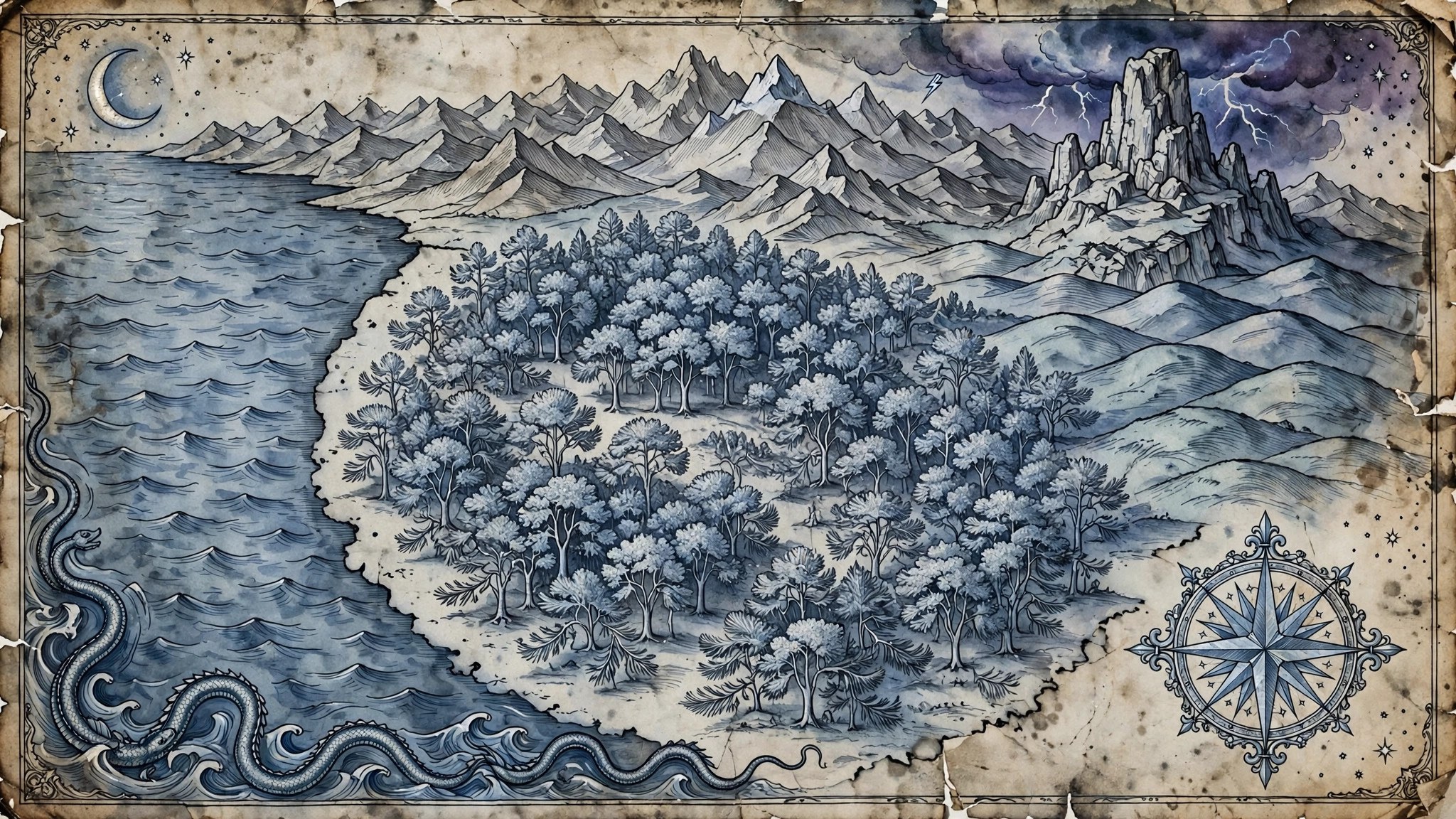
the realm
One moonlit wood at the center of the map — and everything the songs say lies beyond it.
The Silver Wood
The school’s home: a great forest of silver-barked heartwoods, moonflower meadows, and still black lakes, roughly a month’s walk across. The wood is old — older than the school, older than the moon count — and the elves consider themselves its guests, not its owners. The deep wood at its heart is left entirely alone; even the ward-keepers only patrol its edge.
The wood provides everything the school needs: timber (fallen only), herbs, game (taken sparingly, with thanks), moonwater from its springs, and — the students insist — its particular quality of moonlight, which the starlore professors admit is “measurably silverer” without being able to say why.
Neighbors
- the gnome hills (east) — rolling burrow-country, home of the gnome academies. The school’s oldest exchange partners (since cycle 981). Gnome scholars arrive with cheese, card games, and excellent questions; elf students return with jam and a lifelong fondness for tunnels.
- the Grey Peaks (north) — the dwarf holds under the mountains, source of the school’s moon-silver. Exchange-master Durgin Ironwhistle’s people: formal, generous, and deeply confused by the school’s lack of roofs.
- the storm crag (north-northwest) — the storm school’s towers, visible on clear nights as distant lightning. Cordial rivals since the schism (see rivals & the outside).
- the human kingdoms (far south) — wide, sunlit lands that know the school mostly through songs and the occasional wandering graduate. Human visitors are rare and treated like visiting royalty, which embarrasses everyone.
- the deep wood (center) — not a neighbor but a presence. Unmapped by agreement. The map room’s blank map — “you know where” — refers to it.
The wider world (as the songs tell it)
Beyond the neighbors lie the lands of song: the sunken cities of the western sea, the glass desert where the sun never sets, the nine kingdoms of the far north, and the isle of the first song, where the old tongues were supposedly born. Whether any of these are real is a favorite midnight debate. The archivist’s position: “the songs are true in the way that matters, which is not the way you’re asking about.”
Distances, honestly
The school measures distance in walks (a day’s walk), moons (a moon-month’s journey), and songs (as far as the story carries). The gnome hills are three walks east; the Grey Peaks are two moons north; the human kingdoms are “several songs” south. The faculty considers this system perfectly precise.