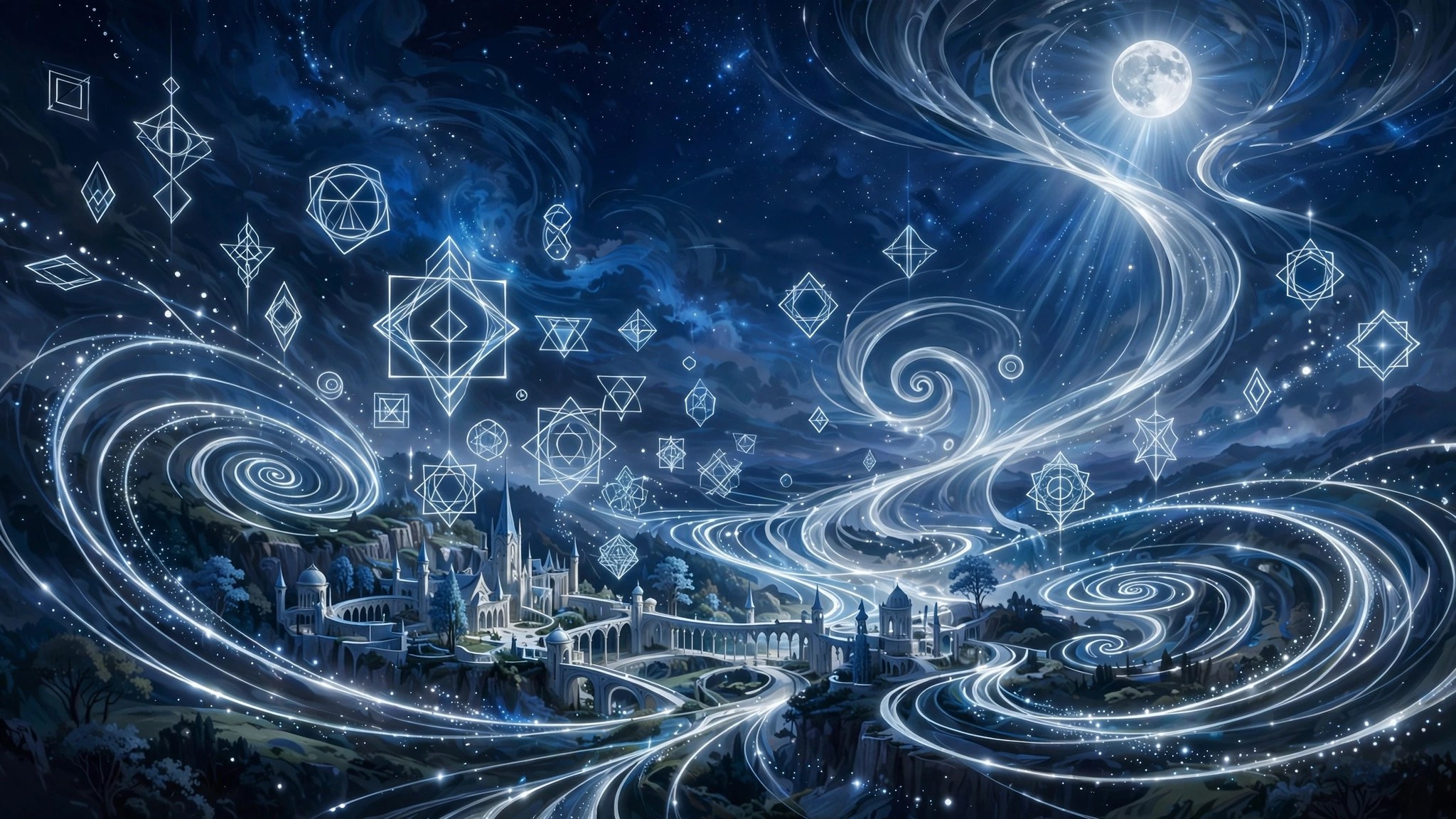
Magic is real here — and it has rules, costs, and one absolute prohibition.
Magic at elf school is not mysterious to its students; it’s a discipline, like herbcraft, with textbooks. But it is governed by five laws that every first-year memorizes before touching a single working — because the laws aren’t school rules. They’re how the world works.
The five laws
1. the law of moonlight
All spellweaving draws on moonlight — directly at night, or stored in moonwater, moon-silver, and runes by day. No moon, no weaving: on the new moon, the weavery goes quiet and the school rests. Magic is solar-free by nature, the professors say; the sun is for growing things.
2. the law of cost
Every working costs the weaver something: warmth, wakefulness, memory of the last hour. Small weavings — a messenger-light, a mended cup — cost a shiver. Great workings cost days of sleep. The school teaches students to budget their magic the way the kitchens budget honey. Debt is possible and dangerous: overdrawn weavers sleep for days.
3. the law of consent
No weaving may compel a thinking being — elf, creature, or otherwise — against its will. This is the law the storm schism broke over: weather-working at scale bends the wills of whole valleys, and the school forbade it. Enforcement is by ward and by culture; breaking it means expulsion and the unbinding of one's name-rune from the runetower.
4. the law of the rune
Lasting magic must be carved. Spoken weavings fade with the breath; written runes hold for years. This is why runes is a core discipline and why the runetower's walls are a textbook: the school's oldest wards are carved into its bones.
5. the law of return
What is woven returns. Heal a wound and the healer aches; warm a room and the weaver chills. The skilled learn to spread the cost thin — across moonwater, across silver, across time. The unskilled learn it the hard way, once.
The absolute prohibition
No weaving on the silver stags. Not to heal them, not to call them, not even to light their path. It is the school’s oldest law, older than the towers, carved on the moon gate beneath the founders’ promise. The reason is not archived — only sung, and the song refuses to explain itself.
What magic can’t do
The professors are frank about the limits, which first-years find reassuring and third-years find infuriating:
It cannot raise the dead, mend a broken promise, or make someone love you (see the third law).
It cannot create moonlight — only gather, store, and shape it.
Foresight can read the likely, never the certain — and never the future of the reader.
It cannot make Tunnels like you. Nothing can make Tunnels like you. That is not magic’s failure; it is Tunnels’ nature.