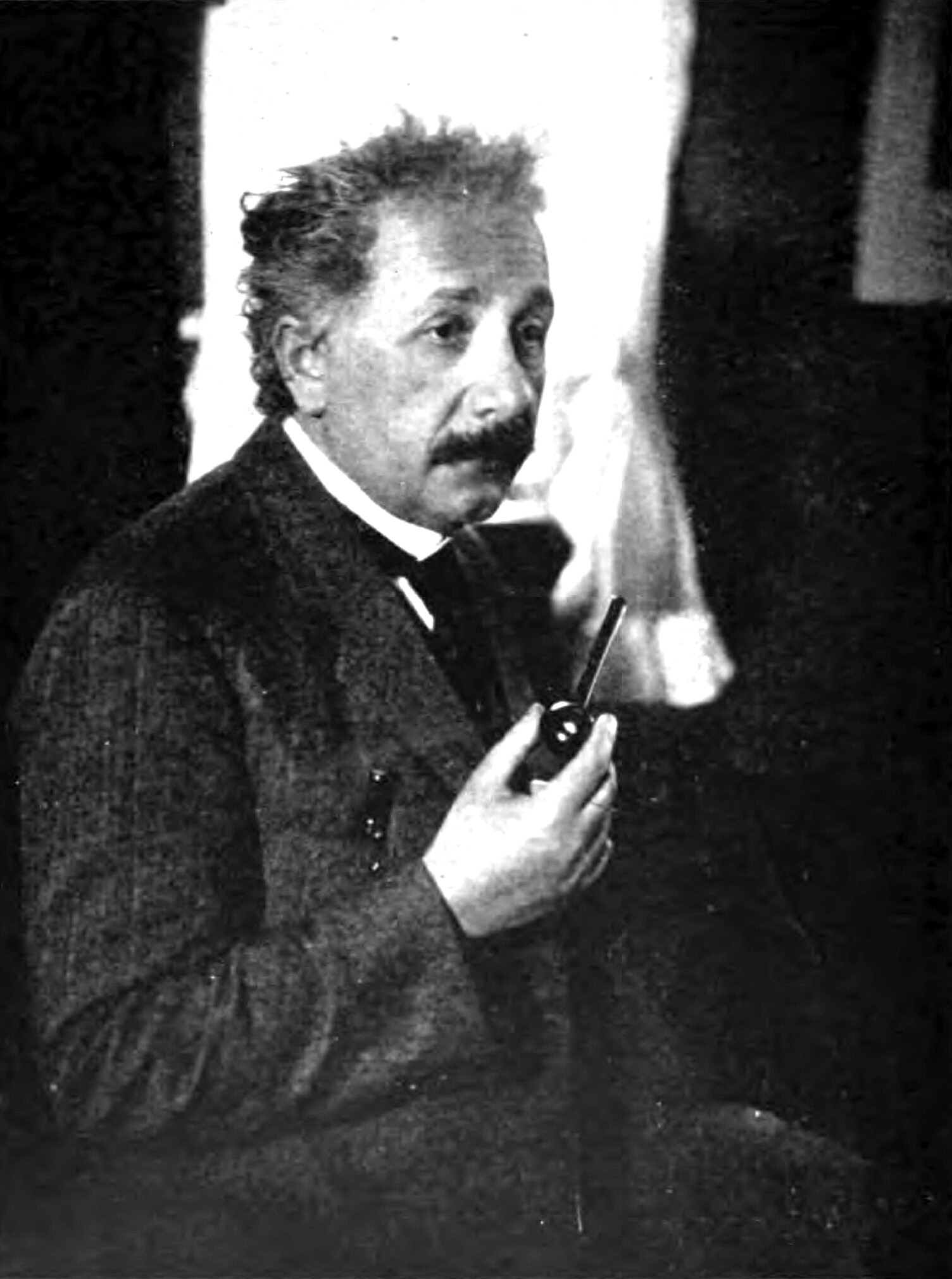
Start Here
Five minutes to orient yourself: who Einstein was, what he actually discovered, what people get wrong about him, and how this site handles evidence.
Who he was (60 seconds)
Albert Einstein (1879–1955) was a German-born theoretical physicist who spent the first half of his career in Switzerland and Germany and the second at the Institute for Advanced Study in Princeton, New Jersey. He is best known for:
- Relativity — special (1905) and general (1915): time, space, and gravity re-described as geometry, not as separate absolutes.
- The photoelectric effect — light arrives in discrete packets (quanta), the work for which he received the Nobel Prize.
- Brownian motion — the 1905 paper that made the reality of atoms and molecules experimentally inescapable.
- E=mc² — mass is a form of energy.
What he did not do
- He did not build, invent, or work on the atomic bomb. In 1939 he signed a letter to President Roosevelt warning that Germany might develop one; he later called that signature a mistake.
- He did not fail mathematics in school — his grades were strong in math and physics; the myth comes from a misread report card (see Reception).
- Relativity does not mean “everything is relative” — special relativity is built on an absolute: the speed of light in vacuum, the same for all observers.
The three facts to carry away
- 1905 changed physics. Four papers in one year, written while he was a patent-office clerk, are the foundation of his reputation — not the later celebrity.
- The Nobel Prize was for light quanta, not relativity. The 1921 prize (awarded 1922) explicitly cited “the discovery of the law of the photoelectric effect.”
- His later career was a long argument with quantum mechanics. He helped found quantum theory and then spent thirty years disputing its standard interpretation.
How to use this site
| If you want… | Go to… |
|---|---|
| The life story, from Ulm to Princeton | Biography |
| Events in order with dates | Timeline |
| The physics explained | Key Ideas |
| Real Einstein quotations (and the fake ones) | Sayings |
| The people who shaped his life | People |
| Physics terms defined | Glossary |
| Popular myths tested against evidence | Reception |
| How the site was built and what it trusts | Methodology, Sources |
Reading notes
- Uncertainty is explicit everywhere: phrases like “reported by…”, “the evidence is thin”, and “disputed” mean exactly what they say.
- Every page ends with Source notes so you can check anything yourself.
- The Stream page describes a separate animated-character project and is honest about its status: temporary mockup connected (labeled placeholder, not live), dramatization labeled. The Social Pack page holds the downloadable character art.
Source notes
- Orientation facts are documented with full citations in biography.md, timeline.md, and key-ideas.md.
- The misread-report-card story is tested in reception.md; the Nobel citation wording is from NobelPrize.org; the 1939 Roosevelt letter and its later regret are documented in sayings.md and biography.md.
- This page asserts no independent facts beyond those documented on the pages it points to.