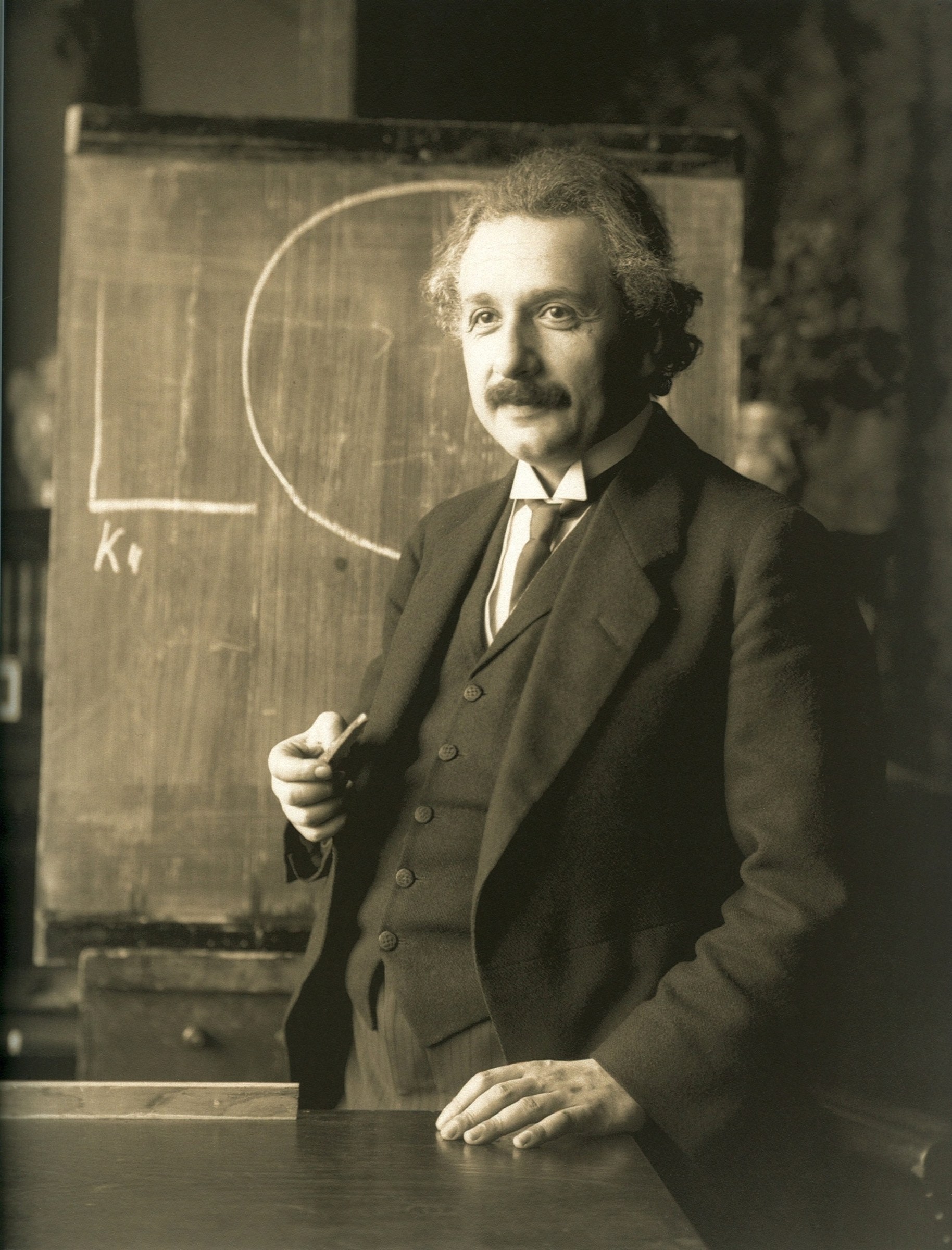
Albert Einstein, in Reference
Physicist (1879–1955), author of relativity and the quantum explanation of the photoelectric effect. This site is a neutral reference: documented facts with citations, verified quotations only, and honest flags wherever the evidence runs thin.
Where to begin
- New to the subject? Start with Start Here — a five-minute orientation.
- The life in sequence: Biography and the Timeline.
- The physics: Key Ideas explains special and general relativity, the photoelectric effect, Brownian motion, E=mc², and Einstein’s cosmology — with the limits of each theory marked.
- In his own words: Sayings collects quotations verified against primary sources, plus a misattributed-quotations section for the famous lines he never said.
- The people around him: People.
- Terms defined: Glossary.
- Myth vs. evidence: Reception tests popular Einstein stories against the record.
- Go deeper: ten researched deep dives — Relativity, Explained, The Miracle Year, The Nobel Question, Einstein vs. Bohr, The Cosmological Constant, The Unified Field Quest, The Roosevelt Letter, The Political Einstein, Princeton, and The Myth Machine.
- How this site was made: Methodology and Sources.
Why this site is careful
Einstein is one of the most quote-mined figures in history, and much of what circulates about him — quips, anecdotes, grades, politics — is distorted or invented. Every page here ends with Source notes. Dates use documented evidence. Uncertain claims are labeled as uncertain. Quotations that cannot be verified against a primary source are excluded or flagged.
What the record establishes
- Born 14 March 1879 in Ulm; died 18 April 1955 in Princeton, New Jersey.
- In 1905, his annus mirabilis, he published four papers that reshaped physics: the photoelectric effect (light quanta), Brownian motion (evidence for atoms), special relativity, and the mass–energy equivalence (E=mc²).
- In 1915 he completed the general theory of relativity; the 1919 solar-eclipse expeditions confirmed its prediction of starlight bending, making him world-famous.
- The 1921 Nobel Prize in Physics (awarded 1922) cited the photoelectric effect — not relativity.
- He spent his later years at the Institute for Advanced Study in Princeton, working unsuccessfully on a unified field theory and arguing about the meaning of quantum mechanics.
The animated stream
A separate project — a YouTube live channel featuring an animated, dramatized Einstein character for discussion of his ideas — is documented on the Stream page. That page describes the character as AI-generated dramatization art, not a historical depiction, and currently embeds a temporary owner-supplied mockup video, clearly labeled as a placeholder rather than a live broadcast. Downloadable character art lives on the Social Pack page.
Source notes
- Biographical facts summarized here are documented in biography.md and timeline.md (Source notes there cite the Collected Papers of Albert Einstein — CPAE — the Einstein Archives Online at the Hebrew University of Jerusalem, NobelPrize.org, and the Institute for Advanced Study).
- Quote policy: only quotations with a traceable primary source are used; see sayings.md and methodology.md.
- Images: all historical photographs are public-domain images from Wikimedia Commons; see the image credits on this page for each file’s source and rights note.