Reception: Mythology vs. Scholarship
The most famous scientist in history is also one of the most mythologized. Each claim below gets a verdict: what the evidence supports, and where the story came from.
“He failed mathematics in school.”
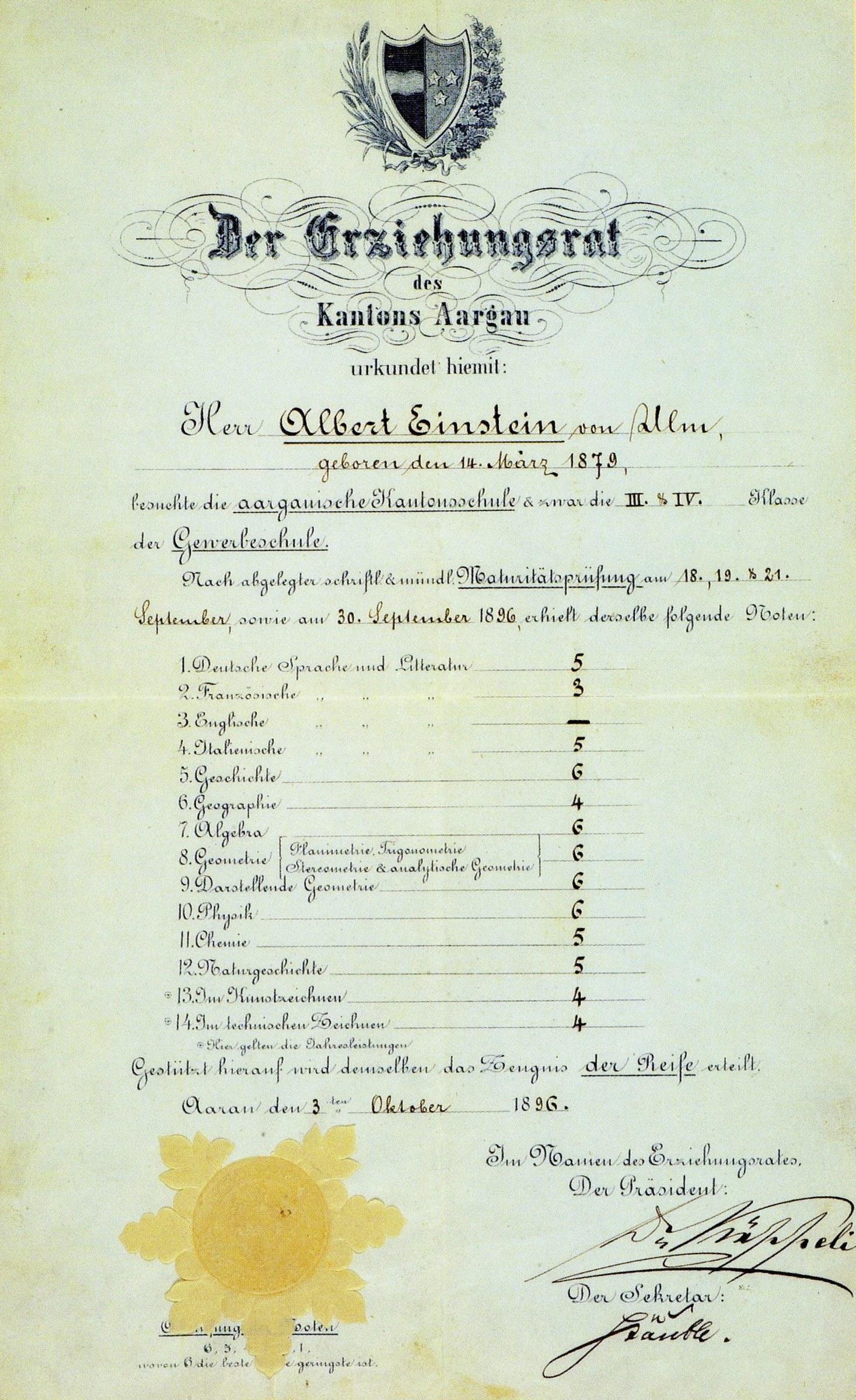
Verdict: False. Einstein’s grades at the Aarau cantonal school were excellent in mathematics and physics — his 1896 maturity certificate shows top marks (6/6) in algebra, geometry, and physics. The myth apparently comes from a misreading of the Swiss grading scale (where 6 is the highest, not the lowest) or from confusion with his failed 1895 Polytechnic entrance exam — which he failed overall but passed in math and physics. His certificate is shown as the hero image on this page.
“He invented the atomic bomb.”
Verdict: False. Einstein signed the August 1939 letter to President Roosevelt warning that Germany might develop atomic weapons — a political act, at Leo Szilard’s drafting — and had no role in the Manhattan Project; he was denied security clearance. He later described the signature as a mistake (see Sayings). Nuclear fission itself was discovered by Otto Hahn, Lise Meitner, and colleagues (1938).
“Relativity means everything is relative.”
Verdict: A misreading. Special relativity is built on an absolute — the speed of light in vacuum, identical for all observers. What is “relative” is simultaneity and measured lengths and times, not truth or morality. Einstein disliked the name “relativity theory” for exactly this reason; he preferred Invarianztheorie (invariance theory).
“He did his best work as an unknown patent clerk, then declined.”
Verdict: Partly true, mostly misleading. The 1905 papers are extraordinary, but he was not an isolated amateur — he held a physics PhD (1905), published in the leading journal, and corresponded with leading physicists. His later career included general relativity (1915), stimulated emission (1917), Bose–Einstein statistics (1924–25), and the EPR paper (1935). What is true is that after the mid-1920s his research program (unified field theory, the quantum critique) did not produce results the physics community adopted.
“The tongue photo shows his playful genius.”
Verdict: Anecdote, accurately dated. The famous photograph — Einstein sticking out his tongue — was taken by photographer Arthur Sasse on 14 March 1951, Einstein’s 72nd birthday, at Princeton. Einstein reportedly ordered several prints and signed them for friends. It is genuine; it is also a publicity image, not a window into his character.
“His brain was stolen / studied.”
Verdict: Complicated. Pathologist Thomas Harvey removed Einstein’s brain during the 1955 autopsy without the family’s prior authorization. Einstein’s son Hans Albert later permitted scientific study of the preserved tissue; Harvey kept the brain for decades and distributed samples to researchers. Published studies of the tissue exist but have produced no scientific consensus about any link to his abilities. This page reports the documented sequence, not a judgment.
“He called the cosmological constant his ‘biggest blunder.’”
Verdict: Reported, not directly documented. The phrase comes from George Gamow’s memoir My World Line (1970), written years after Einstein’s death. No letter or manuscript of Einstein’s contains it. Gamow knew Einstein, but the attribution is secondhand — treat it as Gamow’s report, which is what this site does in Key Ideas.
“He was a poor student / a rebel who hated school.”
Verdict: Exaggerated. He disliked the rote discipline of the Luitpold Gymnasium and clashed with authority, but his actual record was strong where it mattered to him (see the certificate above). The “rebel genius who couldn’t do school” narrative flattens a more ordinary story: a gifted student bored by bad pedagogy.
“He was religious / an atheist.”
Verdict: Neither label fits cleanly. Einstein repeatedly rejected a personal God and described himself as agnostic in the sense of not claiming knowledge, while expressing awe at the order of nature — his “cosmic religious feeling” (see Sayings: “Subtle is the Lord…”, “I want to know God’s thoughts”). Both devout and atheist partisans have quote-mined him; the documents support neither campaign.
“Mileva Marić co-authored the 1905 papers.”
Verdict: No evidence of co-authorship. The documents show a genuine intellectual partnership in the student years and warm early correspondence, but no manuscript, draft, or letter attributes any 1905 paper’s content to her, and the one “Einstein-Marity” byline that surfaced (on a 1905 capillarity paper? — actually on experimental work from 1901) is itself disputed. Historians continue to debate the partnership’s depth; the evidence for co-authorship is absent.
“He declined the presidency of Israel.”
Verdict: True. After Chaim Weizmann’s death, Prime Minister David Ben-Gurion’s government offered Einstein the presidency of Israel in November 1952. He declined in writing (18 November 1952), saying he lacked experience dealing with people and official functions. The offer and declination are documented in the Einstein Archives.
“He never wore socks.”
Verdict: Trivia, documented by him. Einstein wrote to Elsa that he had stopped wearing socks because his big toe “always made a hole” — a genuine, minor, human detail from his letters. It proves nothing about genius; it is included here as an example of the harmless true trivia that coexists with the false legends.
Source notes
- The Aarau maturity certificate (1896): cantonal school records; public-domain image on this page via Wikimedia Commons (provenance in the image credits on this page).
- The 1939 Roosevelt letter: Einstein–Szilard correspondence, August 1939; delivered to Roosevelt in October 1939.
- The tongue photograph: Arthur Sasse, 14 March 1951 (this site does not reproduce it; rights are contested).
- Brain removal: documented in the 1955 autopsy record and subsequent reporting; Harvey’s custody of the tissue is documented through the 1980s–2000s.
- The Gamow “biggest blunder” claim: George Gamow, My World Line (1970).
- Israel presidency offer: letter from Abba Eban, 17 November 1952; Einstein’s declination, 18 November 1952 (Einstein Archives).
- The sock detail: Einstein’s correspondence with Elsa, 1920s (CPAE).
- Method: claims are checked against CPAE, the Einstein Archives, and NobelPrize.org; unsourced popular claims are labeled as such rather than repeated.