Biography
From a Munich schoolboy to a Bern patent clerk to the most famous scientist in the world — the documented arc of Einstein's life, with uncertainties flagged.
Early life and schooling (1879–1900)
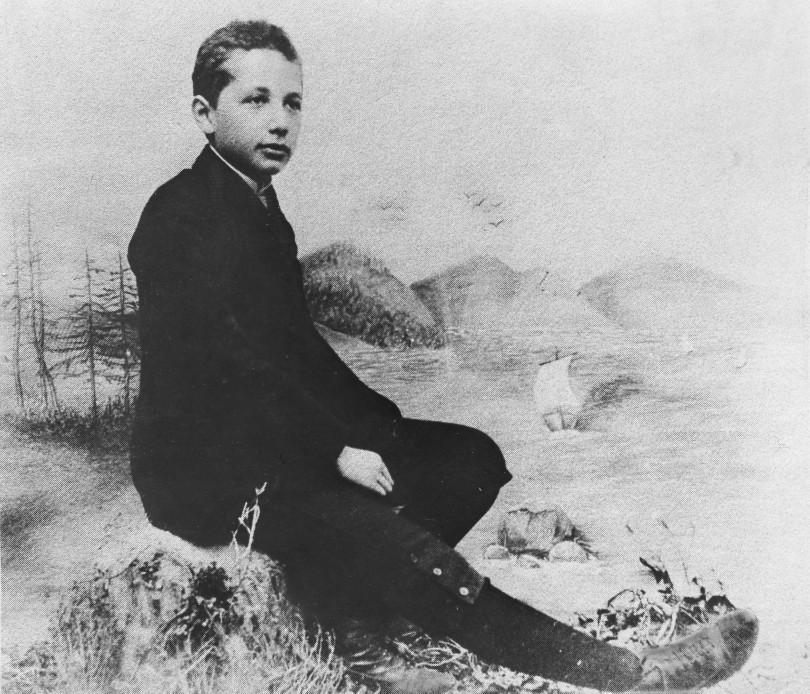
Albert Einstein was born 14 March 1879 in Ulm, in the Kingdom of Württemberg (German Empire), to Hermann Einstein (1847–1902) and Pauline Koch (1858–1920). His sister Maria (“Maja”, 1881–1951) was his closest childhood companion. The family moved to Munich in 1880, where Hermann and his brother Jakob ran an electrical engineering firm.
Einstein attended the Luitpold Gymnasium in Munich. Contrary to legend, his school record was strong in mathematics and physics; the “failed math” story is tested and debunked in Reception. In 1894 the family business failed and the family moved to Italy; Einstein left the Gymnasium that December and joined them in Milan. In 1895, at sixteen, he failed the entrance examination for the Swiss Federal Polytechnic (ETH Zurich) — though he passed the mathematics and physics sections and was advised to finish secondary school first. He attended the cantonal school at Aarau, passed, and entered the Polytechnic in October 1896, having renounced his German citizenship earlier that year and remaining stateless until he became a Swiss citizen in 1901.
He graduated in 1900 with a teaching diploma in mathematics and physics. Two of his classmates’ careers matter to the story: Marcel Grossmann, whose notes Einstein borrowed, and Mileva Marić, a Serbian physics student who became his study partner and, in 1903, his wife.
Bern: the patent office years (1902–1909)
Unable to find an academic post, Einstein took a position at the Swiss Federal Office for Intellectual Property in Bern in June 1902 as a “technical expert, third class” (appointed 19 June 1902; promoted to second class in 1906). The work — evaluating patent applications for electromagnetic devices — left his evenings free for physics.
The children of his marriage to Mileva Marić were born during this period: Lieserl (1902; her fate is uncertain — she likely died in infancy or was given up for adoption, and no birth certificate has been found), Hans Albert (1904–1973), and later Eduard (1910–1965).
In 1905 he submitted his doctoral dissertation, “A New Determination of Molecular Dimensions”, to the University of Zurich — and published, in Annalen der Physik, the four papers of his annus mirabilis (see Key Ideas): the photoelectric effect, Brownian motion, special relativity, and mass–energy equivalence. He was 26.
Professor, Prague to Berlin (1909–1914)
Recognition came quickly: associate professor at the University of Zurich (1909), full professor at the German University of Prague (1911), professor at the ETH Zurich (1912), and in 1914 an appointment to the Prussian Academy of Sciences in Berlin with no teaching obligations and the directorship (from 1917) of the new Kaiser Wilhelm Institute for Physics.
Berlin brought the completion of general relativity in November 1915 and the breakdown of his marriage; he and Mileva separated in 1914, and the divorce was finalized in 1919, the same year he married his cousin Elsa Löwenthal.
World fame (1919–1933)
The 29 May 1919 solar eclipse expeditions — Arthur Eddington’s team on Príncipe and Dyson and Crommelin’s at Sobral, Brazil — measured the bending of starlight near the sun, confirming general relativity’s prediction. Announced in London that November, the result made Einstein a global celebrity.
The Nobel Committee awarded him the 1921 Nobel Prize in Physics (presented in 1922) “for his services to Theoretical Physics, and especially for his discovery of the law of the photoelectric effect” — a conspicuously conservative citation that avoided endorsing relativity. The 1920s brought world tours, growing involvement in pacifist and Zionist causes (he supported the Hebrew University of Jerusalem, to which he later bequeathed his papers), and the beginning of his long dispute with quantum mechanics (the 1927 Solvay Conference debates with Niels Bohr; the 1935 Einstein–Podolsky–Rosen paper).
Princeton (1933–1955)
Einstein was visiting Caltech when the Nazis took power in January 1933. He did not return to Germany; he resigned from the Prussian Academy in March 1933 and accepted a position at the new Institute for Advanced Study in Princeton, New Jersey, arriving in October 1933. He became a US citizen in 1940.
At Princeton he worked — unsuccessfully — on a unified field theory, and continued his critique of the standard interpretation of quantum mechanics. Elsa died in 1936. His 1939 letter to President Roosevelt (written with Leo Szilard) warning of a possible German atomic bomb is documented in Sayings; he had no role in the Manhattan Project and was denied clearance.
He died of an abdominal aortic aneurysm on 18 April 1955 at Princeton Hospital, aged 76. His brain was removed during the autopsy by pathologist Thomas Harvey — a step the family had not authorized in advance; Hans Albert later permitted scientific study of the preserved tissue. Einstein’s papers went to the Hebrew University of Jerusalem.
Source notes
- Dates and appointments: Collected Papers of Albert Einstein (CPAE) volumes 1–10, Princeton University Press / Einstein Papers Project (Caltech); Einstein Archives Online, Hebrew University of Jerusalem.
- School record and the failed-entrance-exam details: Aarau cantonal school records; the 1895 Polytechnic examination is documented in CPAE Vol. 1.
- Lieserl: her existence is known from Einstein–Marić correspondence (letters of 1902); her fate is undocumented — this page states only what the letters establish. See reception.md for how biographers handle the gap.
- Nobel citation wording: NobelPrize.org, “Facts on the Nobel Prize in Physics 1921”.
- Brain removal: documented in contemporary accounts; the consent question is treated in reception.md rather than asserted one way.
- Secondary framing checked against Abraham Pais, Subtle Is the Lord (1982), and Jürgen Neffe, Einstein: A Biography (2007).