The Manor Office
The most private room in the fiction: where the nobleman becomes only the executive, the advisors wait outside, and the ledger gets its hour.
The room
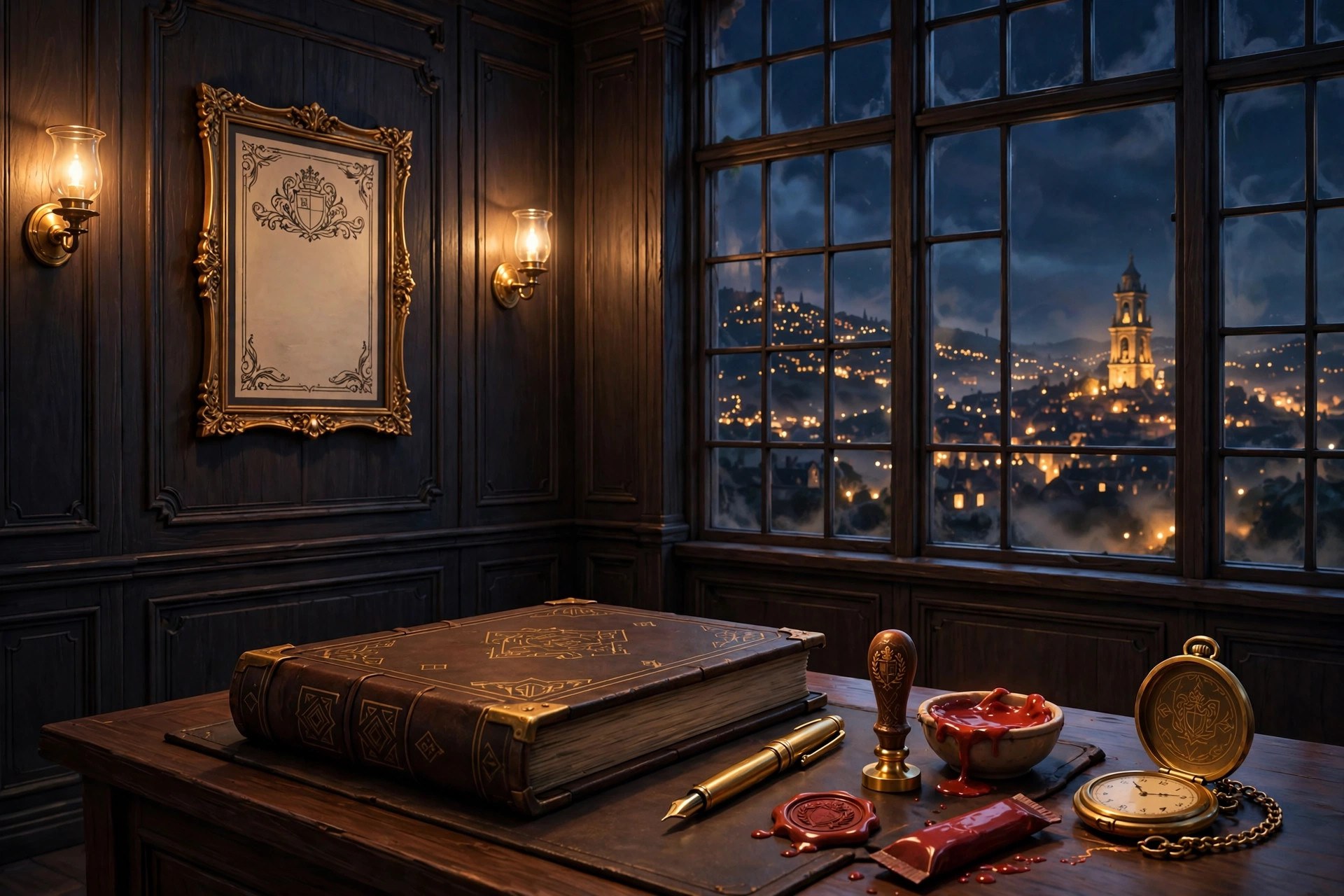
Dark wood panels, brass lamps, a desk the size of a small treaty table, and a window looking down over the Gilt District to the bell tower of the Exchange. The walls hold no portraits — “the office is for the living,” Ceo says — only a single framed charter: the Double Crown, under glass. Behind the desk, a safe with two locks; inside the safe, the grand ledger.
The desk
The desk’s inventory is the fiction’s beloved recurring bit, and the stream has catalogued it:
- The fountain pen — always the same one, always in the inner pocket when not in use.
- The pocket watch — two faces, court time and market time.
- The seal and wax — red wax, the house seal, a small brass heater.
- The day’s petitions — the morning’s stack, annotated in the margins in two inks: black for courtesy, red for arithmetic.
- A single crystal glass, empty until the toast.
The two locks
The grand ledger lives under two locks — one key with the head of the house, one with Steward Bram. Both must turn together. The fiction treats this as the whole Double Crown in miniature: neither the title nor the office opens the book alone.
The ledger hour
One hour each evening, alone, pen in hand, no advisors. The day’s entries reviewed, each priced twice — in gold and in standing — and signed. On the stream, this is the quiet closing segment: the character reads the day back in a low voice, signs the page, and closes the book. The fans’ favorite hour.
Why the room matters
Every other room in the fiction is shared — the hall with the petitioners, the long room with the board, the gala with the world. The manor office is the only room where the character is alone with the consequences. It is where the fiction admits that holding two kinds of power is heavy, and where the character is allowed, briefly, to feel the weight.
Source notes
- The manor office and the ledger hour are original fiction (2026-09-26).
- The illustration on this page is AI-generated dramatization art; see the image credits on this page.