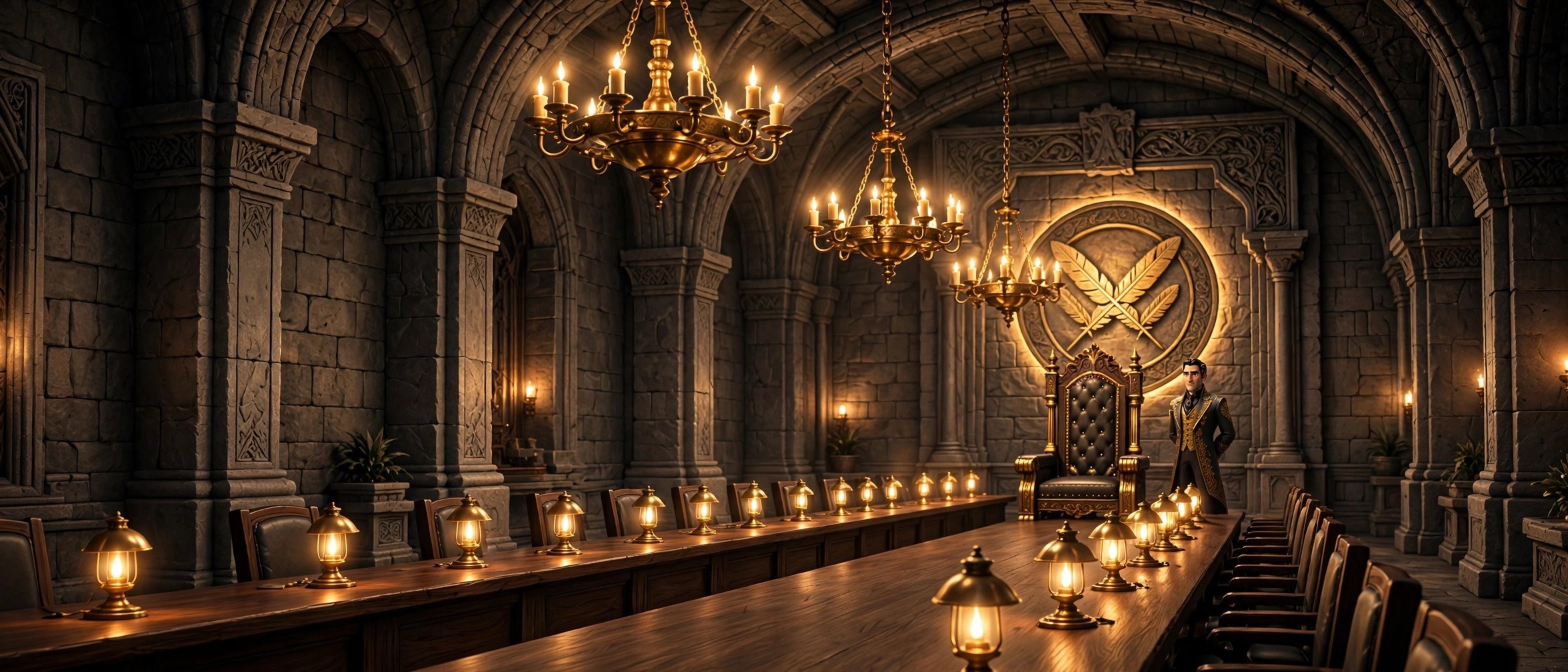
House & Boardroom
The character's whole premise in one room: a throne-room boardroom where the morning's petitions become the afternoon's agenda.
The premise
Most fictional nobles inherit land; most fictional CEOs inherit companies. Nobleman Ceo inherited both, and the in-world Charter of the Double Crown lets him hold them together: a noble title in the Royals court and the chief executive’s office of House Ceo Holdings. The crown gives him standing; the ledger gives him substance. The character’s drama — and comedy — lives in the seam where the two meet.
The charter
The Charter of the Double Crown is the in-world founding document of the concept (original fiction, 2026-09-26). Its articles, as told on this site:
- One holder, two offices. The head of House Ceo may hold a court title and the chief executive’s office simultaneously, and neither may be exercised against the other.
- Two ledgers, one signature. Every decision of the house is entered in the grand ledger — priced in gold and in standing.
- The seal binds. A decision sealed by the holder is final in both the court and the company.
- The audit of honor. Once a year, the court auditors and the company auditors sit at the same table — the famous scene where ceremony meets arithmetic.
The room itself
The house boardroom is the character’s signature set, and the stream’s home base:
- A long table of dark wood down the center of what is unmistakably a throne room — chandeliers above, brass lamps along the table.
- At the head of the table, a high-backed chair that is exactly halfway between a throne and an executive chair. Advisors argue gently about which it is.
- Behind it, the house crest: a gold seal-ring over crossed ledger-quills, carved in stone and backlit in brass.
- Down one wall, portraits of former heads of the house — each one, the guides insist, holding both a scepter and a pen.
A morning petition becomes an afternoon motion
The character’s signature narrative move, and a recurring stream segment:
A petitioner comes to morning court asking the house to dredge the Vell harbor. The nobleman hears the petition with full ceremony. That afternoon, the same matter appears on the board agenda as a capital expenditure — with the harbor master’s figures, the Gilt Bank’s terms, and the house’s seal ready. The petition becomes a motion; the motion becomes a decision; the decision gets sealed and entered. Court by morning, boardroom by afternoon.
Why the concept works for the stream
- Two formats in one character: ceremonial petition-hearing (court) and sharp business talk (boardroom) — the stream literally changes rooms mid-episode.
- Built-in stakes: every decision is priced twice, in gold and in standing, so every segment has two scoreboards.
- Built-in comedy: boardroom jargon in a throne room; court ritual in a quarterly review. The character code-switches constantly, and the audience learns both languages.
Source notes
- The Double Crown concept, the charter articles, the boardroom description, and the petition-to-motion device are original fiction written for this site and the stream companion (2026-09-26).
- The illustration on this page is AI-generated dramatization art; see the image credits on this page.