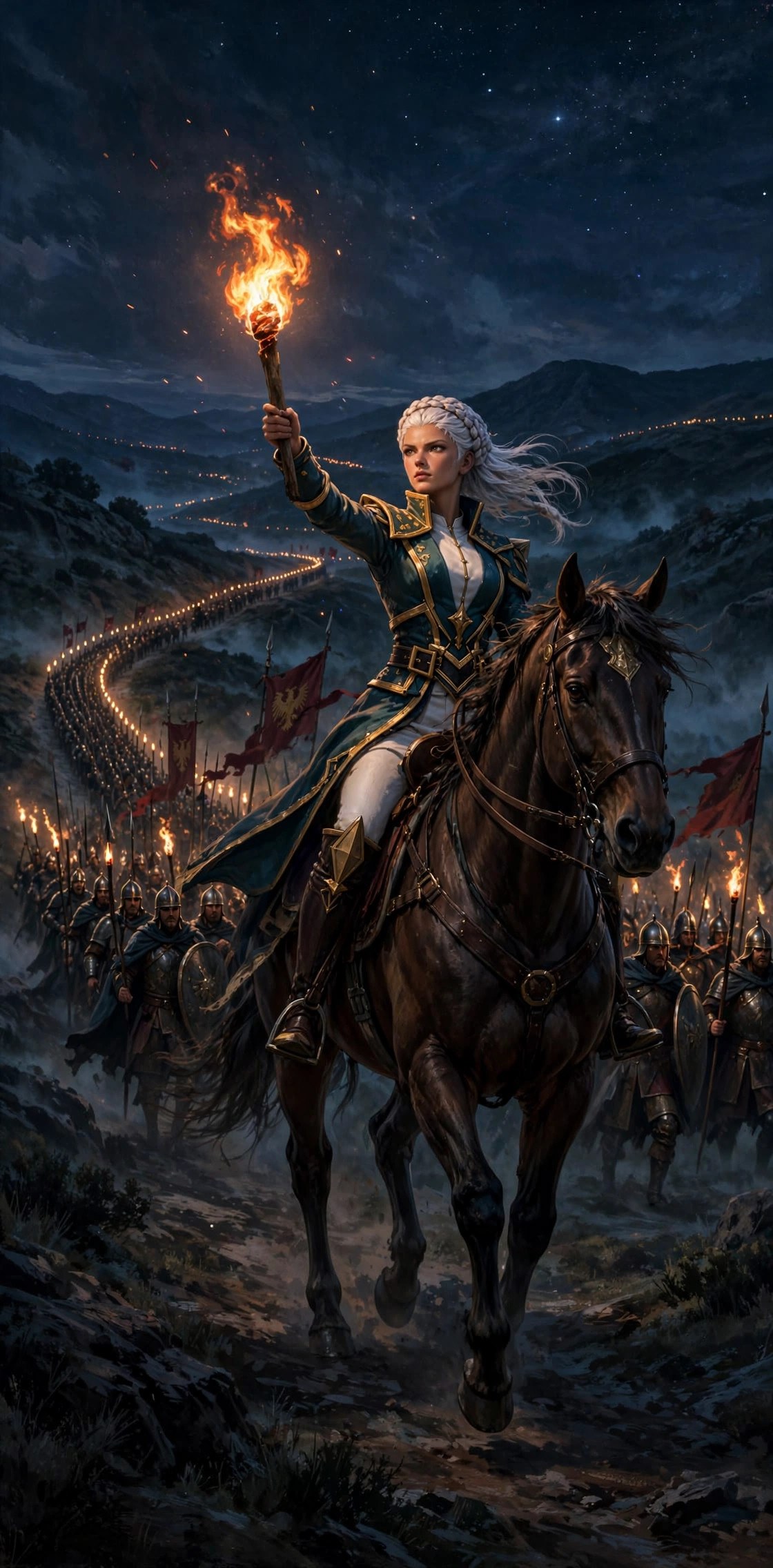
The Night of Torches
Twenty miles in the dark, a river of torchlight through the hills, and a siege lifted by sunrise. Her officers still argue about whether it was brilliant or reckless.
The siege
Greywatch, the western keep, was invested by hill-clan forces in late autumn — cut off, outnumbered, with perhaps ten days of grain. The relief column was twenty miles away at Thornford, and the clan’s scouts held every road between. A daylight march would be seen, met, and bled. The Commander’s council proposed waiting for spring. She proposed the alternative.
The march
At dusk, she ordered every torch in the Thornford camp lit — and then marched the column away from Greywatch, openly, noisily, toward the east. The clan scouts reported it faithfully: the Valdris column was withdrawing. Then, two miles out, in a fold of the hills, the column turned. Torches were doused to every tenth man. The army moved in near-darkness, guided by riders who knew the hill paths, the Commander at its head with a single shaded lantern.
Twenty miles. In the dark. In autumn mud. She walked the first ten on foot — “the horses need their strength for the charge,” she said, “and I need to know the ground” — and rode the last ten. Twice the column lost the path; twice she found it, because she had walked these hills as a junior officer and never forgot ground.
The dawn
Greywatch’s besiegers woke to a sound they had not expected: the dawnwatch horn, blown from behind their lines, answered by Greywatch’s own horn from the walls. The Commander had arrayed her torches along the ridge in the last hour of dark — a river of fire above the siege camp — and at first light she simply walked the column down the hill in good order, banners out.
The siege broke without a pitched battle. The clan forces, finding a fresh Valdris army between them and their supply lines, withdrew in the night that followed. Greywatch’s gates opened at noon. The keep’s commander, who had been composing his final dispatch, instead wrote the dispatch that made the Night of Torches famous: “She came with the dawn, as advertised.”
Brilliant or reckless?
Her officers argue about it to this day. Marshal Caddoc’s position: the march risked the entire field army on a path she hadn’t walked in a decade, and if the clan had posted even a company on the ridge, the torches would have marked the column for slaughter. The Commander’s position, when asked: “The keep had ten days of grain. Arithmetic is not recklessness.” She declines to settle the argument, which her staff takes as its own kind of answer.
Source notes
- This campaign is creative interpretation. See methodology.
- For her other campaigns, see Campaigns. For the Code, see The Commander’s Code.