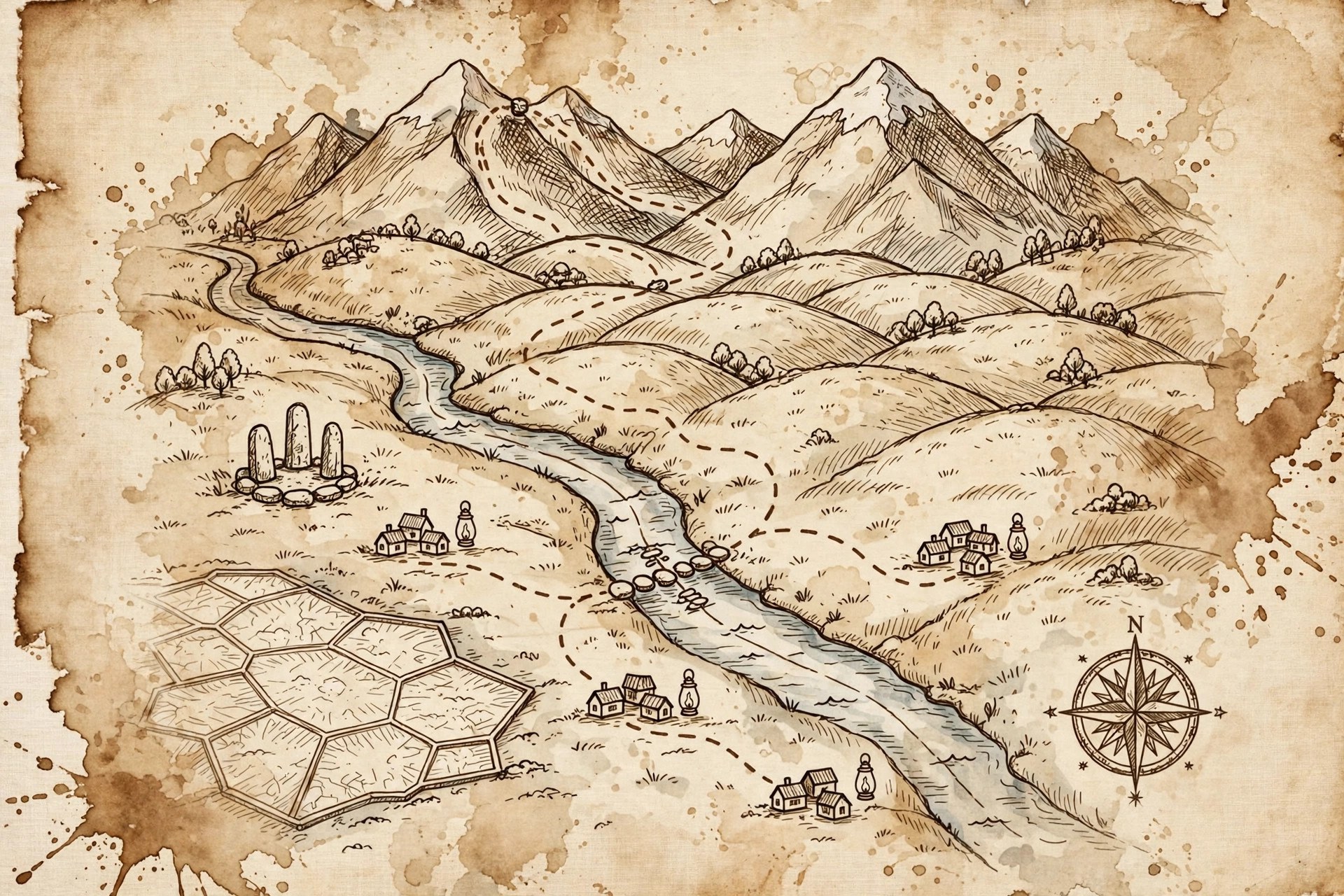
The Wandering World
A world of lantern-lit crossroads, kind villages, and roads that reward the curious.
Creative interpretation
Milo walks a storybook world — not high fantasy with dark lords, but the softer kind: rolling hills, market towns, river fords, and forests that are mysterious rather than menacing. Magic exists the way weather exists: occasionally, locally, and never quite on demand.
Places on Milo’s map
Cinderwick
Grey-stone village in the fold of two hills. Milo’s childhood home and the place he doesn’t talk about. Famous for its lamp-round — every lane lit at dusk, a custom his grandmother started.
The Hollow Road
The old drovers’ road Milo walks most. It winds through orchards and past standing stones. Travelers say the Hollow Road “keeps” the stories told on it, and that on quiet nights you can hear old laughter in the hollows.
Brambleford
A river town of boatbuilders where Milo once spent a whole winter. The ford is treacherous after rain; Milo’s lantern still burns on the near bank, tended by the ferryman’s daughter.
The Saltway
A white-dust trade road crossing the salt flats. Mirages, salt-merchants, and the famous Lantern Cairn — a pile of stones where travelers leave unlit lanterns for the next person. Milo started it. He pretends he didn’t.
Thornwall Market
A walled market town that holds a festival every full moon. Milo times his wanderings to arrive for at least two a year. He has never once won the pie contest and considers the streak “a tradition now.”
The Pilgrims’ Traverse
A mountain pass with a hundred tiny shrines. Milo lights a candle at each one, “for whoever prayed here and had to keep walking anyway.”
Customs of the road
- The lantern-left custom. A lit lantern at a crossroads means: someone was here, rest a while, the road goes on. Travelers add oil if they can. Milo began the custom by accident; the road adopted it.
- Story-toll. At certain inns, the toll for a bed is a story. Milo always pays double.
- The unfinished map. Wanderers of Milo’s stripe draw their maps with blank edges — a declaration that the world is bigger than any chart.
- First-light greetings. In road culture, you greet fellow travelers at dawn with “Light find you” — meaning both the sunrise and good luck.
The gentle rules
This world’s dangers are weather, getting lost, and loneliness — not monsters. Milo’s stories resolve through kindness, cleverness, and showing up, not combat. If you’re writing Milo fiction or roleplaying him, keep the stakes human-sized: a missed ferry, a sick goat, a letter that must arrive by winter. The small stakes are the point — Milo believes no kindness is small.
Ember, the lantern
Milo’s brass lantern is dented, soot-darkened, and older than he is — his grandmother’s. In this interpretation it has exactly one unusual property: it never gutters in wind. Whether that’s craftsmanship, luck, or something softer, Milo won’t speculate. “She’d have called it a well-made lantern,” he says. “I call it Gran.”