Backstory
Before he was a wanderer, he was a boy who couldn't stand an unlit lamp.
Creative interpretation
The lamplighter’s apprentice
Milo grew up in the village of Cinderwick, a grey-stone town tucked into the fold of two hills, where his grandmother kept the lamps. Every dusk she walked the lanes with her long lighting-pole, and Milo — small, quick, devoted — trotted after her carrying the oil.
“Why do we light them all, Gran?” he asked once. “Everyone’s indoors by dark.”
“Because someone might not be,” she said. “And the dark is heavier when you think nobody lit a lamp for you.”
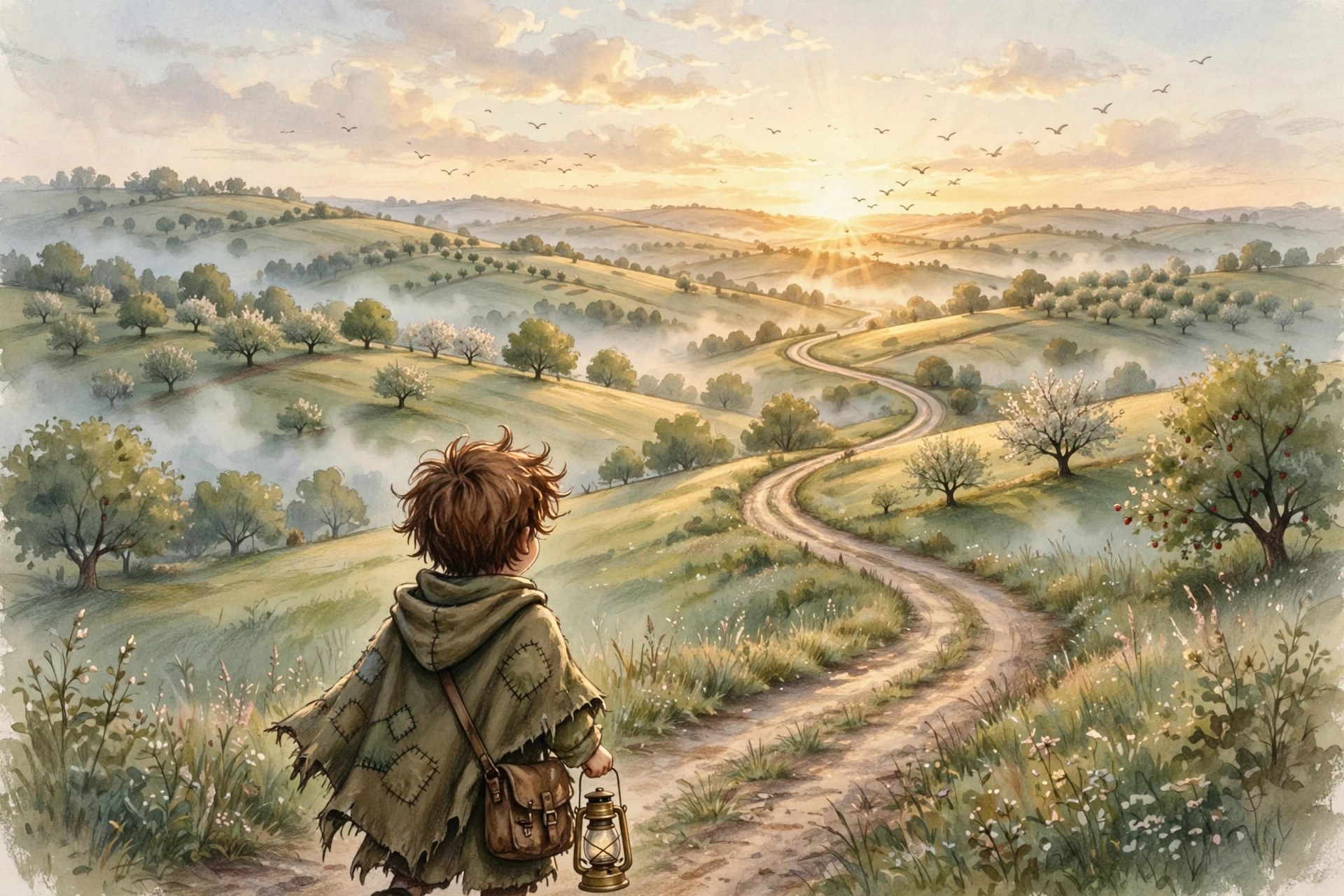
She died in his fourteenth winter. The village council gave the lamp-round to a younger man with a steadier hand, and Milo — suddenly lamp-less in a town that had no more use for him — did the most Milo thing imaginable: he took his grandmother’s old brass lantern, filled it from her oil store, and walked out past the last lit lamp at the edge of town.
He lit it at the crossroads, set it on the milestone, and kept walking.
The road years
That was years ago, in story-time. Since then, in this telling:
- He has walked the Hollow Road, the Saltway, and the Pilgrims’ Traverse, and gotten lost on all of them at least twice.
- He apprenticed himself, briefly, to a tinker, a beekeeper, and a retired pirate — learning mending, patience, and knots, in that order.
- He once carried a lost child six miles through a storm by the simple method of telling her a story with no ending until they reached a lit door.
- He has left hundreds of lanterns at crossroads, fords, and trailheads. Most burn out. Some are tended by strangers who add their own oil. A few, travelers swear, have never gone out.
What he doesn’t talk about
Cinderwick. Ask, and Milo will smile, ask about your hometown with enormous interest, and somehow the hour will pass without an answer. In this interpretation, the wound isn’t dramatic — it’s ordinary: he left, he keeps leaving, and some part of him is still fourteen, standing at the edge of town, wondering if anyone lit a lamp for him.
He lights them for everyone else instead. That’s the whole backstory, really.
The map with unfinished edges
Milo’s map is hand-drawn on a roll of oilcloth, and its edges are deliberately unfinished — blank parchment curling outward. “The world’s bigger than my map,” he says, “and I intend to keep it that way.” Every village where someone was kind gets a tiny lantern drawn in the margin. The map is getting crowded. He considers this his life’s work going well.